In the Middle East, the Arab-Israeli peace process stumbles on; Kuwait was again threatened by Iraqi forces; and Islamic extremists continue their terrorist campaigns in Algeria and Egypt.
Israeli-Syrian Peace Treaty
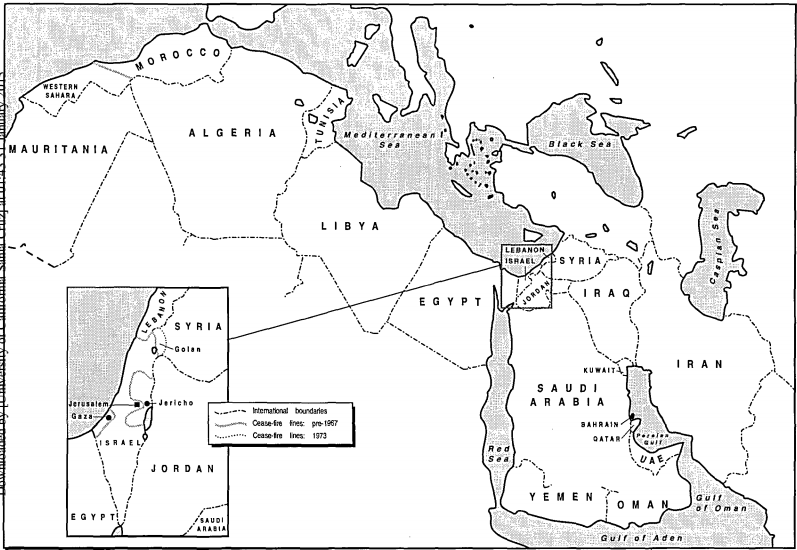
While Syrian President Hafez Assad appears to be dragging his feet over progress towards a peace treaty with Israel, a major step forward was taken on 27 June 1995 when the Israeli and Syrian Chiefs of Staff held discussions in Washington. They agreed that a security arrangement should include: a demilitarised zone; an early-warning system; an international presence; and a staged Israeli withdrawal - but the detail under these headings has not been finalised. The Syrians proposed a formula for an asymmetric demilitarised zone which would require them to demilitarise 10 miles of territory to Israel's six. This zone would be astride the international border which has yet to be agreed. The Syrians have rejected Israel's proposal to keep its early-warning station on Mount Hermon while allowing Syria to establish a station near Zefat in northern Israel.
Israeli-Jordanian Peace Treaty
King Hussein of Jordan and Israeli Prime Minister Yitzhak Rabin, in the presence of US President Bill Clinton, signed a peace treaty on 26 October 1994. Israel agreed to the international border being the boundary line drawn by the British in 1922, and to withdraw from territory east of the line captured in 1967. In return, Jordan has leased back to Israel areas in the Arava valley farmed by Israelis. Water issues were addressed in the Treaty with Israel agreeing to Jordan taking an additional 40 million cubic metres annually from the Yarmouk River. Jordan will not join an antiIsraeli alliance and neither side will allow its territory to be used for attacks on the other. Both have committed themselves to creating a Conference on Security and Cooperation in the Middle East on the lines of the Organisation for Security and Cooperation in Europe with confidence-building and transparency measures. A number of ambitious joint schemes for energy, tourism, transport, water and industry have been proposed. Israel completed its withdrawal from Jordanian territory on 9 February 1995.
Palestinian Self-Rule
Both Israeli Foreign Minister Shimon Peres and Palestinian Chairman Yasser Arafat are making great efforts to reach agreement over the next stage of Israeli withdrawal from the West Bank and the handover of responsibilities to the Palestinian National Authority. The programme agreed in the Declaration of Principles signed on 13 September 1993 is well behind schedule. Although not all details of the next stage have been agreed, it is clear that Israel intends to withdraw totally from the northern Palestinian towns of Jenin, Nablus, Qalqilya and Tulkarm. There would be partial withdrawal and joint patrols in Ramallah and Bethlehem where Israeli settlers use the roads through these towns. There would be no withdrawal from Hebron where a small enclave in the town and the nearby Kiry at Arba are populated by Israeli extremists and an Israeli Army presence is essential not only to protect them, but also to deter them from attacking the Arab population. It had been confidently planned that an agreement on Israeli Defence Force (IDF) withdrawal would be signed in Washington on 25 July 1995 to include provision for some 700 international monitors to deploy in September and the IDF to withdraw at the beginning of November to be replaced by 1,700 Palestinian police. However agreement had not been reached by the end of July. The elections for the self-rule council were to be held before the end of November. Withdrawal from Ramallah and Bethlehem is scheduled for November, but depends on the completion of bypass roads. Until all Palestinian villages can be bypassed, the IDF will continue to patrol through them. While any terrorism is unacceptable to Israel, the level of violence dropped considerably after Islamic Jihad suicide bombers killed 21 Israelis at Beit Lid on 22 January 1995, but increased with another suicide bomb on a bus in Tel Aviv on 24 July. Israel has agreed to transfer all remaining spheres of civil authority but detailed agreements still have to be reached. Electricity and water are two of the most difficult areas to agree on. The Israeli Army has started preparing for redeployment, which involves moving some training units into Israel and using their bases for operational units, and constructing bypass roads to allow unhindered settler movement.
In Lebanon, Hizbollah has intensified its campaign against the IDF and the South Lebanese Army (SLA) with some success. At least 23 Israeli soldiers were killed in Lebanon during 1994 and during the last three months of the year casualties inflicted onHizbollah were roughly equal to those incurred by the IDF and SLA. This situation is likely to continue until an Israeli-Syrian peace treaty, which should contain provision for Syrian control of Hizbollah, is signed.
Iraq
On 7 October 1994, US officials revealed that two Iraqi Republican Guard divisions had moved south, close to the border with Kuwait. The news came, after the move had been monitored for several days, just as Iraqi Prime Minister Tariq Aziz was about to address the United Nations. Kuwaiti forces mobilised and deployed to the border. The US reacted quickly, sending several aircraft squadrons to bases in Saudi Arabia. The first US ground troops, equipped from the stockpile maintained in Kuwait, arrived on 10 October. The UK also sent a marine battalion group with artillery and six additional Tornado GR-1 FGA aircraft. The US reinforcement included some 12,000 ground forces with two brigades of the 24th Mechanized Division (the US Marine Expeditionary Force stood by for deployment, but did not in the event do so), the aircraft carrier USS Washington, and some 50 extra combat aircraft plus tankers and transports. The UAE also sent naval and ground forces to Kuwait. By 12 October, Iraqi forces were being withdrawn and, although allied deployment continued, the crisis was over. The US tabled a UN Resolution forbidding future Iraqi southern deployments, but backed down from calling for a heavy-weapon exclusion zone in southern Iraq. On 15 October, the UN Security Council adopted Resolution 949 which condemned the Iraqi action, but only warned of serious consequences if it was repeated. Five days later, the US Ambassador to the UN, Madeleine Albright, warned Iraq that units north of the 32nd parallel on 20 September 1994 could no longer be deployed south of that line. The UN Security Council has so far voted against lifting the economic sanctions imposed on Iraq, most recently on 11 July 1995, on the grounds that Iraq has not yet revealed all the details of its biological weapons (BW) programme and that many Kuwaiti citizens and much Kuwaiti military and civil property are still unaccounted for. Iraq has now admitted that it had produced botulism and anthrax B W agents and has handed over to UNSCOM a 530-page document said to detail its B W programme. It has been reported that Russia has already signed contracts to develop the West Qurno and North Rumaila oil fields when sanctions are lifted.
The level of political dissent within Iraq can perhaps be judged by the government's efforts to have sanctions lifted. These include:
• The release of two Americans imprisoned for border crossing.
• The release of information on the BW programme.
• The decree releasing all political prisoners and dropping charges against Iraqis living abroad.
• The diplomatic campaign to re-enter the Arab world.
There have been several reports of unsuccessful mutinies in the Army. The defection of two of Saddam Hussein's sons-in-law on 10 August 1995 was a serious blow to the regime. One, General Hussein Kamel Hassan, who was head of the military industry, may reveal more about Iraq's weapon-of-mass-destruction programme.
Iran remains, to some extent, isolated from the world. President Clinton imposed a total ban on US trade with Iran at the end of April 1995, a move which has been supported only by Israel. The US is concerned that Iran has embarked on a nuclear weapons programme, supports Islamic
extremism and terrorism in a number of countries, opposes the Middle East process and may threaten international shipping in the Straits of Hormuz. In June, Iran rejected the European Union's offer of better relations in return for the end of thefatwa imposed on British author Salman Rushdie. Norway recalled its Ambassador from Tehran on 3 July. There is a growing divergence of views within Iran between the religious authorities and President Rafsanjani and his government, essentially over who has ultimate authority. Relations between Iran and Iraq appear to be improving and delegations have visited each other's capitals. Official talks, if established, would focus on questions over prisoners still unaccounted for from the Iran-Iraq War and the support given to opposition groups (such as the Iranian Mujahedin-e-Khalq, based in eastern Iraq, and Iranian support for Iraqi Shi'i). There are also unresolved border questions.
The Gulf States have experienced some instability over the past 12 months. In Qatar, the Amir, Sheikh Khalifa bin Hamad al Thani, was peacefully deposed by his son, the Crown Prince, on 26 June 1995 while out of the country. The new ruler, who was quickly recognised by the other Gulf Cooperation Council (GCC) states, is known to want to solve the maritime dispute with Bahrain. Qatar referred its claim to the Huwar islands to the International Court of Justice (ICJ), which ruled that it had jurisdiction, but there can be no progress without the agreement of both parties. Bahrain will only accept Qatar's claim if its own claim against Qatar in the Zubarah area is dealt with by the ICJ at the same time. In December 1994, while Bahrain was hosting an international conference, it was the scene of violent protest as economic discontent was fuelled by Islamist groups and at least 12 people died. The government has been criticised by Amnesty International, but maintains that there have been far fewer deaths and arrests than Amnesty claims. Opposition to the Saudi regime is becoming more vocal, but is divided over whether the whole Saud family should be overthrown or whether a split in the family should be exploited.
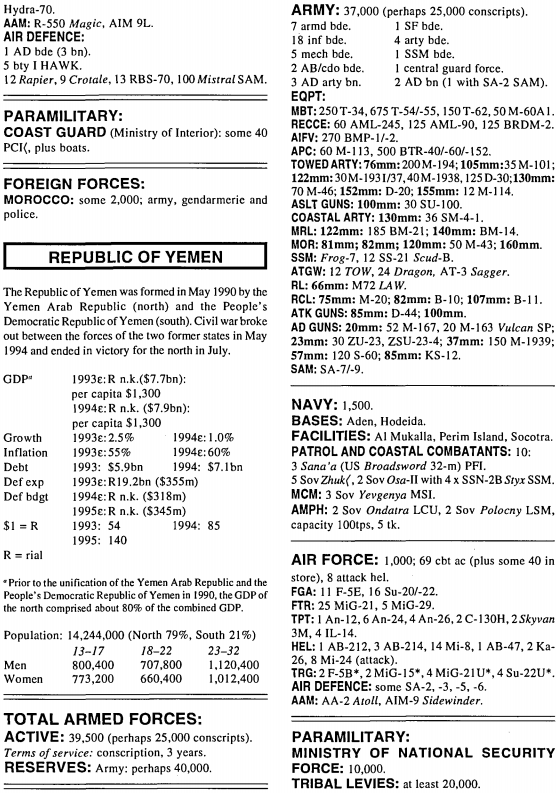
Some progress has been made by Yemen in resolving its border disputes. On 3 June 1995, Yemen and the Oman concluded a border agreement which returns to Yemen some 5,000 km2 of territory ceded to Oman in 1992 by the now-exiled former Vice-President Ali Salim al-Bid. Having achieved this success, Yemeni President Ali Abdullah Salih was able to visit Riyadh on 5 June with some confidence. He agreed to renew the Treaty of Ta' if which defines a part of the common border without amendment in the hope that Saudi Arabia would provide economic aid and allow Yemeni workers to return to Saudi Arabia. However, as yet there has been no movement to resolve the question of the undefined and disputed border east of Najran.
Talks between Algerian President Liamine Zeroual and Abassi Madani, the moderate leader of the Islamic Salvation Front (FIS), which had appeared to be going well, broke down in July 1995. The government maintains that the breakdown was caused by the insistence of the more extreme opposition factions that imprisoned FIS leaders must be released before there can be an end to violence. While the failure of the talks sets back any progress towards a settlement, it has to some extent caused a rift between the FIS and the other opposition factions which the government will hope to exploit. The death toll in the three-year civil war is now put at between 30,000 and 40,000, although the government argues for a much lower number.
United Nations efforts to identify and register those eligible in Western Sahara to vote in a referendum continue to be obstructed by the Moroccan authorities. In April 1995, the UN Secretary-General announced yet another postponement, this time of six months, with the start of the transitional period considered unachievable until 1 January 1996 at the earliest. The Western Saharans have threatened to resume the war, but have not yet done so.
Egyptian relations with Sudan deteriorated sharply following the attempted assassination of Egypt's President Mubarak in Addis Ababa on 26 June 1995 when Sudan was initially accused of being behind the attack. Tension heightened along the Halaib border area, where Egypt forced the withdrawal of 70 Sudanese police from their posts, and shots were exchanged. Both sides issued warnings to the other and the Sudanese threatened to abrogate the 1959 Nile Water Treaty. Meanwhile an Egyptian group - 'the Islamic Group' - claimed responsibility for the assassination attempt. Terrorist activity by Muslim extremists has continued over the last 12 months with an upsurge in the Minya Province of Upper Egypt in the first months of 1995.
Nuclear and Missile Developments
Nuclear Weapons
At present, of the Middle Eastern states, only Iran is considered to be pursuing a nuclear weapons programme, although no doubt Iraq still has ambitions in this respect. However, little is known beyond a general acknowledgement that Iran wants nuclear weapons and that it is planning a large scale nuclear energy programme. Contracts have been placed with Russia to provide a 1,000 megawatt (MW) light-water reactor at Bushehr with options for a second 1,000 MW and two 400 MW reactors. Iran has also approached China to construct further nuclear power stations, but this project appears to have been stalled by a number of problems. One view is that Iran, with its known oil and gas reserves, has no need of an expensive nuclear-energy programme, while the Iranians themselves argue that it makes sense to diversify. Iran is known to have three working uranium mines, one of which has been visited by International Atomic Energy Agency (IAEA) officials who reported that they had found nothing inconsistent with a civil nuclear programme. China has delivered an electromagnetic isotope separator, or calutron, which, while it could be used to separate weapons-grade uranium, is, as reported by the IAEA, of a scale that could only produce isotopes for medical purposes. Iranians have received training in nuclear physics at two institutes in Pakistan, and also in the US and Europe.
Iran joined the Nuclear Non-Proliferation Treaty (NPT) and a safeguards agreement with the IAEA came into force in May 1994. Since then, IAEA inspectors have seen no evidence of a weapons programme and congratulate Iran on its cooperation with the Agency which goes beyond the obligations of the NPT.
President Clinton, at the May 1995 summit in Moscow, is reported to have shown Russian President Boris Yeltsin intelligence regarding Iran's nuclear-weapons programme. While this was sufficient to cause Yeltsin to halt plans to sell Iran a centrifuge-based enrichment plant, he would not agree to halt the sale of the nuclear reactor. There are a number of estimates of how long it would take for Iran to acquire deliverable nuclear weapons. While Israel and some in the US claim that Iran is within three to five years of doing so, the general consensus tends more to a seven- to ten-year ti me-frame.
Ballistic Missiles
The only new deployments of surface-to-surface missiles during the last 12 months are in Iran where four more North Korean Scud-C launchers and 5 more CSS-8 (M-7) launchers have been acquired. There are unconfirmed reports that No-Dong SSM bought from North Korea were delivered, but The Military Balance considers this to be unlikely.
Military Developments
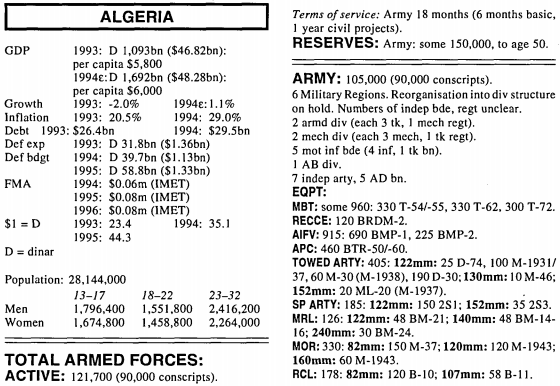
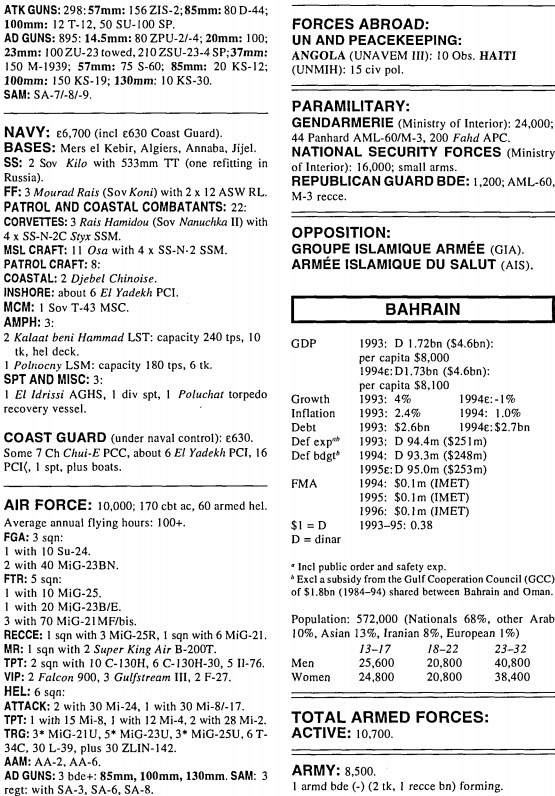
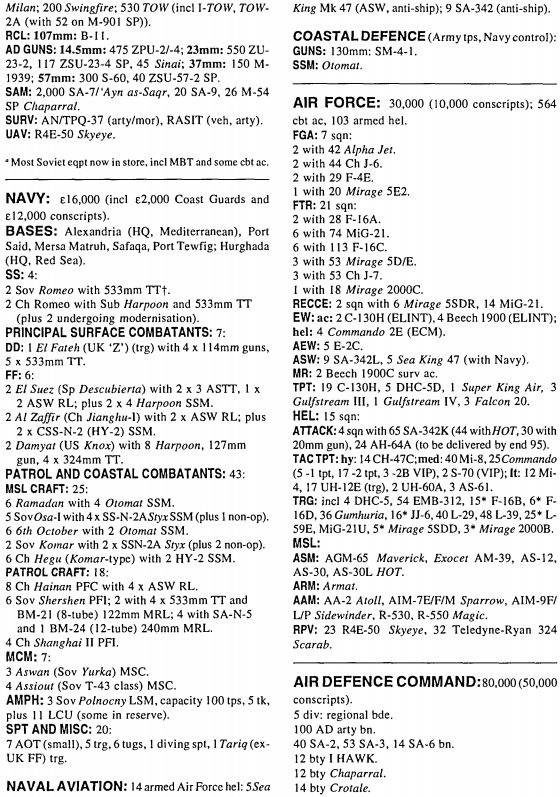
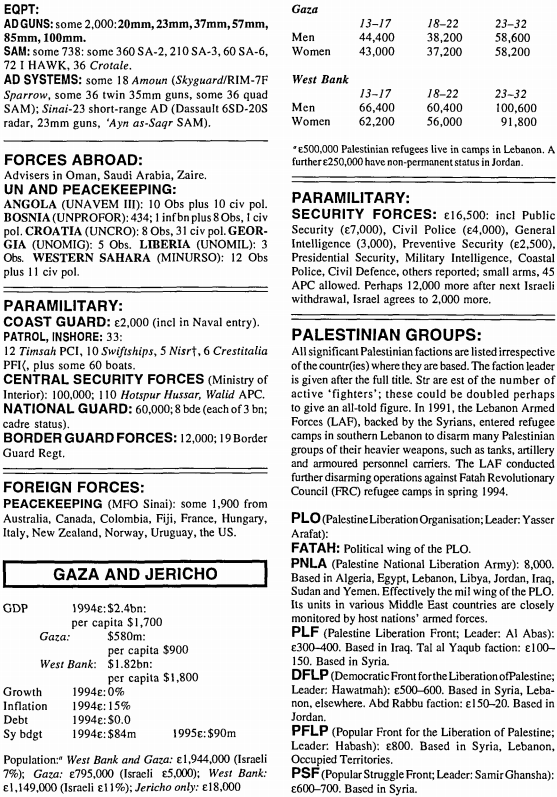
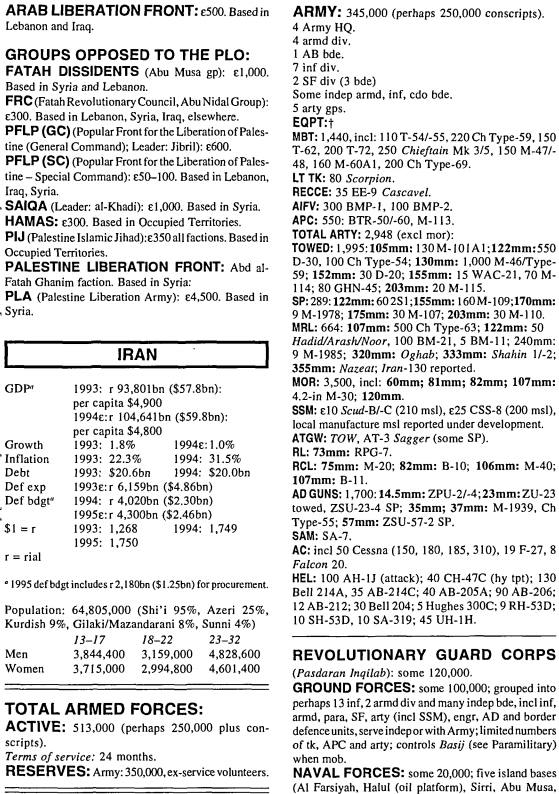
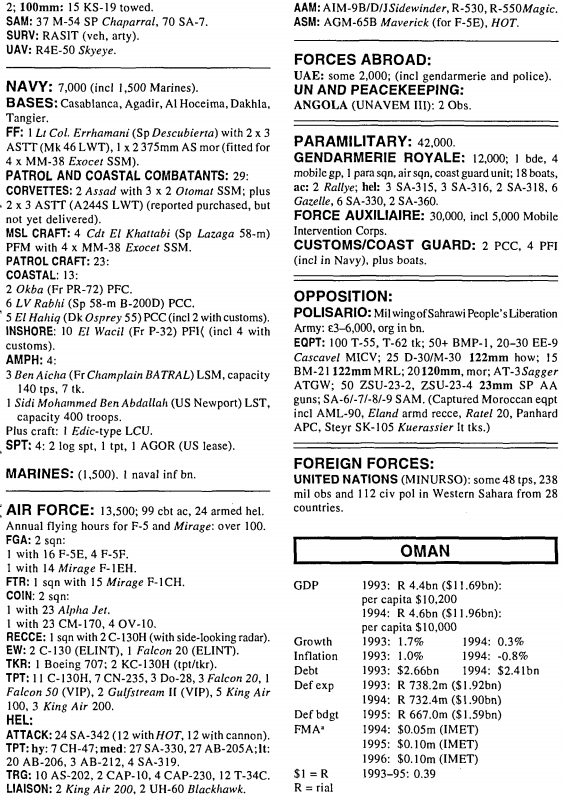
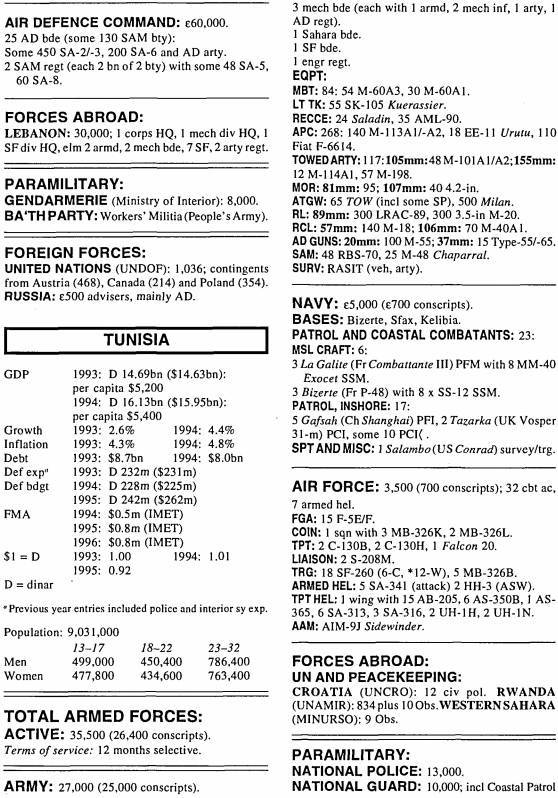
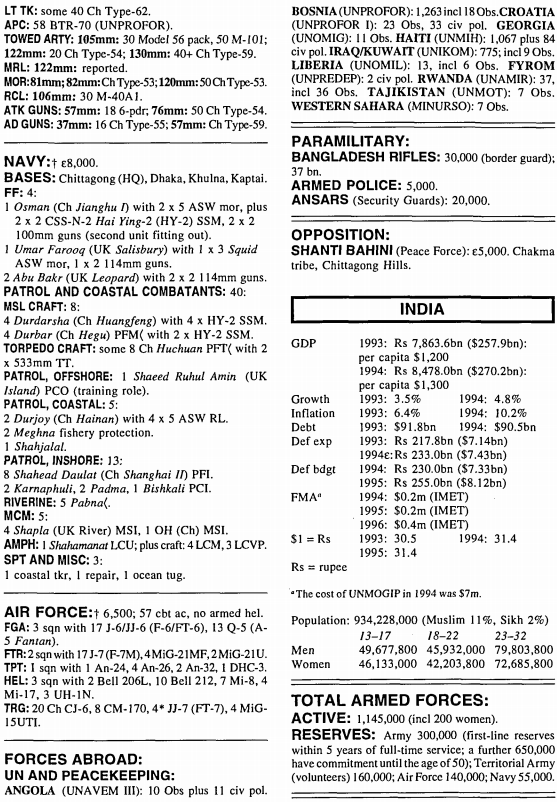
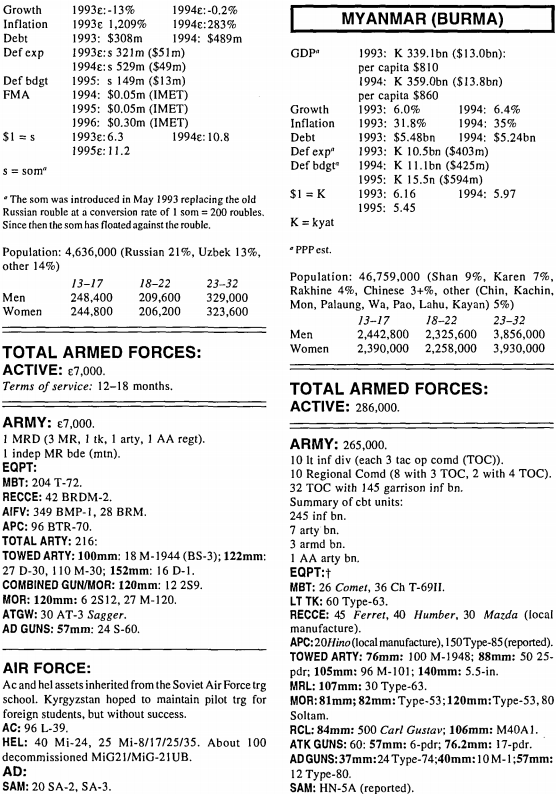
In Algeria, the 28 Mi-2 helicopters shown last year as belonging to the Gendarmerie are actually part of the Air Force's inventory. Mauritania has commissioned a French OPV-54 (AboubekrBen Amer)patrol craft. The Tunisian Navy has acquired three more Chinese Shanghai-class(Gafsah) inshore patrol craft. The Egyptian Army has taken delivery of 150 more M-60 and 50 M-1 Abrams tanks, 600 YPR-765 infantry fighting vehicles and 76 122mm SP artillery. The Air Force has acquired 24 AH-64A Apache attack helicopters and a further 30 F-16C fighters (produced in Turkey). The Navy has leased two US Knox-class frigates.
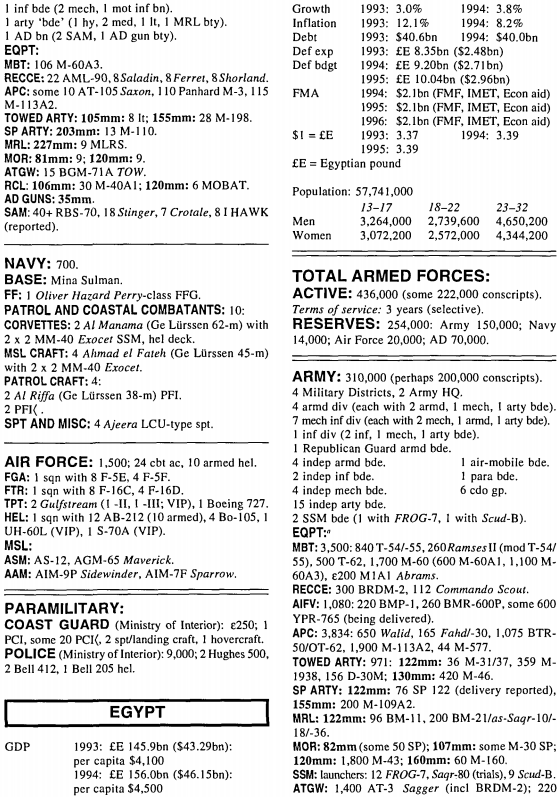
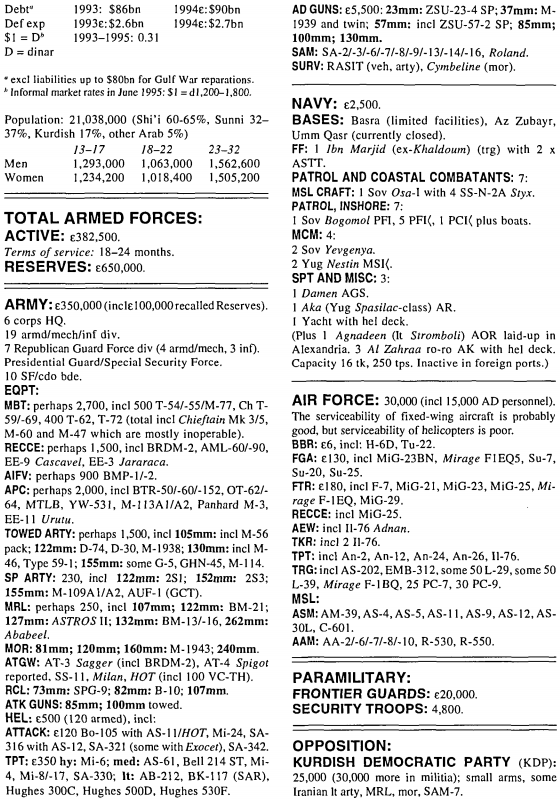
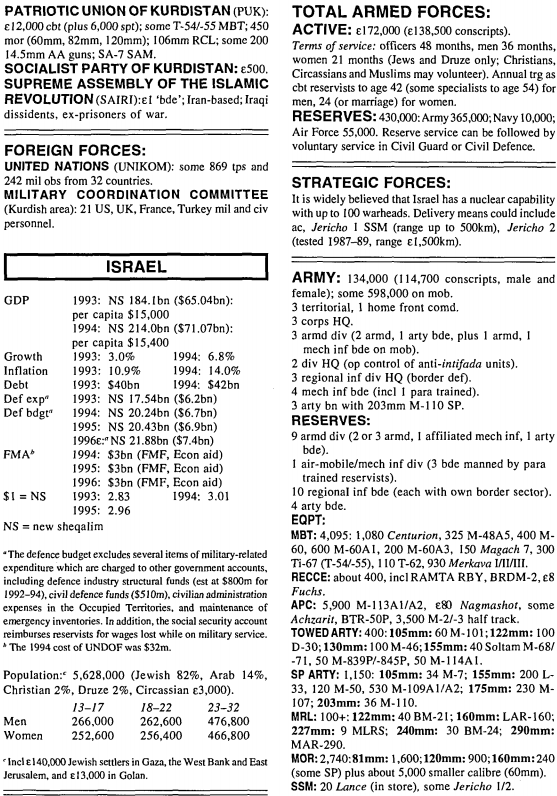
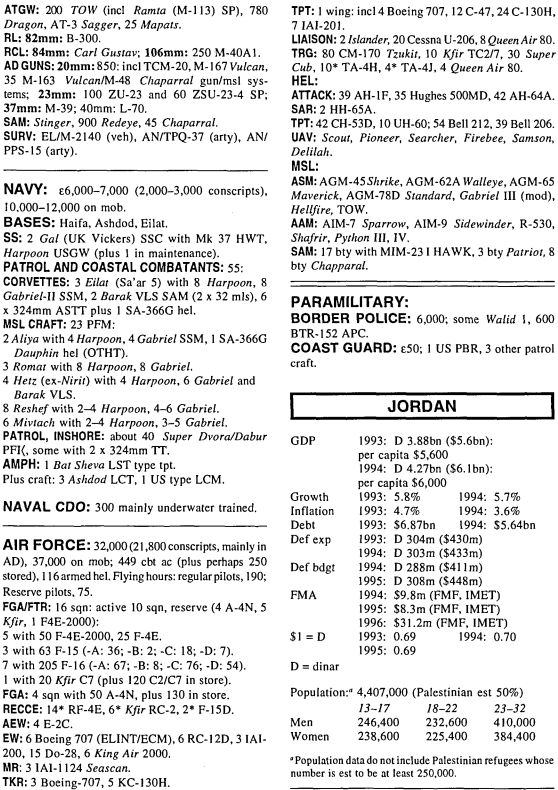
The Israeli Navy has commissioned two more Eilat-class and one more Romat-class missile craft. The Army now has 9 MLRS in service with the artillery, and six more have been ordered. Israel and the US reached agreement in May 1995 for the continued US funding for the next five years of Israel's Arrow anti-tactical ballistic-missile system. An annual provision of $40m has been reported, rather less than the amount sought by the Israelis. A series of test flights are expected to take place shortly. On 5 April 1995, Israel launched the Ofek-3 satellite which is confidently reported as having an intelligence collection capability. Lebanon has 16 UH-1H utility helicopters not previously listed inThe Military Balance whose serviceability is doubtful.
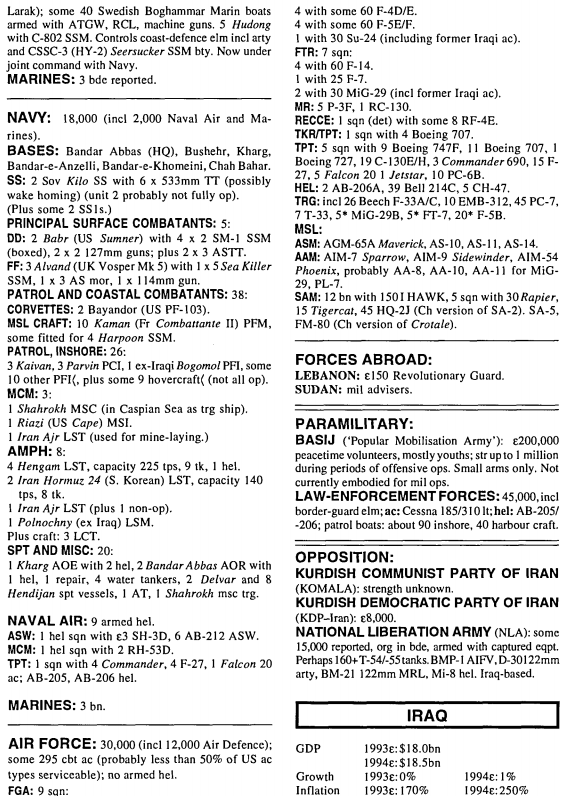
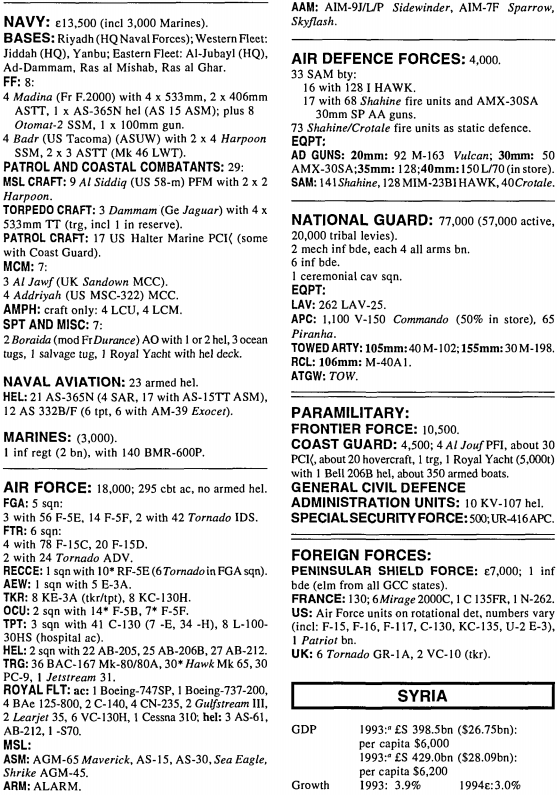
The US is planning to provide a further 225 M-113 APCs. The Syrian Army has taken delivery of 100 T-72 tanks, and the Air Force has received six Mashak basic training aircraft from Pakistan. The Iranian Air Force has ten Swiss PC-6B liaison aircraft not previously listed. The Revolutionary Guard naval forces have taken delivery of five Chinese Hudong-classmissile craft. The Navy expects to take delivery of its third Kilo-classsubmarine before the end of 1995, and there have been reports of Iranian moves to acquire the use of naval facilities at Port Sudan. The Army has taken delivery of about one-third of the 100 T-72 tanks ordered from Poland. There are 200 more Chinese Type 69 tanks and 200 more BMP 1/2 than listed before. The number of Chinese 107mm Type 63 MRL held is some 500. The first production of the Zufuqar-4 tank, an Iranian built T-72, and of an indigenous APC, the Boraq are reported. There have been no reports of Iraqi armaments acquisitions or of domestic production.
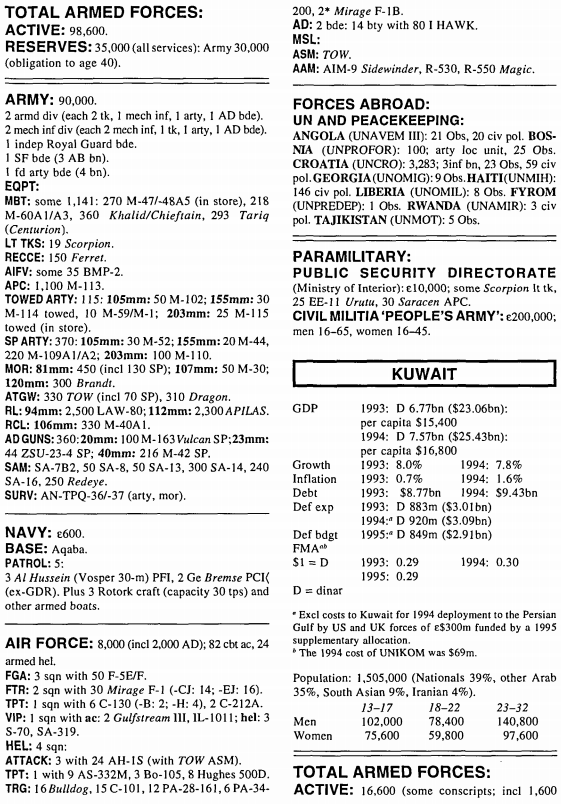
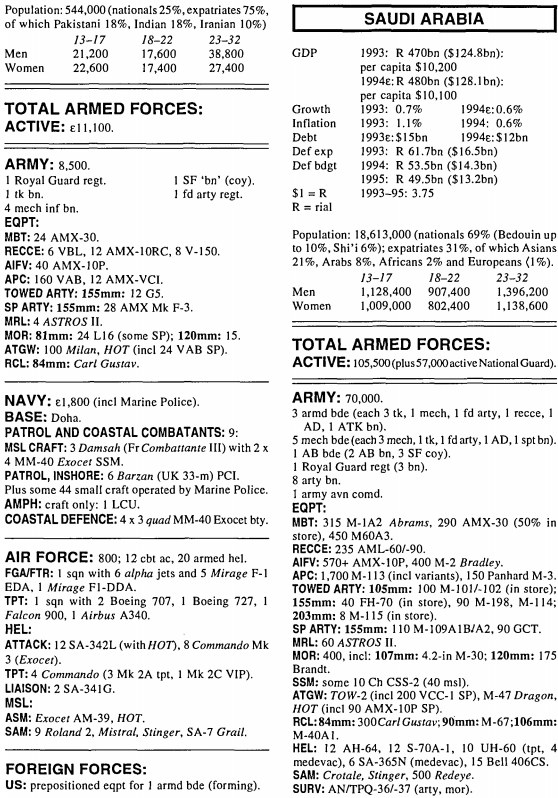
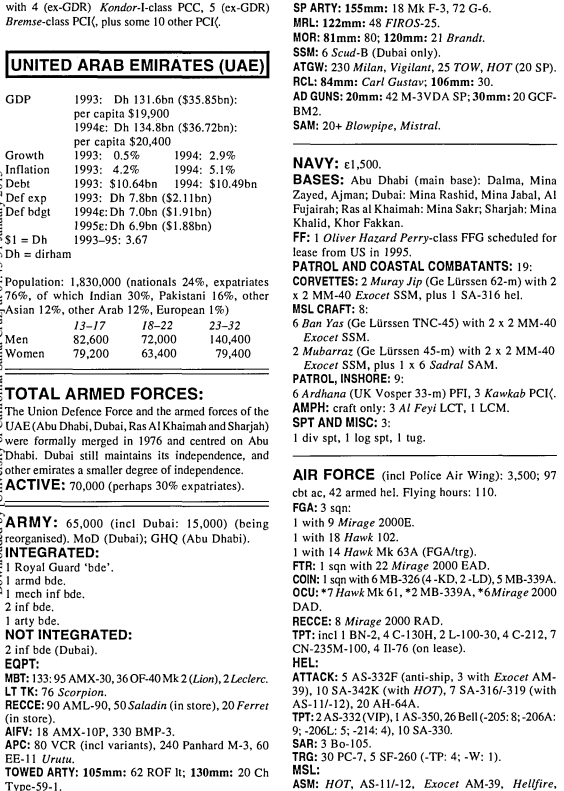
The UAE Air Force has acquired seven Spanish CN-23M-100 and four Russian Ilyushin-16 transport aircraft. Seven AS-565 anti-submarine warfare helicopters have been ordered from France. The Army has received its first two French Leclerc tanks; 45 of the total order of 396 should be delivered before the end of 1995.70 more BMP-3 infantry fighting vehicles have also been delivered. Army manpower strength has risen by 8,000. The UAE Navy has commissioned a US Oliver Hazard Perry-class frigate. In Qatar, the Army has acquired 12 AMX-VCI infantry fighting vehicles, 12 AMX-10RC reconnaissance vehicles and eight V-150 APC. The Air Force has taken delivery of two Mistral SAM launchers and has ordered Mirage 2000-5 fighters for delivery by the end of 1997. The Navy has four fast patrol craft on order from Vospers of the UK for delivery in 1995. The Kuwaiti Army's inventory has increased greatly with 60TOW ATGW mounted on HMMVW, 76 BMP-3 and the first eight, of an order of 254,Desert Warrior infantry fighting vehicles. An order has been placed for Starburst close air-defence systems worth ё50m.
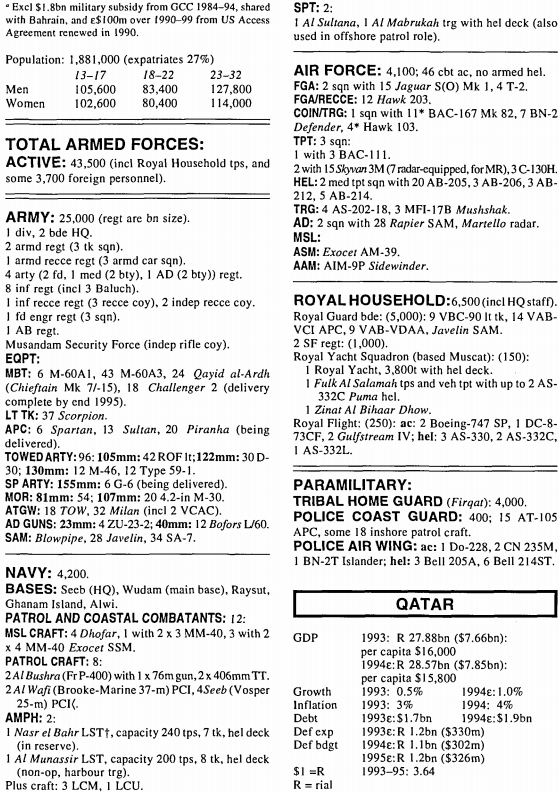
The Saudi Arabian Army now has 315 M-1 Abrams tanks, an increase of 285, and 400 M-2 Bradley fighting vehicles (200 more than last year). The Navy has commissioned a third UK Sandown (Al Jawf) coastal minesweeper and ordered two French La Fayette-classfrigates. Aircraft orders include 20 Hawk advanced trainers for delivery in 1996 and 20 PC-9 primary trainers also from the UK. The delivery schedule for 48 Tornado IDS ordered in 1993 for delivery in 1996 appears to have slipped by one to two years. A major reorganisation of the Bahraini Army is taking place with the formation of an armoured, an infantry and an artillery brigade and an increase of 1,700 in manpower. 26 more M-60 tanks have also been acquired. The Navy has commissioned a US Oliver Hazard Perry-class frigate. The Omani Air Force has withdrawn its elderly Hunter FGA aircraft from service and taken delivery of eight more Hawk 203 aircraft. The Army has acquired 18 Challenger-2 tanks which will be delivered by the end of 1995, 20Piranha APCs and six G-6 155mm SP guns - a further 19 have still to be delivered. The Navy has ordered three fast patrol craft from France.
Defence Spending The IISS estimates that regional defence spending dropped from $44.5 bn in 1993 to $42.7 bn in 1994 in constant 1993 dollars. Budgetary data for 1995 indicate a further decline to $41 bn in 1995. The region spends more on defence as a proportion of GDP than any other region, and the per capita spending is also relatively high. GCC countries account for about half of the total.
Saudi Arabia's defence budget in 1995 is $13.2 bn. The government has released defence expenditure figures for 1992 ($15.4 bn), 1993 ($16.5 bn) and 1994 ($14.3 bn) which reflect the scale of Saudi weapons acquisitions and orders (over $30 bn) in the aftermath of the war with Iraq. Questions have been raised about the government's ability to pay for these arms purchases given the prolonged fiscal and current-account deficits exacerbated by the squeeze on government revenue following the sharp decline in the price of oil in 1993. These factors contributed to contract renegotiations with major suppliers announced in 1994, which involved rescheduling deliveries and payments due in 1994-95, but did not result in any programme cancellations. A marked decline in new Saudi arms purchases in 1994 and 1995 has accompanied these adjustments. However, there seems no reason why the existing substantial procurement programme should not remain effective. In 1995, the government repaid the last tranche of the $4.5 bn war loan of 1991, and mid-1995 indications are that there has been a material improvement in both the fiscal and current balance. High procurement spending is also evident from the recent defence budgets of other GCC states. In 1995, Kuwait's budget drops from $3.1bn in 1994 to $2.9 bn, excluding supplementary expenditure of $232m for the 1994 deployment of coalition forces and $170m for joint exercises. Procurement amounts to $1.4 bn. The cost of UNIKOM was about $69m in 1994. UNSCOM's budget for 1995 amounts to $25m, to which the GCC states are contributing $12m. In Oman, both the 1993 and 1994 out-turn were higher than budget, with procurement the reason for the overspend. The defence budget for 1995 is $1.7bn, up from the 1994 figure of $1.6 bn, but down from out-turn of $1.9 bn. Actual UAE spending levels are uncertain because no details of the defence budget are published in advance and there are conflicting figures for past expenditure. The International Monetary Fund (IMF) cite a figure of $1.6 bn for 1993, whereas estimates attributed to the Central Bank cite $2.1 bn for 1993 and a similar level for 1994.
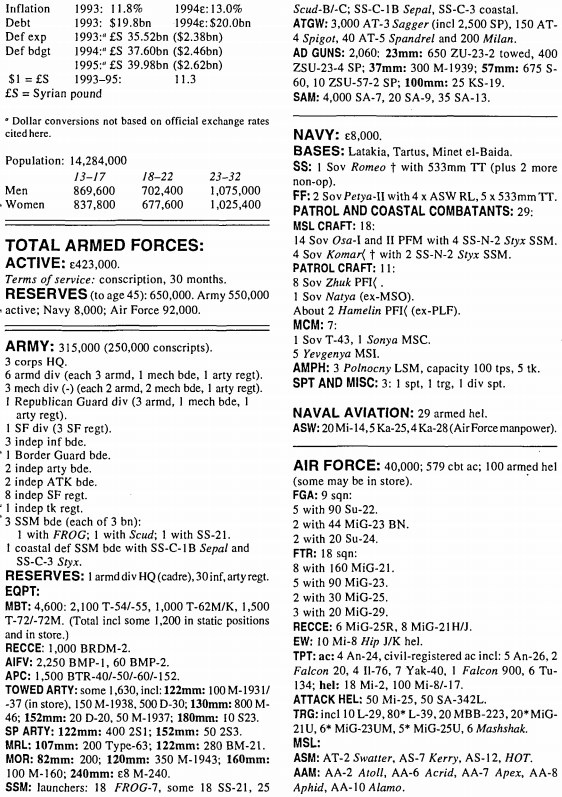
Israel's defence budget for 1995 remains static in real terms at $6.7 bn, and continues to be supported by the largest individual allocation of US Foreign Military Assistance (FMA) - $3 bn, including $1.8 bn for equipment. The cost of UNTSO in 1994 was about $29m. Syria's defence spending accounts for one-quarter of public spending, and in 1995 the defence budget obtains a small increase to ёS40bn or an estimated $2.6 bn. The cost of UNDOF in 1994 was about $30m.
In the case of Iran, there are discrepancies between the official spending reported to the IMF and independent estimates. This variation has partly to do with the devaluation of the rial, which makes for problems in dollar conversion, and partly to do with unreported extra-budgetary expenditure. According to the IMF, 1993 out-turn was R1.8 bn ($1.4 bn at the average annualised exchange rate) or 7% of public spending. The defence budget for 1994 was $2.3 bn, and remains about the same in 1995. Iraq's military spending is certain to be substantial by regional comparison, but serious data limitations allow for order-of-magnitude estimates only. Egypt's defence budget for 1993 was $1.6 bn, $1.8 bn in 1994, and rises to $2 bn in 1995. The budget continues to be supported by the second largest individual allocation of US FMA - unchanged in 1995 at $2.1 bn including $1.3 bn for equipment. The cost of UNIFIL' s operation in Lebanon during 1994 was some $ 142m. In the case of Yemen, no reliable details are available on the military expenditure incurred as a result of the 1994 civil war. The UN has estimated the costs of war damage at $200m, of which $20m is required for emergency repair work. InNorth Africa, the cost of MINURSO in 1994 was about $41 m. Algeria's defence budget has increased by a nominal 48%, and by some 12% in dollar terms to $1.3 bn.
It is not clear what economic repercussions for the GCC states will accompany any relaxation of UN sanctions on Iraq's oil trade. Oil is the major source of government revenue for the GCC states, and directly or indirectly determines the level of their arms purchases from foreign sources. The larger GCC producers (Saudi Arabia, the UAE and Kuwait) are members of the 12-nation Organisation of Petroleum-Exporting Countries (OPEC) cartel - which seeks to optimise its members' revenue by agreements on production quotas and prices. In 1994, OPEC supplied about 37% (about 24.8m barrels a day) of total global demand (about 67.9mb/d). Saudi Arabia has the largest share of OPEC production quotas (almost one-third or about 8mb/d in 1994). In 1994, UAE oil output was about 2.2mb/d, while that of Kuwait was about 1.9mb/d. Oil production in Oman and Bahrain, which are not OPEC members, and Qatar, which is, amounted to about 1.3mb/ per day in 1994. In 1994, the combined oil output of the six GCC states amounted to about 13.5m/ per day-worth, valued at some $69 bn for the year, or about one-fifth of global production. By comparison, Iraq's quota, which was about 3.2mb/d in 1989 (capacity about 3.5mb/d), is currently 600,000b/d and for domestic use only since Iraq rejected the UN offer in 1995 to export oil worth some $2bn (up from the 1991 offer of $1.6bn) over six months to pay for food and medical supplies, but also to pay war reparations and to fund continuing UN operations. It is estimated that, on the lifting of sanctions, output could be raised to 2.6mb/d within a year and thereafter to the level of the pre-Gulf War production capacity. The Iraqi government's ambition is to export 5.5mb/d by 2000 with the help of foreign investment.
There are several possible options open to OPEC for accommodating Iraqi production. First, if global demand for oil is more or less static, the pressure will be on OPEC producers to agree to reduce individual quotas pro rata. This is likely to be more acceptable to smaller producers than the larger ones - and to Iran, which has tended to argue in favour of keep supply levels below those of demand in order to maximise prices. However, the largest OPEC producer, Saudi Arabia, has already signalled its intention to maintain current market share within the OPEC cartel when sanctions on Iraq are lifted. Before the war with Iraq, Saudi Arabia's oil production was about 5mb/d. Dislocation of Kuwaiti production and sanctions on Iraq resulted in current levels of about 8mb/d. A second option, again assuming demand is relatively static, is to raise production levels in an attempt to win market share from non-OPEC producers. The danger of this strategy is that it would probably lead to declining oil prices, a price war between OPEC and non-OPEC producers, and conceivably one between OPEC member-states themselves (several of which are already inclined to breach quota agreements). A third option arises if demand for oil increases, since Iraqi output could be permitted to absorb much of the extra demand. Again, Saudi Arabia - with a production capacity of lOmb/d against a quota of 8mb/d - may attempt to gain a share of the extra demand.
For the Gulf States, the likely cost of each of these options will determine their bargaining stance within OPEC. Assuming an eventual Iraqi quota of 3.5mb/d, a pro rata cut in GCC quotas at existing OPEC aggregate production levels implies a revenue decline of 11-12% - probably representing the least acceptable outcome for the large GCC producers. Alternatively, given a decision to increase production despite static demand, the consequences for GCC oil revenue are less predictable and would depend on actual pricing levels. Undoubtedly, the most favourable outcome for the GCC states would be an increase in global demand which would absorb the extra supply from Iraq
Ближний Восток и Северная Африка
Политические события и события в области безопасности
На Ближнем Востоке арабо-израильский мирный процесс застопорился; Кувейту вновь угрожают иракские войска; исламские экстремисты продолжают свои террористические кампании в Алжире и Египте.
Израильско-Сирийский Мирный Договор
В то время как сирийский президент Хафез Асад, по-видимому, не торопится с продвижением к мирному договору с Израилем, 27 июня 1995 года был сделан важный шаг вперед, когда израильские и сирийские начальники штабов провели переговоры в Вашингтоне. Они согласились с тем, что механизм обеспечения безопасности должен включать в себя: демилитаризованную зону; систему раннего предупреждения; международное присутствие; и поэтапный уход Израиля - но детали под этими заголовками не были окончательно определены. Сирийцы предложили формулу асимметричной демилитаризованной зоны, которая потребовала бы от них демилитаризовать 10 миль территории до шести израильских. Эта зона будет находиться на международной границе, которая еще не согласована. Сирийцы отвергли предложение Израиля сохранить свою станцию раннего предупреждения на горе Хермон, позволив при этом Сирии создать станцию близ Зефата на севере Израиля.
Израильско-Иорданский Мирный Договор
Король Иордании Хусейн и премьер-министр Израиля Ицхак Рабин в присутствии президента США Билла Клинтона подписали мирный договор 26 октября 1994 года. Израиль согласился на то, что международная граница является пограничной линией, проведенной британцами в 1922 году, и на то, чтобы уйти с территории к востоку от линии, захваченной в 1967 году. Взамен Иордания вернула Израилю земли в долине Аравы, обрабатываемые израильтянами. Водные вопросы были урегулированы в договоре с Израилем, согласившимся на то, чтобы Иордания брала дополнительно 40 миллионов кубометров воды ежегодно из реки Ярмук. Иордания не присоединится к антиисраильскому альянсу, и ни одна из сторон не позволит использовать свою территорию для нападения на другую. Обе стороны обязались создать конференцию по безопасности и сотрудничеству на Ближнем Востоке по линии Организации по безопасности и сотрудничеству в Европе с мерами укрепления доверия и транспарентности. Был предложен ряд амбициозных совместных проектов в области энергетики, туризма, транспорта, водоснабжения и промышленности. Израиль завершил свой уход с иорданской территории 9 февраля 1995 года.
Палестинское самоуправление
Как министр иностранных дел Израиля Шимон Перес, так и председатель Палестинской национальной администрации Ясир Арафат прилагают огромные усилия для достижения соглашения по следующему этапу ухода Израиля с Западного берега и передачи ответственности Палестинской национальной администрации. Программа, согласованная в Декларации принципов, подписанной 13 сентября 1993 года, значительно отстает от графика. Хотя не все детали следующего этапа были согласованы, ясно, что Израиль намерен полностью уйти из северных палестинских городов Дженин, Наблус, Калькилия и Тулькарм. Частичный вывод войск и совместное патрулирование в Рамалле и Вифлееме, где израильские поселенцы пользуются дорогами, проходящими через эти города. Не будет никакого ухода из Хеврона, где небольшой анклав в городе и близлежащий Кири в арбе населены израильскими экстремистами, и присутствие израильской армии необходимо не только для их защиты, но и для того, чтобы удержать их от нападения на арабское население. Было уверенно запланировано, что соглашение о выводе израильских сил обороны (ИДФ) будет подписано в Вашингтоне 25 июля 1995 года и будет включать положение о развертывании примерно 700 международных наблюдателей в сентябре, а ИДФ будут выведены в начале ноября и заменены 1700 палестинскими полицейскими. Однако к концу июля соглашение так и не было достигнуто. Выборы в совет самоуправления должны были состояться до конца ноября. Вывод войск из Рамаллы и Вифлеема намечен на ноябрь, но зависит от завершения строительства объездных дорог. До тех пор, пока все палестинские деревни не будут обойдены, ЦАХАЛ будет продолжать патрулировать их. Хотя любой терроризм является неприемлемым для Израиля, уровень насилия значительно снизился после того, как террористы-смертники "Исламского джихада" убили 21 израильтянина в Бейт-Лиде 22 января 1995 года, но возрос после взрыва еще одной бомбы смертника в автобусе в Тель-Авиве 24 июля. Израиль согласился передать все оставшиеся сферы гражданской власти, но детальные договоренности еще предстоит достичь. Электричество и вода-две самые трудные области для согласования. Израильская армия начала подготовку к передислокации, которая включает переброску некоторых учебных подразделений в Израиль и использование их баз для оперативных подразделений, а также строительство объездных дорог для беспрепятственного передвижения поселенцев.
В Ливане "Хезболла" с некоторым успехом активизировала свою кампанию против ИДФ и армии Южного Ливана (ОАС). По меньшей мере 23 израильских солдата были убиты в Ливане в 1994 году, и в течение последних трех месяцев этого года потери "Хезболлы" были примерно равны потерям, понесенным ИДФ и ОАС. Эта ситуация, вероятно, будет продолжаться до тех пор, пока не будет подписан израильско-сирийский мирный договор, который должен содержать положение о сирийском контроле над "Хезболлой".
Ирак
7 октября 1994 года американские официальные лица сообщили, что две дивизии иракской Республиканской гвардии двинулись на юг, вплотную к границе с Кувейтом. Новость пришла после того, как за ходом операции следили в течение нескольких дней, как раз в тот момент, когда премьер-министр Ирака Тарик Азиз собирался выступить перед Организацией Объединенных Наций. Кувейтские войска были мобилизованы и развернуты на границе. США отреагировали быстро, отправив несколько авиаэскадрилий на базы в Саудовской Аравии. Первые сухопутные войска США, оснащенные из запасов, хранящихся в Кувейте, прибыли 10 октября. Великобритания также направила батальонную группу морской пехоты с артиллерией и шесть дополнительных самолетов Tornado GR-1 FGA. Американское подкрепление включало около 12 000 сухопутных войск с двумя бригадами 24-й механизированной дивизии (экспедиционные силы морской пехоты США были готовы к развертыванию, но не сделали этого), авианосец USS Washington и около 50 дополнительных боевых самолетов плюс танкеры и транспорты. ОАЭ также направили в Кувейт военно-морские и сухопутные силы. К 12 октября иракские войска были выведены, и, хотя развертывание союзников продолжалось, кризис был исчерпан. США представили резолюцию ООН, запрещающую будущие развертывания иракских войск на юге страны, но отказались от призыва к созданию зоны отчуждения тяжелого вооружения на юге Ирака. 15 октября Совет Безопасности ООН принял резолюцию 949, в которой осудил действия Ирака, но лишь предупредил о серьезных последствиях в случае их повторения. Пять дней спустя посол США в ООН Мадлен Олбрайт предупредила Ирак, что подразделения к северу от 32-й параллели 20 сентября 1994 года больше не могут быть развернуты к югу от этой линии. Совет Безопасности ООН до сих пор голосовал против отмены экономических санкций, введенных в отношении Ирака, последний раз 11 июля 1995 года, на том основании, что Ирак еще не раскрыл всех деталей своей программы по биологическому оружию (БО) и что многие кувейтские граждане и значительная часть кувейтской военной и гражданской собственности все еще числятся пропавшими без вести. Ирак теперь признал, что он произвел возбудителей ботулизма и сибирской язвы и передал ЮНСКОМ 530-страничный документ, в котором подробно излагается его программа борьбы с БВ. Сообщалось, что Россия уже подписала контракты на разработку месторождений Западная Курно и Северная Румайла после снятия санкций.
Об уровне политического инакомыслия в Ираке, возможно, можно судить по усилиям правительства, направленным на отмену санкций. К ним относятся:
* Освобождение двух американцев, осужденных за пересечение границы.
* Обнародование информации о программе БО.
* Указ об освобождении всех политических заключенных и снятии обвинений с иракцев, проживающих за рубежом.
* Дипломатическая кампания по возвращению в арабский мир.
Было несколько сообщений о неудачных мятежах в армии. Дезертирство двух зятьев Саддама Хусейна 10 августа 1995 года стало серьезным ударом по режиму. Один из них, генерал Хусейн Камель Хасан, который был главой военной промышленности, может рассказать больше о программе Ирака по созданию оружия массового уничтожения.
Иран остается в некоторой степени изолированным от мира. Президент Клинтон ввел полный запрет на торговлю США с Ираном в конце апреля 1995 года, этот шаг был поддержан только Израилем. США обеспокоены тем, что Иран приступил к ядерной оружейной программе, поддерживает исламистский экстремизм и терроризм в ряде стран противостоят ближневосточному процессу и могут угрожать международному судоходству в Ормузском проливе. В июне Иран отверг предложение Европейского Союза об улучшении отношений в обмен на прекращение фетвы, навязанной британскому автору Салману Рушди. Норвегия отозвала своего посла из Тегерана 3 июля. В Иране наблюдается растущее расхождение во взглядах между религиозными властями и президентом Рафсанджани и его правительством, главным образом в вопросе о том, кто обладает высшей властью. Отношения между Ираном и Ираком, как представляется, улучшаются, и делегации посетили столицы друг друга. Официальные переговоры, если они состоятся, будут сосредоточены на вопросах о пленниках, все еще не учтенных в Ирано-Иракской войне, и поддержке, оказываемой оппозиционным группам (таким как иранский моджахед-и-Хальк, базирующийся в восточном Ираке, и иранской поддержке иракских шиитов). Есть также нерешенные пограничные вопросы.
За последние 12 месяцев государства Персидского залива испытали некоторую нестабильность. Эмир Катара шейх Халифа бен Хамад Аль Тани был мирно свергнут своим сыном, Наследным принцем, 26 июня 1995 года, находясь за пределами страны. Новый правитель, которого быстро признали другие государства Совета сотрудничества стран Персидского залива (ССАГПЗ), как известно, хочет решить морской спор с Бахрейном. Катар передал свои претензии к островам Хувар в Международный суд (МС), который постановил, что он обладает юрисдикцией, но без согласия обеих сторон прогресс невозможен. Бахрейн примет претензии Катара только в том случае, если его собственные претензии в отношении Катара в районе Зубара будут рассматриваться международным судом одновременно. В декабре 1994 года, когда Бахрейн принимал международную конференцию, он стал ареной ожесточенных протестов, поскольку экономическое недовольство подпитывалось исламистскими группировками, и по меньшей мере 12 человек погибли. Правительство подверглось критике со стороны "Международной амнистии", но утверждает, что было гораздо меньше смертей и арестов, чем утверждает "амнистия". Оппозиция саудовскому режиму становится все более громкой, но разделена по вопросу о том, следует ли свергнуть всю семью Саудов или использовать раскол в семье.
Йемен добился определенного прогресса в урегулировании своих пограничных споров. 3 июня 1995 года Йемен и Оман заключили пограничное соглашение, которое возвращает Йемену около 5000 км2 территории, переданной Оману в 1992 году ныне изгнанным бывшим вице-президентом Али Салимом аль-бидом. Достигнув этого успеха, президент Йемена Али Абдалла Салих смог посетить Эр-Рияд 5 июня с некоторой уверенностью. Он согласился возобновить договор Та'Иф, определяющий часть общей границы без поправок, в надежде, что Саудовская Аравия окажет экономическую помощь и позволит йеменским рабочим вернуться в Саудовскую Аравию. Однако до сих пор не было предпринято никаких шагов для решения вопроса о неопределенной и спорной границе к востоку от Наджрана.
Переговоры между президентом Алжира Лиамином Зеруалем и Абасси Мадани, умеренным лидером Исламского фронта спасения (ФИС), которые, как казалось, шли хорошо, сорвались в июле 1995 года. Правительство утверждает, что крах был вызван настойчивым требованием наиболее радикальных оппозиционных фракций освободить заключенных лидеров ФИС, прежде чем можно будет положить конец насилию. В то время как провал переговоров сдерживает любой прогресс на пути к урегулированию, он в некоторой степени вызвал раскол между ФИС и другими оппозиционными фракциями, который правительство надеется использовать. Число погибших в ходе трехлетней гражданской войны в настоящее время составляет от 30 000 до 40 000 человек, хотя правительство настаивает на гораздо меньшем числе жертв.
Марокканские власти по-прежнему препятствуют усилиям Организации Объединенных Наций по выявлению и регистрации лиц, имеющих право голоса в Западной Сахаре на референдуме. В апреле 1995 года Генеральный секретарь ООН объявил о еще одной отсрочке, на этот раз на шесть месяцев, причем начало переходного периода было признано недостижимым не ранее 1 января 1996 года. Западные сахарцы угрожали возобновить войну, но до сих пор этого не сделали.
Отношения Египта с Суданом резко ухудшились после покушения на президента Египта Мубарака в Аддис-Абебе 26 июня 1995 года, когда Судан был первоначально обвинен в причастности к этому нападению. Напряженность усилилась в Пограничном районе Халаиб, где Египет вынудил 70 суданских полицейских покинуть свои посты, и произошел обмен выстрелами. Обе стороны предупредили друг друга, и суданцы пригрозили аннулировать Нильский договор 1959 года. Тем временем ответственность за покушение взяла на себя египетская группировка "Исламское государство". Террористическая деятельность мусульманских экстремистов продолжалась в течение последних 12 месяцев, причем в провинции Минья Верхнего Египта в первые месяцы 1995 года она резко возросла.
Карта
Ядерные и ракетные разработки
Ядерное оружие
В настоящее время из ближневосточных государств только Иран считается ведущим ядерную программу, хотя, несомненно, Ирак все еще имеет амбиции в этом отношении. Однако мало что известно, кроме общего признания того, что Иран хочет иметь ядерное оружие и что он планирует крупномасштабную ядерную энергетическую программу. С Россией заключены контракты на поставку легководного реактора мощностью 1000 мегаватт (МВт) в Бушере с опционами на второй реактор мощностью 1000 МВт и два реактора мощностью 400 МВт. Иран также обратился к Китаю с просьбой о строительстве новых атомных электростанций, но этот проект, как представляется, был остановлен рядом проблем. Одна точка зрения состоит в том, что Ирану с его известными запасами нефти и газа не нужна дорогостоящая ядерно-энергетическая программа, в то время как сами иранцы утверждают, что имеет смысл диверсифицировать свою деятельность. Известно, что Иран располагает тремя действующими урановыми шахтами, одну из которых посетили представители Международного агентства по атомной энергии (МАГАТЭ), сообщившие, что они не обнаружили ничего несовместимого с гражданской ядерной программой. Китай поставил электромагнитный сепаратор изотопов, или калутрон, который, хотя и может быть использован для разделения оружейного урана, по данным МАГАТЭ, имеет такие масштабы, что может производить изотопы только для медицинских целей. Иранцы прошли подготовку по ядерной физике в двух институтах в Пакистане, а также в США и Европе.
Иран присоединился к Договору о нераспространении ядерного оружия (ДНЯО), и в мае 1994 года вступило в силу соглашение о гарантиях с МАГАТЭ. С тех пор инспекторы МАГАТЭ не видели никаких свидетельств наличия оружейной программы и поздравляют Иран с его сотрудничеством с агентством, которое выходит за рамки обязательств по ДНЯО.
Сообщается, что президент Клинтон на саммите в мае 1995 года в Москве продемонстрировал президенту России Борису Ельцину разведданные, касающиеся иранской ядерной программы. Хотя этого было достаточно, чтобы заставить Ельцина прекратить планы по продаже Ирану центрифужной обогатительной фабрики, он не согласился бы остановить продажу ядерного реактора. Существует ряд оценок того, сколько времени потребуется Ирану, чтобы приобрести ядерное оружие, пригодное для доставки. В то время как Израиль и некоторые в США утверждают, что Иран находится в пределах трех - пяти лет от этого, общее согласие имеет тенденцию скорее к семилетнему-десятилетнему периоду.
Баллистические ракеты
Единственное новое развертывание ракет класса "земля-земля" за последние 12 месяцев было осуществлено в Иране, где были приобретены еще четыре северокорейские пусковые установки Scud-C и 5 пусковых установок CSS-8 (М-7). Есть неподтвержденные сообщения о том, что закупленные у Северной Кореи БР No-Dong были поставлены, но военный баланс считает это маловероятным.
Военные события
В Алжире 28 вертолетов Ми-2, показанных в прошлом году как принадлежащие жандармерии, фактически являются частью инвентаря ВВС. Мавритания заказал французский OPV-54 (AboubekrBenAmer) патрульных судов. Военно-Морской Флот Туниса приобрел еще три китайских сторожевых корабля класса Shanghai (Gafsah). Египетская армия приняла на вооружение еще 150 танков М-60 и 50 M-1 Abrams, 600 боевых машин пехоты YPR -765 и 76 122-мм САУ. ВВС приобрели 24 ударных вертолета AH-64A Apache и еще 30 истребителей F-16C (турецкого производства). Военно-Морской Флот арендовал два американских фрегата класса Knox.
Израильские военно-морские силы ввели в строй еще два ракетных корабля класса Eilat один ракетный корабль класса Romat. В настоящее время армия имеет на вооружении 9 РСЗО, и еще шесть были заказаны. В мае 1995 года Израиль и США достигли соглашения о продолжении американского финансирования в течение следующих пяти лет израильской системы противоракетной обороны Arrow. Сообщалось о ежегодном выделении $40 млн., что значительно меньше суммы, запрашиваемой израильтянами. В ближайшее время ожидается серия испытательных полетов. 5 апреля 1995 года Израиль запустил спутник Ofek-3, который, как уверенно сообщают, обладает способностью сбора разведывательной информации. Ливан располагает 16 вертолетами общего назначения UH-1H, ранее не числившимися на военном балансе, чья исправность вызывает сомнения.
США планируют предоставить еще 225 БТР М-113. Сирийская армия приняла поставку 100 танков Т-72, а ВВС получили шесть базовых учебных самолетов Mashak из Пакистана. Иранские ВВС имеют десять швейцарских самолетов связи PC-6B, ранее не перечисленных. Военно-морские силы революционной гвардии приняли поставку пяти китайских ракетных кораблей класса Hudong. Военно-морской флот рассчитывает получить свою третью подводную лодку класса Kilo до конца 1995 года, и поступали сообщения о том, что Иран предпринимает шаги по приобретению военно-морских объектов в Порт-Судане. Армия приняла на вооружение около трети из 100 танков Т-72, заказанных в Польше. Есть еще 200 китайских танков типа 69 и 200 БМП 1/2, больше чем указано выше. Число китайских 107-мм РСЗО типа 63 составляет около 500. Сообщается о первом производстве танка Zufuqar-4, иранского танка Т-72 и местного БТР Boraq. Не поступало никаких сообщений о приобретении иракских вооружений или о внутреннем производстве.
ВВС ОАЭ приобрели семь испанских CN-23M-100 и четыре российских транспортных самолета Ил-16. Из Франции были заказаны семь противолодочных вертолетов AS-565. Армия получила свои первые два французских танка Leclerc; 45 из общего заказа 396 должны быть поставлены до конца 1995 г. 70 были также поставлены еще боевые машины пехоты БМП-3. Численность живой силы Армии возросла на 8000 человек. ВМС ОАЭ ввели в строй американский фрегат класса Oliver Hazard Perry. В Катаре армия приобрела 12 боевых машин пехоты AMX-VCI, 12 разведывательных машин AMX-10RC и восемь БТР V-150. ВВС приняли поставку двух пусковых установок ЗРК Mistral и заказали истребители Mirage 2000-5 для поставки к концу 1997 года. Военно-морской флот имеет четыре быстроходных патрульных корабля по заказу Vospers Великобритании для поставки в 1995 году. Запасы кувейтской армии значительно возросли: 60 ПТРК TOW установлены на HMMVW, 76 БМП-3 и первые восемь из порядка 254 боевых машин пехоты Desert Warrior. Был размещен заказ на системы ПВО Starburst close стоимостью ё 50 млн.
В настоящее время армия Саудовской Аравии имеет 315 танков M-1 Abrams, что на 285 больше, и 400 боевых машин M-2 Bradley (на 200 больше, чем в прошлом году). Военно-Морской Флот ввел в строй третий британский береговой тральщик Sandown (Al Jawf) и заказал два французских фрегата класса La Fayette. Заказы на самолеты включают 20 учебных Hawk для поставки в 1996 году и 20 основных учебных PC-9 также из Великобритании. График поставки 48 удостоверений TornadoIDS, заказанных в 1993 году для поставки в 1996 году, по-видимому, сократился на один-два года. Происходит крупная реорганизация бахрейнской армии с формированием бронетанковой, пехотной и артиллерийской бригад и увеличением численности личного состава на 1700 человек. Также было приобретено еще 26 танков М-60. ВМС США ввели в строй фрегат класса OliverHazardPerry. ВВС Омана сняли с вооружения свой старый самолет Hunter FGA и приняли на вооружение еще восемь самолетов Hawk 203. Армия приобрела 18 танков Challenger-2, которые будут поставлены к концу 1995 года, 20 бронетранспортеров Piranha и шесть 155-мм САУ G-6 - еще 19 должны быть поставлены. Военно-морской флот заказал три быстрых патрульных корабля из Франции.
Расходы на оборону. По оценкам МИСИ, расходы на оборону в регионе сократились с $44,5 млрд. в 1993 году до $42,7 млрд. в 1994 году в постоянных ценах 1993 года. Бюджетные данные за 1995 год указывают на дальнейшее снижение до $41 млрд. Регион тратит на оборону больше, чем любой другой регион, и расходы на душу населения также относительно высоки. Страны ССЗ составляют около половины от общего числа.
Оборонный бюджет Саудовской Аравии в 1995 году составил $13,2 млрд. Правительство опубликовало данные о расходах на оборону за 1992 год ($15,4 млрд.), 1993 год ($16,5 млрд.) и 1994 год ($14,3 млрд.), которые отражают масштабы закупок и заказов саудовского оружия (свыше $30 млрд.) после войны с Ираком. Были подняты вопросы о способности правительства оплачивать эти закупки оружия с учетом продолжительного дефицита бюджета и текущего счета, усугубленного сокращением государственных доходов после резкого снижения цен на нефть в 1993 году. Эти факторы способствовали пересмотру условий контрактов с основными поставщиками, о котором было объявлено в 1994 году и который предусматривал перенос сроков поставок и платежей в 1994-1995 годах, но не привел к отмене каких-либо программ. Эти корректировки сопровождались заметным сокращением новых закупок оружия Саудовской Аравией в 1994 и 1995 годах. Однако, как представляется, нет никаких причин, по которым существующая существенная программа закупок не должна оставаться эффективной. В 1995 году правительство выплатило последний транш военного займа в размере $4,5 млрд. в 1991 году, и в середине 1995 года появились признаки существенного улучшения как финансового, так и текущего баланса. Высокие расходы на закупки также очевидны из недавних оборонных бюджетов других государств ССЗ. В 1995 году бюджет Кувейта сократился с $3,1 млрд. в 1994 году до $2,9 млрд. без учета дополнительных расходов в размере $232 млн. на развертывание коалиционных сил в 1994 году и $170 млн. на совместные учения. Объем закупок составляет $1,4 млрд. В 1994 году стоимость ИКМООНН составляла около $69 млн. Бюджет ЮНСКОМ на 1995 год составляет $25 млн., в который государства ССАГПЗ вносят $12 млн. в Омане и 1993, и 1994 годы были выше бюджета, а причиной перерасхода стали закупки. Оборонный бюджет на 1995 год составляет $1,7 млрд., что выше показателя 1994 года в $1,6 млрд., но ниже - в $1,9 млрд. Фактические уровни расходов ОАЭ неопределенны, поскольку никакие детали оборонного бюджета не публикуются заранее, и существуют противоречивые цифры прошлых расходов. Международный валютный фонд (МВФ) приводит цифру в $1,6 млрд. за 1993 год, в то время как оценки, приписываемые Центральному банку, указывают на $2,1 млрд. за 1993 год и аналогичный уровень за 1994 год.
Оборонный бюджет Израиля на 1995 год остается неизменным в реальном выражении на уровне $6,7 млрд и продолжает поддерживаться за счет крупнейшего индивидуального выделения внешней военной помощи США (FMA) - $3 млрд, включая $1,8 млрд на оборудование. Стоимость ОНВУП в 1994 году составляла около $29 млн. оборонные расходы Сирии составляют четверть государственных расходов, а в 1995 году оборонный бюджет получает небольшое увеличение до ё40 млрд, или приблизительно $2,6 млрд. Стоимость СООННР в 1994 году составляла около $30 млн.
В случае Ирана существуют расхождения между официальными расходами, сообщенными МВФ, и независимыми оценками. Это изменение отчасти связано с девальвацией риала, что создает проблемы при пересчете доллара, а отчасти-с несообщаемыми внебюджетными расходами. По данным МВФ, в 1993 году отток составил 1,8 млрд риал ($1,4 млрд. по среднему годовому курсу), или 7% государственных расходов. Оборонный бюджет на 1994 год составил $2,3 млрд, и остается примерно таким же в 1995 году. Военные расходы Ирака, несомненно, будут значительными по сравнению с регионами, но серьезные ограничения в данных позволяют делать только оценки порядка величины. Оборонный бюджет Египта на 1993 год составлял $1,6 млрд, в 1994 году - $1,8 млрд., а в 1995 году вырос до $2 млрд. Бюджет по - прежнему поддерживается за счет второго по величине индивидуального распределения FMA США -неизменного в 1995 году на уровне $2,1 млрд, включая $1,3 млрд на оборудование. Расходы на операцию ВСООНЛ в Ливане в 1994 году составили около $142 млн. в случае Йемена нет достоверных сведений о военных расходах, понесенных в результате гражданской войны 1994 года. ООН оценила стоимость военного ущерба в $200 млн, из которых $20 млн требуется на проведение аварийно-восстановительных работ. В Африке расходы МООНРЗС в 1994 году составили около $41 млн. оборонный бюджет Алжира увеличился номинально на 48%, а в долларовом выражении-примерно на 12% до $1,3 млрд.
Неясно, какие экономические последствия для стран ССАГПЗ будут сопровождать любое ослабление санкций ООН в отношении торговли иракской нефтью. Нефть является основным источником государственных доходов для государств ССАГПЗ и прямо или косвенно определяет уровень их закупок вооружений из иностранных источников. Крупнейшие производители стран ССАГПЗ (Саудовская Аравия, ОАЭ и Кувейт) являются членами картеля 12-Национальной Организации стран-экспортеров нефти (ОПЕК), который стремится оптимизировать доходы своих членов путем заключения соглашений о квотах на добычу и ценах. В 1994 году ОПЕК поставляла около 37% (около 24,8 млн баррелей в день) от общего мирового спроса (около 67,9 млн баррелей в сутки). Саудовская Аравия имеет самую большую долю квот ОПЕК на добычу (почти треть или около 8 млн баррелей в сутки в 1994 году). В 1994 году добыча нефти в ОАЭ составляла около 2,2 млн баррелей в сутки, в то время как в Кувейте - около 1,9 млн баррелей в сутки. добыча нефти в Омане и Бахрейне, не являющихся членами ОПЕК, и Катаре, который является таковым, составила около 1,3 млн баррелей в сутки в 1994 году. В 1994 году совокупная добыча нефти в шести государствах ССАГПЗ составила около 13,5 млн баррелей в сутки, что составляет около $69 млрд. в год, или около одной пятой мировой добычи. Для сравнения, квота Ирака, которая составляла около 3,2 Мб / сут в 1989 году (мощность около 3,5 Мб/сут), в настоящее время составляет 600 000 б/сут и предназначена только для внутреннего использования, поскольку Ирак отклонил предложение ООН в 1995 году экспортировать нефть на сумму около $2 млрд (по сравнению с предложением 1991 года в размере $1,6 млрд) в течение шести месяцев для оплаты продовольствия и медикаментов, а также для выплаты военных репараций и финансирования продолжающихся операций ООН. Предполагается, что после отмены санкций объем производства может быть увеличен до 2,6 Мбит/с в течение года, а затем до уровня производственных мощностей, существовавших до войны в Персидском заливе. Иракское правительство стремится экспортировать 5,5 Мбит / с к 2000 году с помощью иностранных инвестиций.
ОПЕК может предложить несколько вариантов размещения иракской добычи. Во-первых, если мировой спрос на нефть будет более или менее статичным, производители ОПЕК будут вынуждены согласиться на пропорциональное сокращение индивидуальных квот. Это, вероятно, будет более приемлемо для мелких производителей, чем для крупных - и для Ирана, который склонен отстаивать сохранение уровня предложения ниже уровня спроса, чтобы максимизировать цены. Однако крупнейший производитель ОПЕК, Саудовская Аравия, уже заявила о своем намерении сохранить текущую долю рынка в картеле ОПЕК, когда санкции в отношении Ирака будут сняты. До войны с Ираком добыча нефти Саудовской Аравией составляла около 5 млн баррелей в сутки. дислокация кувейтской добычи и санкции против Ирака привели к текущему уровню около 8 млн баррелей в сутки. второй вариант, опять же предполагающий относительно статичный спрос, заключается в повышении уровня добычи в попытке завоевать долю рынка у производителей, не входящих в ОПЕК. Опасность этой стратегии заключается в том, что она, вероятно, приведет к снижению цен на нефть, ценовой войне между производителями ОПЕК и странами, не входящими в ОПЕК, и, возможно, к войне между самими государствами - членами ОПЕК (некоторые из которых уже склонны нарушать соглашения о квотах). Третий вариант возникает в том случае, если спрос на нефть возрастает, поскольку иракскому производству может быть позволено поглотить большую часть дополнительного спроса. Опять же, Саудовская Аравия - с производственной мощностью 10mb/d против квоты 8 МБ/d-может попытаться получить долю дополнительного спроса.
Для стран Персидского залива вероятная стоимость каждого из этих вариантов будет определять их переговорную позицию в рамках ОПЕК. Предполагая, что в конечном итоге иракская квота составит 3,5 Мб/сут, пропорциональное сокращение квот ССЗ на существующих уровнях совокупного производства ОПЕК предполагает снижение доходов на 11-12% - вероятно, это наименее приемлемый результат для крупных производителей ССЗ. С другой стороны, если принять решение об увеличении добычи, несмотря на статический спрос, то последствия для нефтяных доходов ССЗ будут менее предсказуемыми и будут зависеть от фактического уровня цен. Несомненно, наиболее благоприятным исходом для государств ССАГПЗ было бы увеличение глобального спроса, который поглотил бы дополнительное предложение из Ирака.
Central and Southern Asia
Central Asia
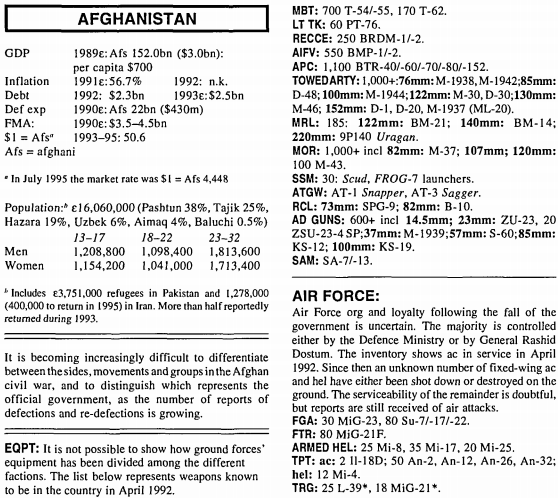
The separate civil wars in Afghanistan and on the Afghan-Tajikistan border continued unabated. In Afghanistan, the appearance in January 1995 of a new major faction, Taleban - formed primarily by religious students and organised in southern Afghanistan - both complicated and increased the intensity of the civil war. Initially, Taleban was extremely successful. By March 1995 the group appeared to control the southern half of the country, threatening Kabul. In the capital, Taleban soon found itself fighting elements of the forces of General Ahmad Shah Masud and of Gulbuddin Hekmatyar, halting their further advance. Taleban appears to have Pakistan's backing, but hopes that the group would rise above Afghanistan's acknowledged factionalism have not been realised. Throughout the last 12 months there have been numerous reports of defections and groups changing sides. Taleban has not yet joined or allied itself to either of the main factions, but the war is expected to continue between the Northern Farsi (Uzbek, Turkmen and Tajik) groups, and Taleban and the southern Pashtun groups.
On 16 December 1994, the UN Security Council adopted Resolution 968 which established an observer mission (UNMOT) for six months to monitor the cease-fire agreed to by the government of Tajikistan and the Islamic opposition. The cease-fire has not been respected and fighting flared up again in April 1995 when rebels based in Afghanistan made a series of raids along the Tajik border. This prompted a strong response from Russian forces, including reported air attacks on targets in Afghanistan. Peace talks took place at Almaty in June, but no agreement was reached on how to integrate the opposition into the Tajik government.
In February 1995, Kazakhstan and Russia signed a number of cooperative agreements and issued a joint declaration that they 'would begin to form unified armed forces'. This does not mean a single armed force, but a close alliance whose forces would be unified when necessary to face a common threat. The five former Soviet Central Asian states signed two Commonwealth of Independent States (CIS) agreements: the Memorandum on Maintaining Peace and Stability in March; and the Agreement on Creating a Joint Air Defence System in May. Also in May, Kazakhstan, Kyrgyzstan and Tajikistan signed an agreement protecting CIS external borders.
Southern Asia
In India it has been a relatively quiet year, although there is still no solution to the violence in Kashmir. The worst incidence of violence occurred in May 1995 when, during a fight between the Indian Army and Muslim militants, a holy shrine and several hundred homes were destroyed in the Muslim town of Charar-e-Sharief, some 20 miles south-west of Srinagar. Both sides blame the other for the shrine's destruction. After visiting Kashmir, Bhuvanesh Chaturvedi, Minister of State in the Prime Minister's office, said on 3 July that the government was ready to hold unconditional talks with 'anyone' to end the violence there.
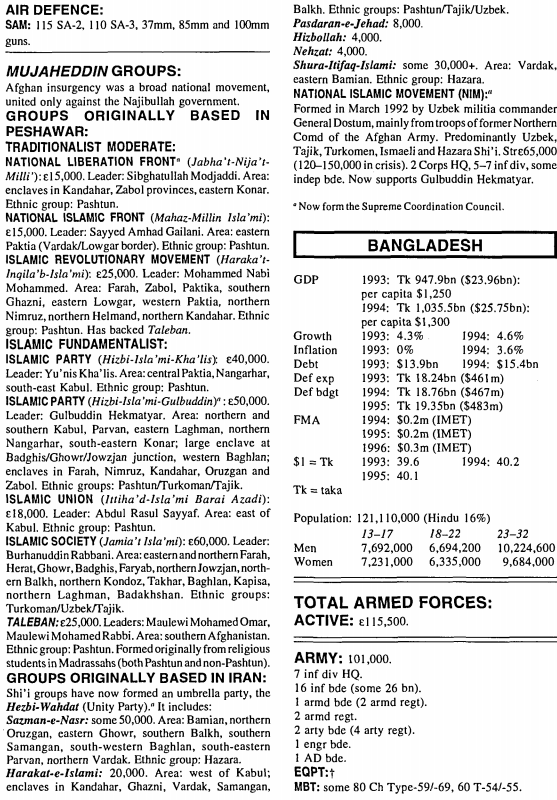
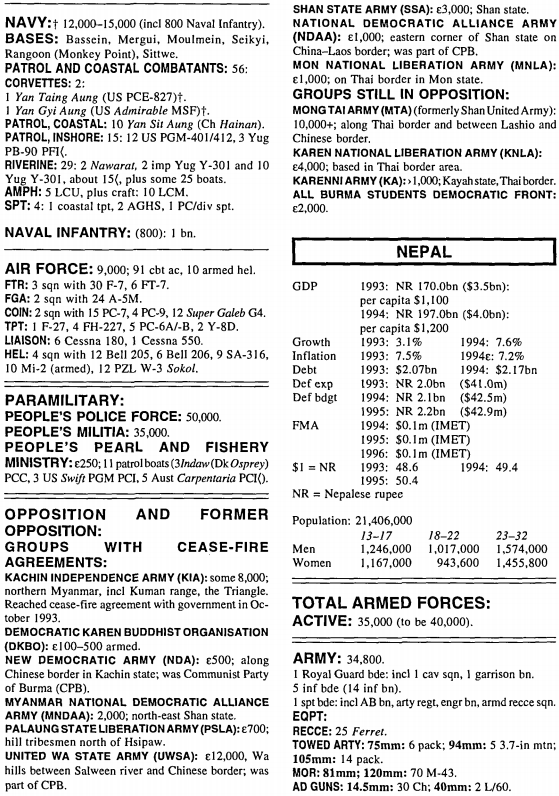
In January Myanmar's Army launched a major campaign against the Karen rebels, one of the few groups still able to oppose the government. The Karen main stronghold of Manerplaw was taken at the end of the month and another, Kawmoora, some three weeks later. The Karen movement decided to stop attempting to control territory and to revert to guerrilla warfare instead. Although a substantial number of arms were handed into the government, the fight continues with some Karens escaping over the border to Thailand.
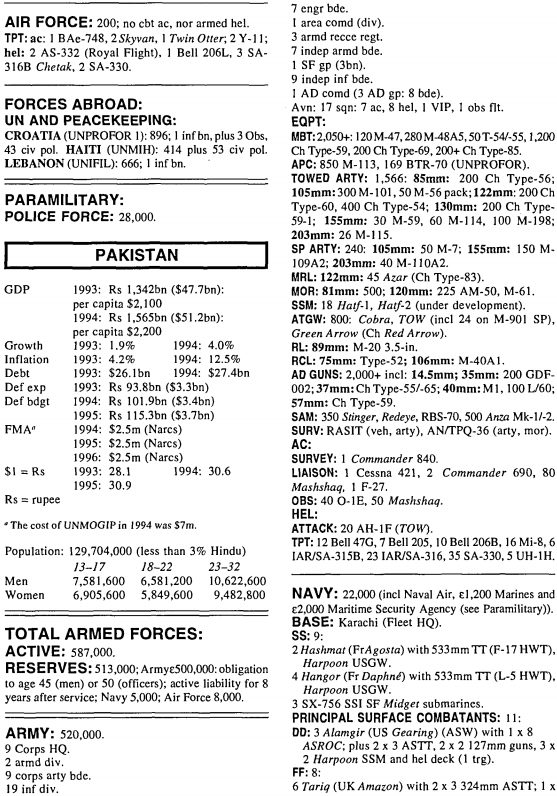
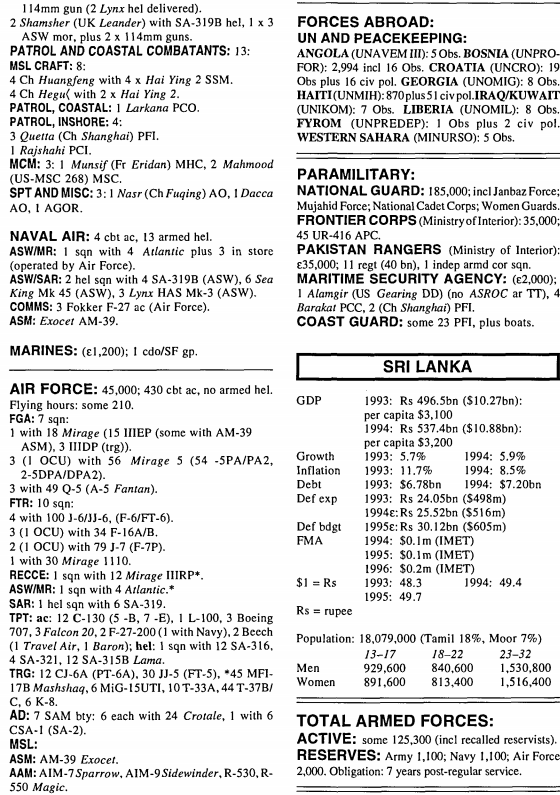
In Pakistan, there has been a major outbreak of communal violence in Karachi caused by the Mohajiv Qaumi Movement formed by Urdu-speaking Muslims who migrated to Pakistan after partition in 1947. So far, around 1,000 people have died and the city is virtually ungovernable. In Sri Lanka, the ruling United National Party was defeated in elections in August 1994 and was replaced by a coalition government led by Chandrika Kumaratunga' s People's Alliance. The new government quickly eased the economic blockade on the region controlled by the Liberation Tigers of Tamil Eelam (LTTE), lifted the state of emergency and invited the Tamil Tigers to peace talks. But armed clashes continued until midnight on 7 January 1995 when a cease-fire agreed by the Sri Lanka government and the LTTE, and monitored by Canadian, Dutch and Norwegian officials, came into force. Later that month the LTTE dropped its demand for independence and was willing to accept autonomy with Sri Lanka. The cease-fire ended when two naval patrol boats were sunk by mines in Trincomalee harbour on 19 April. The following day the Tamil Tigers attacked two army posts and the police rounded up some 1,000 Tamils across the country. In June it was revealed that India was providing naval ships and maritime aircraft to prevent supplies from reaching the LTTE across the Palk Strait. The worst incident in the renewed fighting occurred on 28 June when up to 1,000 LTTE raided the island of Mandaitivu, killing over 100 government soldiers.
Nuclear Developments
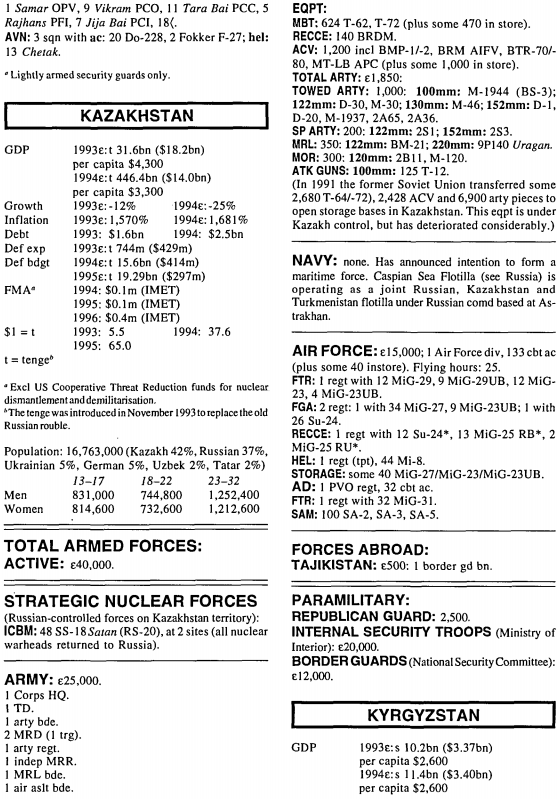
Kazakhstan has made good progress towards achieving non-nuclear status. Russia's Strategic Rocket Forces announced that the transfer of nuclear warheads from Kazakhstan was completed on 24 April 1995. In the December 1994 START Memorandum of Understanding, Kazakhstan declared it had 69 deployed ICBM and had destroyed no launcher silos. There were still 31 ICBM at Derzhavinsk and 38 at Zhangiz-Tobe. On 1 June 1995 there were only 48 ICBM left in Kazakhstan.
Also in June, the Indian Foreign Minister ruled out halting fissile-material production until there is a satisfactory global convention to ban its use for weapons. Pakistan continues to reject US proposals to put its enrichment facilities under International Atomic Energy Agency (IAEA) safeguards (in return for F-16 aircraft) as there is no guarantee of a similar monitoring measure in India. Pakistan has, however, halted production of uranium-235, but is continuing with the construction of a socalled 'research reactor' at Khushab which, it is suspected, could produce plutonium.
Missile Proliferation
It is still unclear whether Pakistan has received either complete missiles, missile components or technology from Chinaforthe M-11 missile system, although US intelligence officials believe that up to 30 missiles have been delivered to Lahore. Both China and Pakistan deny this. China also refutes claims that the M-11 is covered by Missile Technology Control Regime (MTCR) parameters (missiles which can carry a 500kg payload over 300km). They claim its range is 185 miles (296km) and its payload 1,000 lbs (453kg), but have accepted the US concept of 'inherent capability'. There have been no reports in the last 12 months of tests of Indian ballistic missiles, although development is thought to be continuing. It is now accepted that a regiment of short-range (150km) Privthi SSM has been formed, but may not yet be operational. Although under international pressure to end missile production, the Indian government declared on 9 May 1995 that there was no question of halting the programme.
Conventional Military Developments
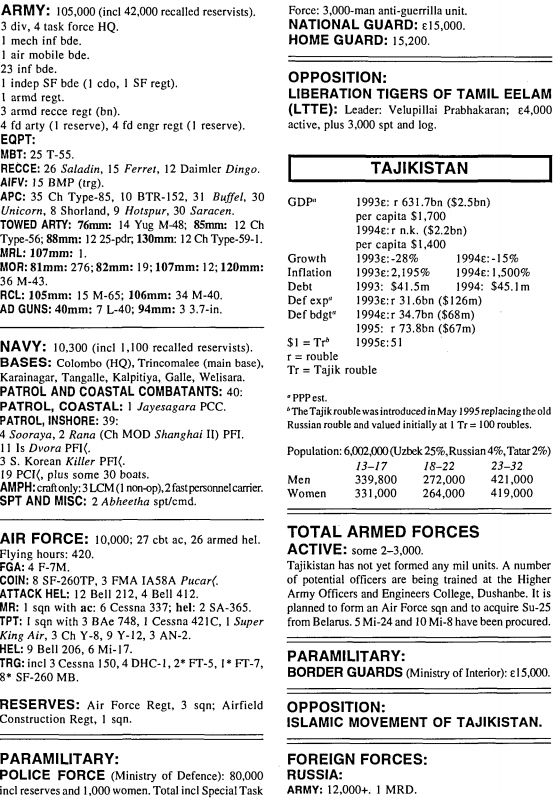
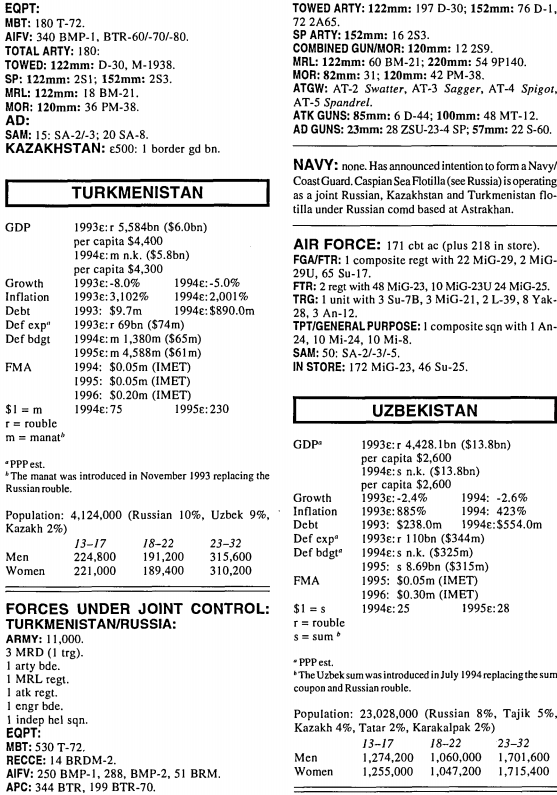
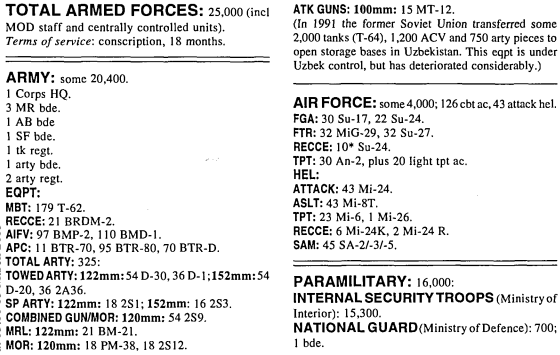
Kazakhstan no longer has a regiment of 48 Mi-24 attack helicopters, which are presumed to have returned to Russia. 20 Su-27 fighter aircraft are due to be delivered in 1995. Turkmenistan has disposed of some 500 of the over 1,000 aircraft held in store. In Uzbekistan, the Army has formed a Corps HQ and a special forces brigade. The cadre airborne division has been redesignated a brigade, the motor rifle division has converted to three independent brigades, and the artillery has been expanded by two regiments. Tank strength has risen by 50 and fresh information has allowed a more detailed inventory to be compiled. The Air Force has formed a reconnaissance unit with 10 Su-24 aircraft and has 10 more An-2 transport planes.
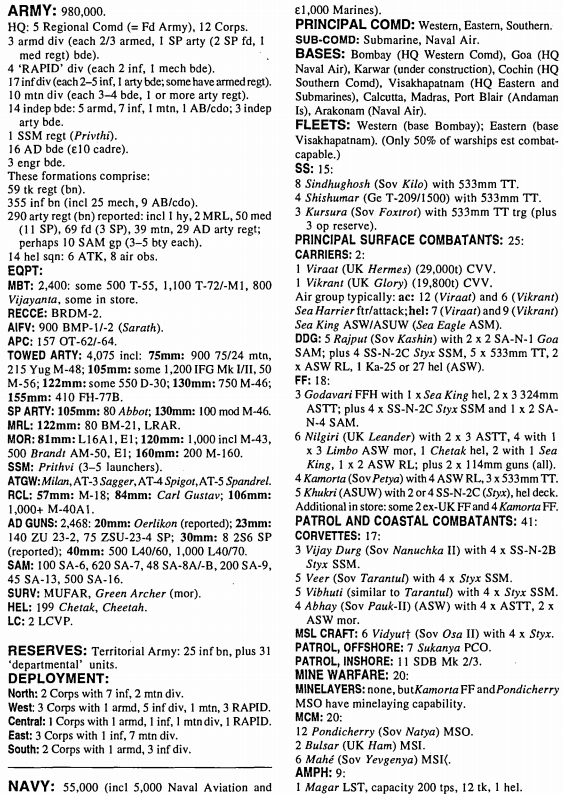
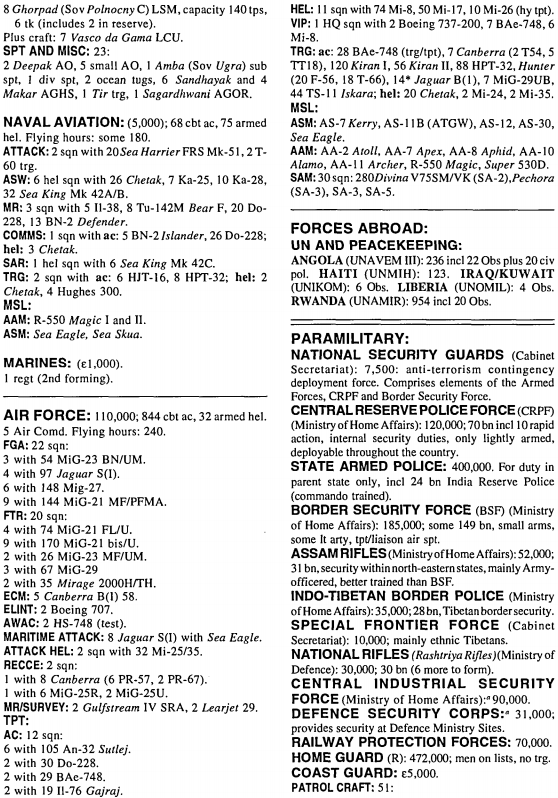
The Bangladeshi Navy has commissioned four Shapla (ex-UK River-class) and one Chinese inshore (probably a Wosoa-class) mine-sweepers. The Air Force has retired its elderly 12 Su-7 aircraft. The Indian Army' s order of battle has been reassessed. It is now considered to comprise three armoured divisions (one more than in 1994), no mechanised division, 17 infantry divisions (five less) and ten mountain divisions (no change). Four Reorganised Army Plains Infantry Divisions (RAPID) have been formed which have both mechanised and infantry brigades. A missile regiment armed with Privthi SSM has been formed, but it is not known how many launchers it is equipped with nor when it will be fully operational. Army manpower strength is now considered to be under one million. The number of tanks in service is much reduced, mainly because several hundred have been withdrawn for upgrading, probably at the expense of producing the Indian-designed Arjun. The Army was incorrectly shown as having 50 SA-11 SAM last year. The Navy has commissioned two more Vibhuti-class corvettes and acquired ten more Do-228 maritime reconnaissance aircraft. The Navy has ambitious plans for the future, including the indigenous production of nuclear submarines and an aircraft carrier. The submarine programme is still in the research and development phase, and the boat is not planned to be operational until 2003-5. The aircraft carrier will also take some years to produce, and until then the two current carriers will need extensive refits. As yet, no decision has been reached over whether to buy the Russian carrier Gorshkhov or not. The Indian Defence Minister has said that negotiations have been under way to buy six Russian frigates. The Air Force has formed an additional MiG-27 FGA squadron and acquired 28 more aircraft. Ten MiG-29 aircraft (including two trainers) have been ordered and may be the first of a larger purchase. Refurbishment of the MiG-21 force is considered essential, but as yet it has not been decided whether the contract should be awarded to Russia or Israel.
During the last 12 months, Myanmar has taken delivery of 150 Chinese Type-85 APCs. There have been unconfirmed reports of Chinese plans to construct a naval base at Hainggy i Island at the mouth of the River Bassein south-west of the capital, and a SIGINT station on Great Coco Island north of the Andamans. China is already involved in port improvements at Akyab, Kyaukpyu and Mergui. It is conjectured that in return for Chinese naval rights in the Bay of Bengal, Myanmar will receive a further package of arms, estimated to be worth $400m. Orders reportedly include some 30 older aircraft (F-7, A-5), two Y-8 transport aircraft, six Hainan-class coastal patrol boats plus 20 helicopters, 60armoured fighting vehicles and 50 artillery pieces (all unspecified).
The Pakistani Army has acquired 100 more Chinese Type-85 tanks, and the Navy has commissioned two more Tariq (UK Amazon)-class frigates. Three French Agosta 90B submarines are on order, the first to be built in France, the other two in Pakistan, and six more Type-21 (Amazon-class) frigates have been ordered from the UK.
The Sri Lankan Army has acquired 15 BMP armoured fighting vehicles for training purposes, the first of a much larger order- now postponed or cancelled - to be delivered. The Navy has lost three patrol boats. In September 1994, the Sagarawardene was sunk by a Tamil Tiger suicide squad, and in April 1995 two more were sunk by mines in Trincomalee harbour. The Tamil Tigers have also shot down two Air Force transport planes, probably BAe 748 (Andover) aircraft.
Defence Spending
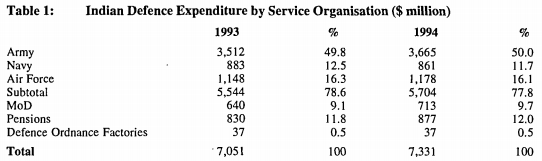
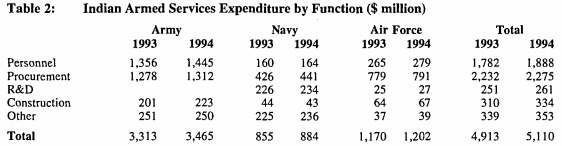
Expenditure by India and Pakistan in recent years accounts for about three-quarters of all spending by the countries in this section, excluding the costs of the civil war in Afghanistan which are not known. In 1995, India and Pakistan both increased their defence budgets by 6-7% in real terms, and there are more substantial increases in the case of Sri Lanka and Myanmar. India's defence budget for 1995 is R255bn ($8.1 bn), a real increase of some 6% over the enlarged 1994 out-turn of R235 bn ($7.5 bn). In recent years the Army has received about half of the total defence budget (see Table 1). In 1995 its allocation is R124 bn ($4 bn). The Air Force takes about 16% of the budget and in 1995 receives R41 bn ($1.3 bn). Funding for the Navy is the lowest priority (about 12%), and in 1995 it receives R15 bn ($480m). This excludes certain items in its budget, including procurement for which details are not yet available. Other funding is for central Ministry of Defence (MoD) organisation, the Defence Ordnance Factories and pensions. The Indian method of classifying defence expenditure follows the UK practice of including operational spending under manpower and procurement costs, and consequently does not make use of an Operations and Maintenance (O&M) heading. This funding may also be found under 'Other', shown in Table 2. Funds for procurement, R&D and construction are classified as capital outlay.
The largest part of the procurement budget is spent on aircraft and aero-engines ($740m in 1993 and$820min 1994). Capital spending on the naval fleet was $340m in 1993and$330min 1994. MoD policy on weapons procurement generally reflects a continuing struggle between ends and means, exacerbated by supply problems and deteriorating terms of trade with Russia and other former Soviet states as they have increasingly demanded hard currency (in place of rupees). Some policy shift is now becoming apparent towards long-term commitment to indigenous R&D and production supported by foreign joint ventures rather than licensed production. Any move away from licensed production is likely to require a sustained effort over the long term. Although Indian experience with indigenous production has been mixed to date (generally programmes have run upagainst technological and financial barriers andtime-scaleshaveconsequently been compromised) it has laid the foundation for an extensive defence industrial base.
Cost escalation in indigenous programmes has squeezed resources for buying new equipment from foreign sources. According to the US Arms Control and Disarmament Agency (ACDA), imports of defence equipment have declined sharply from their peak in 1988, when they amounted to $4.3 bn (at constant 1993 prices) to $2 bn in 1990, $615 in 1992 and a provisional $ 10m in 1993. Accumulating debt has been one factor in curtailing procurement from abroad. According to a Ministry of Finance report, imported defence equipment accounted for about 9% of India's external debt in 1993 - of which about 90% was owed to Russia in unrequited rupee credits, but with a sizeable dollar-denominated component of almost $1 bn. Delays in development are another factor which has held up several new production programmes. This has resulted in priority being switched to spares provisioning and limited modernisation programmes in order to keep existing equipment in service. While a less costly option than purchasing new weapons systems from abroad, this policy is still relatively expensive in hard-currency terms, with over 80% of the $300- 500m annual budget reportedly sourced from abroad, and the MoD reportedly seeking to reduce its dependence on Russia as its major supplier (some 75-80% of Indian defence equipment is of Soviet origin and most was produced under licence in India).
In 1995, Pakistan's defence budget amounts to R115 bn ($3.7 bn) - a real increase of some 7% over 1994. No other statistical details are released by the government. As a proportion of gross domestic product (GDP), defence expenditure is about three times that of India. According to ACDA, arms imports in 1993 amounted to $430m. Sri Lanka's military expenditure is increasing sharply as a result of the counter-insurgency operations against the Tamil Tigers. In mid-1995, the government announced supplementary funding of R4.5 bn ($90 m) - almost one fifth of the 1994 budget - to cover additional costs of this campaign. Myanmar added K2.8 bn (about $108m at market exchange rates) of supplementary funds for the 1994 military budget, while the defence budget for 1995 (K15.5 bn or nearly $600m) has increased by 40% over 1994. Budgetary information from Kazakhstan, Kyrgyzstan, Tajikistan, Turkmenistan and Uzbekistan has improved since 1994 with the publication by the International Monetary Fund (IMF) of external audits of government expenditure, including defence. However, lack of transparency in military accounting, high inflation, and uncertainty over the purchasing power of domestic currencies still create difficulties in estimating real expenditures. According to NATO, these states appear to have adopted differing policies towards accepting financial responsibility for the residual Russian armed forces on their territory. In general, defence expenditure has been concentrated on manpower and O&M functions rather than on R&D and procurement. In Tajikistan, the projected cost for 1995 of UNMOT - the first UN operation in the Central Asian republics of the former Soviet Union - is $7m.
Центральная и Южная Азия
Средняяя Азия
Отдельные гражданские войны в Афганистане и на афгано-таджикской границе продолжались безостановочно. В Афганистане появление в январе 1995 года новой крупной фракции "Талебан", сформированной в основном религиозными студентами и организованной в южном Афганистане, осложнило и усилило интенсивность гражданской войны. Изначально, "Талибан" был чрезвычайно успешным. К марту 1995 года группировка, казалось, контролировала южную половину страны, угрожая Кабулу. В столице Талебан вскоре оказался сражающимся отрядом генерала Ахмад-Шаха Масуда и Гульбеддина Хекматияра, остановив их дальнейшее продвижение. Талебан, по-видимому, пользуется поддержкой Пакистана, но надежды на то, что эта группа поднимется выше признанного афганского фракционизма, не оправдались. В течение последних 12 месяцев поступали многочисленные сообщения о дезертирстве и группировках, переходящих на другую сторону. Талебан еще не присоединился ни к одной из основных группировок, но война, как ожидается, будет продолжаться между северными фарси (узбекскими, туркменскими и таджикскими) группами и Талебаном и южными пуштунскими группами.
16 декабря 1994 года Совет Безопасности ООН принял резолюцию 968, в соответствии с которой была учреждена миссия наблюдателей (МНООНТ) сроком на шесть месяцев для наблюдения за прекращением огня, согласованным правительством Таджикистана и исламской оппозицией. Перемирие не соблюдалось, и боевые действия вновь вспыхнули в апреле 1995 года, когда боевики, базирующиеся в Афганистане, совершили серию рейдов вдоль таджикской границы. Это вызвало решительный ответ со стороны российских войск, включая сообщения о воздушных атаках на цели в Афганистане. В июне в Алма-Ате состоялись мирные переговоры, но не было достигнуто соглашения о том, как интегрировать оппозицию в таджикское правительство.
В феврале 1995 года Казахстан и Россия подписали ряд соглашений о сотрудничестве и приняли совместное заявление о том, что они "приступят к формированию объединенных вооруженных сил". Это означает не единую вооруженную силу, а тесный союз, силы которого были бы объединены, когда это необходимо для противостояния общей угрозе. Пять бывших советских государств Центральной Азии подписали два соглашения Содружества Независимых государств (СНГ): меморандум о поддержании мира и стабильности в марте и соглашение о создании совместной системы ПВО в мае. Также в мае Казахстан, Кыргызстан и Таджикистан подписали соглашение о защите внешних границ СНГ.
Южная Азия
В Индии этот год был относительно спокойным, хотя до сих пор нет решения проблемы насилия в Кашмире. Наиболее массовые случаи насилия имели место в мае 1995 года, когда в ходе боев между индийской армией и мусульманскими боевиками была разрушена святыня и несколько сотен домов в мусульманском городе чарар-Э-Шариф, примерно в 20 милях к юго-западу от Шринагара. Обе стороны обвиняют друг друга в разрушении храма. После посещения Кашмира Бхуванеш Чатурведи, государственный министр в кабинете премьер-министра, заявил 3 июля, что правительство готово провести безоговорочные переговоры с "кем угодно", чтобы положить конец насилию там.
В январе армия Мьянмы развернула крупную кампанию против каренских повстанцев, одной из немногих группировок, все еще способных противостоять правительству. Главный оплот Каренов в Манерплоу был взят в конце месяца, а еще один, Кавмура, примерно через три недели. Движение Каренов решило прекратить попытки контролировать территорию и вместо этого вернуться к партизанской войне. Хотя значительное количество оружия было передано правительству, борьба продолжается, и некоторые Карены бегут через границу в Таиланд.
В Пакистане произошла крупная вспышка общинного насилия в Карачи, вызванная движением Мохаджив Кауми, сформированным мусульманами, говорящими на урду, которые мигрировали в Пакистан после раздела в 1947 году. К настоящему времени погибло около 1000 человек, и город практически неуправляем. В Шри-Ланке правящая Объединенная национальная партия потерпела поражение на выборах в августе 1994 года и была заменена коалиционным правительством во главе с Народным альянсом Чандрики Кумаратунги. Новое правительство быстро ослабило экономическую блокаду региона, контролируемого "Тиграми освобождения Тамил-Илама" (ТОТИ), отменило чрезвычайное положение и пригласило "Тамил-тигров" на мирные переговоры. Однако вооруженные столкновения продолжались до полуночи 7 января 1995 года, когда соглашение о прекращении огня, согласованное правительством Шри-Ланки и ТОТИ и контролируемое канадскими, голландскими и норвежскими официальными лицами, вступило в силу. Позднее в том же месяце ТОТИ отказалась от своего требования независимости и была готова согласиться на автономию со Шри-Ланкой. Прекращение огня прекратилось, когда 19 апреля в гавани Тринкомали были подорваны на минах два патрульных катера ВМС. На следующий день тамильские Тигры напали на два армейских поста, и полиция окружила около 1000 тамилов по всей стране. В июне стало известно, что Индия предоставляет военно-морские суда и морскую авиацию для предотвращения поставок через пролив Палк для ТОТИ. Самый серьезный инцидент в ходе возобновившихся боевых действий произошел 28 июня, когда около 1000 ТОТИ совершили налет на остров Мандаитиву, убив более 100 правительственных солдат.
Ядерные разработки
Казахстан добился значительного прогресса в достижении неядерного статуса. Ракетные войска стратегического назначения России объявили о завершении переброски ядерных боеголовок из Казахстана 24 апреля 1995 года. В меморандуме о взаимопонимании СНВ от декабря 1994 года Казахстан заявил, что он развернул 69 МБР и не уничтожил ни одной пусковой установки. В Державинске оставалась еще 31 МБР, а в Жангиз-Тобе - 38. На 1 июня 1995 года в Казахстане осталось всего 48 МБР.
Также в июне министр иностранных дел Индии исключил возможность прекращения производства расщепляющегося материала до тех пор, пока не будет принята удовлетворительная глобальная Конвенция о запрещении его использования в качестве оружия. Пакистан по-прежнему отвергает предложения США поставить свои объекты по обогащению под гарантии Международного агентства по атомной энергии (МАГАТЭ) (в обмен на самолеты F-16), поскольку в Индии нет гарантии принятия аналогичных мер по мониторингу. Пакистан, однако, прекратил производство урана-235, но продолжает строительство так называемого "исследовательского реактора" в Хушабе, который, как подозревают, может производить плутоний.
Ракетное распространение
До сих пор неясно, получил ли Пакистан либо полные ракеты, ракетные компоненты или технологию от Китая для ракетной системы М-11, хотя американские разведчики считают, что до 30 ракет были доставлены в Лахор. И Китай, и Пакистан отрицают это. Китай также опровергает утверждения о том, что на М-11 распространяются параметры режима контроля ракетных технологий (РКРТ) (ракеты, которые могут нести 500 кг полезной нагрузки на протяжении 300 км). Они утверждают, что его дальность составляет 185 миль (296 км) и его полезная нагрузка 1000 фунтов (453 кг), но приняли американскую концепцию "врожденной способности". За последние 12 месяцев не поступало никаких сообщений об испытаниях баллистических ракет в Индии, хотя считается, что разработка продолжается. В настоящее время принято считать, что полк малой дальности (150 км) Privthi SSM сформирован, но, возможно, еще не вступил в строй. Несмотря на международное давление с целью прекращения производства ракет, индийское правительство 9 мая 1995 года заявило, что о прекращении этой программы не может быть и речи.
Обычные Военные Разработки
В Казахстане больше нет полка из 48 ударных вертолетов Ми-24, которые предположительно вернулись в Россию. 20 истребителей Су-27 должны быть поставлены в 1995 году. Туркменистан утилизировал около 500 из более чем 1000 самолетов, находящихся в запасе. В Узбекистане армия сформировала штаб корпуса и бригаду специального назначения. Кадровая воздушно-десантная дивизия была преобразована в бригаду, мотострелковая дивизия преобразована в три самостоятельные бригады, а артиллерия была расширена на два полка. Численность танков возросла на 50 человек, и свежая информация позволила составить более подробный перечень. ВВС сформировали разведывательный отряд из 10 самолетов Су-24 и еще 10 транспортных самолетов Ан-2.
Бангладешские военно-морские силы ввели в строй четыре минных тральщика типа Shapla (бывший британский River класс) и один китайский береговой (вероятно, класса Wosoa). ВВС уже вывели на пенсию свои 12 старых самолетов Су-7. Боевой порядок индийской армии был пересмотрен. В настоящее время считается, что она состоит из трех танковых дивизий (на одну больше, чем в 1994 году), ни одной механизированной дивизии, 17 пехотных дивизий (на пять меньше) и десяти горных дивизий (без изменений). Были сформированы четыре реорганизованные армейские равнинные пехотные дивизии (Рапид), которые имеют как механизированные, так и пехотные бригады. Сформирован ракетный полк, вооруженный БР Privthi, но неизвестно, сколько пусковых установок он оснащен и когда он будет полностью готов к работе. Численность живой силы армии в настоящее время считается менее миллиона человек. Количество танков в строю значительно сократилось, главным образом потому, что несколько сотен были отозваны для модернизации, вероятно, за счет производства спроектированного индийцами Arjun. В прошлом году в армии было неверно показано наличие 50 ЗРК SA-11. Военно-Морской Флот ввел в строй еще два корвета Vibhuti и приобрел еще десять морских разведывательных самолетов Do-228. У ВМФ есть амбициозные планы на будущее, в том числе создание собственного производства атомных подводных лодок и авианосца. Программа подводных лодок все еще находится на стадии исследований и разработок, и лодку планируется ввести в эксплуатацию только в 2003-2005 годах. Производство авианосца также займет несколько лет, а до тех пор два нынешних авианосца будут нуждаться в обширном переоборудовании. Решение о покупке российского авианосца Горшков пока не принято. Министр обороны Индии сообщил, что ведутся переговоры о покупке шести российских фрегатов. ВВС сформировали дополнительную эскадрилью МиГ-27 FGA и приобрели еще 28 самолетов. Десять самолетов МиГ-29 (в том числе два учебно-тренировочных) были заказаны и могут стать первой крупной покупкой. Перевооружение сил МиГ-21 считается необходимым, но до сих пор не решено, будет ли контракт заключен с Россией или Израилем.
За последние 12 месяцев Мьянма приняла на вооружение 150 китайских БТР типа 85. Имеются неподтвержденные сообщения о планах Китая построить военно-морскую базу на острове Хайнги в устье реки бассейн к юго-западу от столицы, а также станцию СИГИНТ на острове Грейт-Коко к северу от Андаманских островов. Китай уже участвует в усовершенствовании портов в Акьябе, Кяукпю и Мергуи. Предполагается, что в обмен на китайские военно-морские права в Бенгальском заливе Мьянма получит дополнительный пакет вооружений, оцениваемый в $400 млн. Согласно сообщениям, заказы включают около 30 старых самолетов (F-7, A-5), два транспортных самолета Y-8, шесть береговых патрульных катеров класса Hainan плюс 20 вертолетов, 60 боевых бронированных машин и 50 артиллерийских орудий (все они не указаны).
Пакистанская армия приобрела еще 100 китайских танков Type-85,а военно-морской флот ввел в строй еще два фрегата класса Tariq (англ. Amazon) французские подводные лодки Agosta 90B находятся на стадии заказа, первая будет построена во Франции, две другие - в Пакистане, а еще шесть фрегатов типа 21 (класса Amazon) были заказаны в Великобритании.
Шри-ланкийская армия приобрела 15 боевых бронированных машин БМП для учебных целей, первый из гораздо большего заказа-теперь отложенного или отмененного - который должен быть доставлен. Флот потерял три патрульных катера. В сентябре 1994 года Sagarawardene был потоплен Отрядом самоубийц "Тамильский Тигр", а в апреле 1995 года еще два судна были затоплены минами в гавани Тринкомали. Тамильские тигры также сбили два транспортных самолета ВВС, вероятно, самолет BAe 748 (Andover).
Расходы на Оборону
Расходы Индии и Пакистана в последние годы составляют около трех четвертей всех расходов стран, включенных в этот раздел, за исключением расходов на гражданскую войну в Афганистане, которые неизвестны. В 1995 году Индия и Пакистан увеличили свои оборонные бюджеты на 6-7% в реальном выражении, а в случае Шри-Ланки и Мьянмы наблюдается более существенный рост. Оборонный бюджет Индии на 1995 год составляет 255 млрд индийских рупий ($8,1 млрд), что на 6% больше, чем в 1994 году, когда он составлял 235 млрд индийских рупий ($7,5 млрд). За последние годы армия получила около половины всего оборонного бюджета (см. таблицу 1). В 1995 году его объем составил 124 млрд рупий ($4 млрд). ВВС занимают около 16% бюджета и в 1995 году получают 41 млрд рупий ($1,3 млрд). Финансирование Военно-Морского Флота является самым низким приоритетом (около 12%), и в 1995 году он получает 15 млрд рупий ($480 млн). Это исключает некоторые статьи его бюджета, включая закупки, детали которых еще не известны. Другое финансирование идет на организацию центрального Министерства обороны (МО), оборонные заводы боеприпасов и пенсии. Индийский метод классификации расходов на оборону следует британской практике включения оперативных расходов в расходы на рабочую силу и закупки и, следовательно, не использует рубрику "операции и техническое обслуживание" (O&M). Это финансирование также можно найти в разделе "Прочее", как показано в таблице 2. Средства на закупки, НИОКР и строительство классифицируются как капитальные затраты.
Таб.1
Большая часть бюджета закупок расходуется на самолеты и авиадвигатели ($740 млн в 1993 г. и $820 млн в 1994 г.). Капитальные затраты на военно-морской флот составили $340 млн в 1993 году и $330 млн в 1994 году. Политика МО в области закупок оружия в целом отражает продолжающуюся борьбу между целями и средствами, усугубляемую проблемами поставок и ухудшением условий торговли с Россией и другими бывшими советскими государствами, поскольку они все чаще требуют твердой валюты (вместо рупий). В настоящее время становится очевидным некоторый сдвиг в политике в сторону долгосрочной приверженности местным НИОКР и производству, поддерживаемым иностранными совместными предприятиями, а не лицензированным производством. Любой отход от лицензионного производства, вероятно, потребует постоянных усилий в долгосрочной перспективе. Несмотря на то, что индийский опыт работы с местным производством до настоящего времени был неоднозначным (как правило, программы сталкивались с серьезными технологическими и финансовыми барьерами, а масштабные затраты времени были соответственно скомпрометированы), он заложил основу для создания обширной оборонно-промышленной базы.
Таб.2
Рост расходов в рамках местных программ привел к сокращению ресурсов для приобретения нового оборудования из иностранных источников. По данным агентства США по контролю над вооружениями и разоружению (ACDA), импорт военной техники резко сократился с пикового уровня в 1988 году, когда он составлял $4,3 млрд (в постоянных ценах 1993 года) до $2 млрд в 1990 году, $615 в 1992 году и $10 млн в 1993 году. Накопление задолженности стало одним из факторов сокращения закупок из-за рубежа. Согласно отчету Министерства финансов, импорт оборонной техники составлял около 9% внешнего долга Индии в 1993 году, из которых около 90% приходилось на Россию в виде безответных кредитов в рупиях, но с существенной долларовой составляющей почти в 1 млрд. Задержки в развитии являются еще одним фактором, который задержал несколько новых производственных программ. Это привело к тому, что приоритет был переключен на обеспечение запасными частями и ограниченные программы модернизации, чтобы сохранить существующее оборудование в эксплуатации. Хотя это менее затратный вариант, чем покупка новых систем вооружений из-за рубежа, эта политика по-прежнему является относительно дорогой в твердой валюте, поскольку более 80% годового бюджета в размере $300-500 млн., как сообщается, поступает из-за рубежа, и МО, как сообщается, стремится уменьшить свою зависимость от России как своего основного поставщика (около 75-80% индийской оборонной техники имеет советское происхождение и большая часть была произведена по лицензии в Индии).
В 1995 году оборонный бюджет Пакистана составил 1115 млрд реалов ($3,7 млрд) - реальный рост примерно на 7% по сравнению с 1994 годом. Никаких других статистических данных правительство не публикует. По отношению к валовому внутреннему продукту (ВВП) расходы на оборону примерно в три раза превышают расходы Индии. По данным ACDA, импорт оружия в 1993 году составил $430 млн. Военные расходы Шри-Ланки резко увеличиваются в результате операций по борьбе с повстанцами против тамильских тигров. В середине 1995 года правительство объявило о дополнительном финансировании в размере 4,5 млрд. реалов ($90 млн.) - почти пятая часть бюджета 1994 года - для покрытия дополнительных расходов на эту кампанию. Мьянма добавила к военному бюджету 1994 года 2,8 млрд. K. (около $108 млн. по рыночным обменным курсам) дополнительных средств, в то время как оборонный бюджет 1995 года (15,5 млрд. K., или почти $600 млн.) увеличился на 40% по сравнению с 1994 годом. Бюджетная информация Казахстана, Кыргызстана, Таджикистана, Туркменистана и Узбекистана улучшилась с 1994 года с публикацией Международным валютным фондом (МВФ) внешних ревизий государственных расходов, включая оборону. Однако отсутствие прозрачности в военном учете, высокая инфляция и неопределенность в отношении покупательной способности национальных валют по-прежнему создают трудности в оценке реальных расходов. По данным НАТО, эти государства, по-видимому, проводят различную политику в отношении принятия финансовой ответственности за оставшиеся российские вооруженные силы на своей территории. В целом расходы на оборону были сосредоточены на людских ресурсах и научно-исследовательских работах, а не на НИОКР и закупках. В Таджикистане прогнозируемая стоимость на 1995 год МНООНТ - первой операции ООН в центральноазиатских республиках бывшего Советского Союза-составляет $7 млн.
AFGHANISTAN
BANGLADESH
INDIA
KAZAKHSTAN, KYRGYZSTAN
MYANMAR (BURMA)
NEPAL
PAKISTAN
SRI LANKA
TAJIKISTAN
TURKMENISTAN, UZBEKISTAN
East Asia and Australasia
The two most serious developments in the region are North Korea's nuclear programme and the rising tension in the South China Sea.
Regional Cooperation
In January 1995, Cambodia obtained observer status and candidate membership of the Association of South-East Nations (ASEAN) when it agreed to adhere to its Treaty of Amity and Cooperation. In July .Vietnam became a full member of ASEAN, following a decision first taken in July 1994.
The South China Sea
The long-simmering dispute among the South-east Asian states and China for the territory and resources of the South China Sea took a turn for the worse when, for the first time, Chinese forces came into direct conflict with an ASEAN state. In January 1995, Chinese troops, said by Beijing to be fishermen, removed Filipino fishermen from Mischief Reef which lies within the Exclusive Economic Zone (EEZ) of the Philippines. In April, the Philippine Navy destroyed a number of Chinese markers on several other reefs, all closer to the Philippines than Mischief Reef, and arrested over 50 Chinese fishermen. In May, another confrontation between the Navy and Chinese fishing boats took place at Mischief Reef when the latter attempted to block a naval ship carrying a group of international journalists. Two Chinese frigates were also in the area at the time. The Philippines reinforced its forces by sending five F-5 aircraft to its airstrip on Thitu island. Various other claimants to the Spratly Islands, including Vietnam and Taiwan, were also engaged in incidents in the region. On 25 March, Taiwanese artillery fired on a Vietnamese supply ship close to Ban Than island where Taiwan had earlier begun construction work to which Vietnam had protested, asking the Taiwanese to leave. Indonesia, which had previously believed that China's claim in the Spratly Island area did not include their lucrative gas field near Natuna island, became concerned when China declined to confirm that it had no claim to Indonesian resources. While these infrequent clashes are worrying, the ability of regional claimants to sustain military operations in the Spratlys is extremely limited. Particularly lacking is in-flight refuelling capability, possessed only by China, naval afloat support, although this can be considered a luxury, and amphibious warfare shipping.
Sino-American Relations
Relations between China and the United States have also worsened. Trade disputes over intellectual property rights have been settled temporarily, but Beijing has been unable to ensure that all its citizens comply fully with the agreed terms. China was also unsuccessful in persuading the US to grant it favourable terms for membership of the World Trade Organisation. Human rights issues also featured with China's arrest of Harry Wu, a former Chinese dissident with US citizenship. Various other issues continued to aggravate Sino-American relations, including China's continuing nuclear-weapon testing programme, uncertainty over its missile exports to Pakistan and Chinese nuclear assistance to Iran. China's most vituperative response to US policy came after the US Administration reversed in May 1995 its previous assurance that a visa would not be granted to the President of Taiwan for a private visit to the United States.
The Koreas
In February 1995, North Korea demanded the withdrawal of the Polish delegation to the Neutral Nations Supervisory Commission. The UN Forces Command protested, claiming that this was a violation of the 1953 Armistice Agreement. The other (originally communist) Czech delegation which operated in North Korea had been expelled in 1993. More recently, North Korean troops have openly violated the Demilitarised Zone (DMZ). North Korea withdrew from the Military Armistice Commission (MAC) in April 1994 and persuaded the Chinese to withdraw in September. In June 1995, the North Korean government informed the UN Command that it would soon declare the Armistice Agreement null and void. These developments are striking when viewed in the context of a seemingly more accommodating approach by North Korea on the nuclear issue.
Internal Conflicts
Clashes between Philippine security forces and the insurgent Moro Islamic Liberation Front (MILF) continued throughout the second half of 1994 in the southern island of Mindanao. The worst incident occurred in April 1995 when the MILF launched a major attack on the town of Ipil, burning it down and killing over 40 people. In February 1995, MILF leaders claimed that they had some 120,000 active supporters organised in six divisions but admitted that, as yet, only half were armed. This may be an exaggerated claim, but MILF strength is certainly more than Vice-Chief of Staff General Alfredo Filler's claim of only 6,000. A Regional Army Commander covering three of Mindanao's 17 provinces reported 5,000 MILF in his region alone. In Cambodia, the Khmer Rouge continues to control some areas and to attack road and rail links.
On 5 June, a UN-sponsored meeting of East Timorese activists agreed on a common declaration calling for respect of human rights, and to hold further meetings. This was the result of an earlier meeting between Portugal, Indonesia and the UN in January 1995 when Indonesia announced that it would withdraw two of its seven battalions stationed in East Timor. In May 1995, Papua New Guinea announced an amnesty for all concerned in the civil war in Bougainville.
Nuclear Developments
China has carried out three further nuclear tests since its test on 10 June 1994. The first of these took place on 7 October 1994 and had an estimated yield of 40-150 kilotons. The second occurred on 15 May 1995, only 48 hours after the Nuclear Non-Proliferation Treaty (NPT) had been extended indefinitely. Its yield has also been estimated as being between 40 and 150 kilotons and the explosion measured 5.8 on the Richter Scale. The third took place on 17 August, measured 5.6 on the Richter Scale and is estimated as having a yield of between 20 and 80 kilotons. Chinese officials have said that more tests are planned before the Comprehensive Test Ban Treaty (CTBT) comes into force. While the continuation of Chinese testing was widely regretted, only Japan has taken action, cutting grant aid to China.
France has decided to resume nuclear testing at the Muroroa site. Australia and New Zealand have protested, freezing military cooperation and trade with France and Australia has withdrawn its Ambassador in Paris. French commandos boarded a Greenpeace ship on 9 July 1995 which had violated the 12-mile exclusion zone in the Pacific, ensuring maximum publicity for those opposed to testing.
Chemical Weapon Terrorism
The first recorded major attempt to use Chemical Weapons (CW) for terrorism was in Japan on 20 March 1995. A weak version of the nerve gas Sarin was released at five locations on the Tokyo underground railway system. Some 4,695 people were treated immediately after the event and four weeks later the death toll had reached 12. A sect known as Aunt Shinrikyo is considered responsible for the attack and its leaders have been arrested. Aum Shinrikyo was also suspected of two earlier, similar, but less serious, incidents of gas attacks in 1994. Since the March attack, two devices containing chemicals which, when combined, form cyanide gas were discovered at railway stations in Japan on 4 and 5 July. There have been no 'copy-cat' incidents elsewhere in the world.
Missile Developments
It was reported in June 1995 that China had test-fired a new missile, said to be the DF-31 , reportedly propelled by solid fuel and fired from a mobile launcher. Its range has been estimated as up to 8,000 km, bringing the US west coast and all of Europe within its scope. The CSS-5 (or DF-21 ) 1,800km-range ballistic missile is coming into service, and up to ten are already believed to have been operationally deployed. There are more CSS-4 (DF-5) ICBM deployed than the four listed for some years in The Military Balance. Some sources suggest as many as ten, but TheMilitary Balance considers seven the correct number. In July 1995, China held a naval exercise north of Taiwan which included firing ballistic missiles on two days. Taiwan has taken this as a political display of Chinese strength.
On 20 February 1995,North Korea also tested a new ballistic missile. Whether this was a NoDong or a Taepo-Dong is not clear, but according to South Korean sources, the tested missile could have a range of 1,500km, which suggests the latter. Although there has been one report that North Korea has deployed six operational No-Dong mobile launchers, The Military Balance has not listed these as a confirmed deployment.
Карта
Military Developments
Although Australian active Army strength has been reduced by some 4,000, it has acquired 12 more Rapier SAM launchers and four CH-47D Chinook transport helicopters. Australia is to build 30 1,200-ton corvettes of which 18 are destined for Malaysia.
Fresh information has allowed a reassessment of the Chinese Army (PLA) order of battle. The Navy has commissioned one more Ming-class and its first Kilo-class submarine; a second Kilo is due to be delivered by the end of 1995. Just how many Kilos have been ordered is uncertain. There will be no less than four, but the total could be much higher. The fourth Jiangwei-class frigate, three more Houxin-class missile craft and two more Yukan-class and the first of a new class, the Yuting, tank landing ships have been commissioned. Two Jiangnan-classfrigates have been retired. China has bought 15 Ilyushin 76M transport aircraft from Uzbekistan, and China and Pakistan are jointly developing the FC-1 combat aircraft which is planned to have a capability similar to the US F-16. There is growing evidence that the Chinese Navy is now its paramount service.
The Japanese Self Defense Force (SDF) has acquired ten MLRS and introduced 120mm mortars and the Type-10 SAM. The Maritime SDF has commissioned its sixth Harushio-class submarine and its second Kongo-class destroyer. Four 8,900-ton amphibious ships with a lift capacity of 1,000 troops and tanks, and a helicopter and hovercraft capability, are to be built and are intended to support peacekeeping operations. The first is due to be delivered in 1998. For the second year running, orders for new aircraft and helicopters are large. The total for both 1994 and 1995 is: Army 63; Air Force 43; Navy 23. This includes four Boeing 767 -200 AWACS aircraft for delivery in 1998 and 1999. The FS-X indigenous fighter programme continues with the first model due to fly in 1995. The original planned buy of 130 aircraft may be scaled down because of escalating cost.
The strength of the North Korean Air Force has been reassessed. It is now thought to have over 200 fewer aircraft than listed last year, but 30 more Mi-24 attack helicopters. The South Korean Army has acquired 200 more KIFV (indigenous infantry fighting vehicles), 16 more Kooryong 130mm, 36 tube MRL and ten more AH-1 Cobra attack helicopters. The Navy has commissioned its third Chang Bogo-class (German T-209/1200) submarine and one more Po Hang-class frigate, and has eight more P-3C ASW aircraft. The Air Force has taken delivery of the first 12 of an order for 120 F-16 aircraft.
The Republic of China, Taipei, Army has reduced its manpower strength by some 49,000 over the last 12 months. 20 M-60 tanks, 24 AH-1 Cobra attack helicopters and 12 OH-58D Kiowa armed scout helicopters have been acquired. The Navy has commissioned two more ChengKung-class frigates and leased three Knox-class frigates from the US. The first Jin Chiang-class missile craft, armed with four Hsiung Feng 1 SSM, has also been commissioned. It is planned to order ten more of this class. Four US Aggressive-class off-shore minesweepers have been acquired. The Air Force has retired 40 F-104 fighters and has added 38 more Ching-Kuo FGA/fighter aircraft to its inventory; the first of this indigenously produced aircraft came into service in 1994. A squadron of four E-2C Hawkeye AEW aircraft is now operational and four E-2D have been ordered.
The Thai Navy has commissioned one Naresuan-classfrigate, the first of two being built in China, and has leased one US Knox-classfrigate. The Navy has two more P-3AOrion maritime aircraft, and is taking delivery of 14 A-7E Corsair maritime attack aircraft during July 1995. The Air Force has retired its 15 A-37B COIN aircraft. It is reported that Cambodia is to take delivery of 40 Czech T-55 tanks in the near future. Vietnam has acquired six Russian Su-27 air-defence fighters. Fiji has taken delivery of two more Pacific Forum (Kulu-class) patrol craft built in Australia.
The Malaysian Army has taken delivery of 69 more KIFV. The original buy of KIFV has been deployed with the Malaysian battalion in Bosnia. The Navy has acquired a third US LST 511 and has leased from the US a Newport-class tank landing ship, thereby doubling its amphibious capability. The first of two UK-built frigates was launched in December 1994. The Air Force has taken delivery of 12 more Hawk 208 FGA aircraft. The last of 18 MiG-29 aircraft was delivered in July 1995 and six CN 235 transport aircraft were ordered from Indonesia. In Singapore, the first of six Fearless-class patrol ships has been launched; a second batch of six may be armed with SSM. The second Swedish-designed (Landsort), Singaporean-built, Bedok-class mine-hunter has been commissioned. There are suggestions that Singapore is to buy a number (four and six have been mentioned) of redundant Type 206 submarines from Germany. Delivery is unlikely before 1997-98, and then only if agreement can be reached on performance guarantees and a support package including training. The Brunei Army has recruited an extra 500 men. Indonesia has acquired 26 British Scorpion light tanks plus eight APC variants. 24 Hawk 100/200 are on order for delivery in 1996-97 and 20 MD3-160 trainers have been ordered from Malaysia.