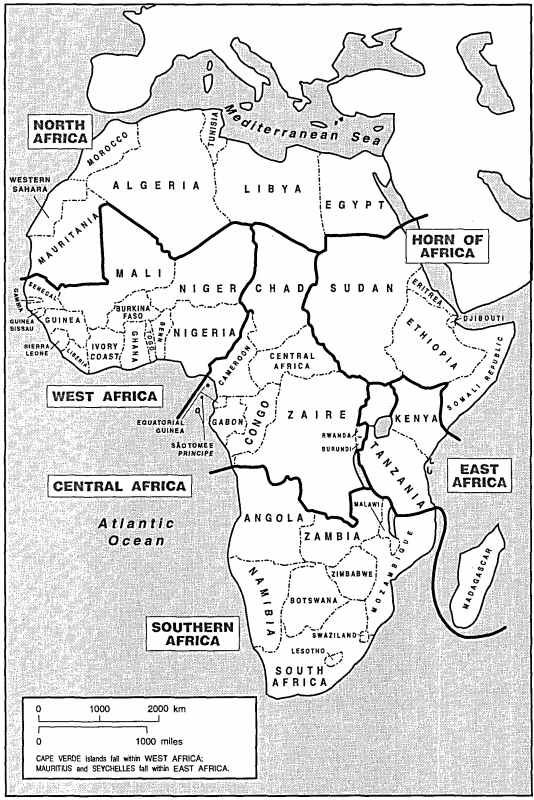
On 2 June 1995, the Organisation of African Unity (OAU) - which includes, in addition to the states listed in this section of The Military Balance, Sao Tome and Principe, Swaziland, the Comoros, and the North African states of Algeria, Egypt, Libya, Mauritania and Tunisia, but not Morocco - adopted a draft Nuclear-Weapons-Free Zone treaty. Drafting of the treaty began in 1993 after the end of apartheid in South Africa. It is being submitted to the UN General Assembly and, once approved, will be opened for signature. The draft includes a protocol (considered stronger than the similar commitment in the Nuclear Non-Proliferation Treaty (NPT)) under which nuclear-armed states would pledge not to use nuclear weapons against African states. The status of Diego Garcia, where US nuclear weapons are suspected of being stored, is a potential problem.
Only two African countries, Djibouti and the Comoros, have not signed the NPT. Angola, Botswana, Mozambique, Sao Tome and Principe, Somalia and Sudan are non-signatories of the Chemical Weapons Convention (CWC), but only Lesotho, Mauritius and the Seychelles have ratified it.
In general, there have been very few changes in either the order of battle or the manpower strengths or weapons holdings of African states in the last 12 months. However, the instances listed are significant when the overall armed strength of the country concerned is taken into account.
Political and Strategic Developments
Horn of Africa
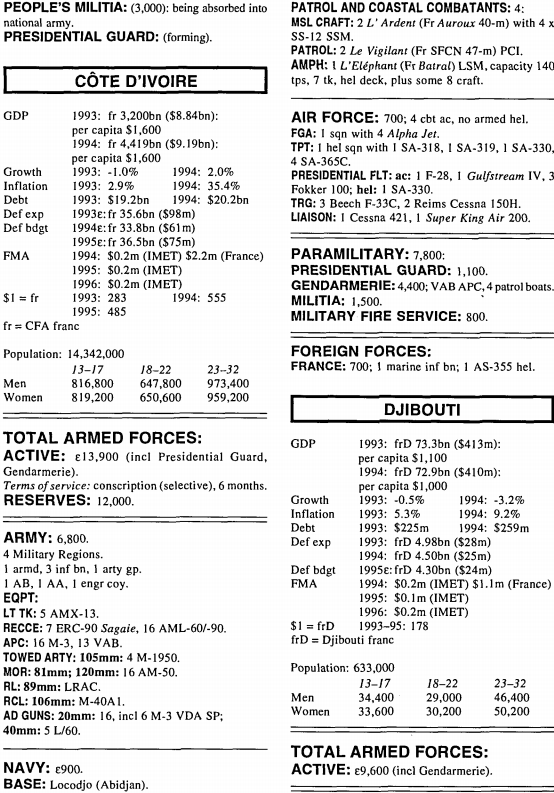
In Djibouti the government and the Front for the Restoration of Unity and Democracy (FRUD) signed an agreement on 26 December 1994 which provided for an immediate cease-fire, a revision of the Constitution and the integration of FRUD militia into the national army. In December 1994, the Ethiopian Constituent Assembly adopted a new Constitution establishing a federal government and dividing the country into nine states with considerable autonomy and the right to secede. The United Nations peacekeeping force (UNOSOM) completed its withdrawal from Somalia on 1 March 1995, its mission unaccomplished. Also in March, two Mogadishu-based leaders, Mohammed Farah Aideed and AH Mahdi Mohammed, reached agreement over joint control of the port and airport (although Aideed had effective control) and an attempt was made to form a Benadir regional authority. In the north, Somaliland still maintains its independence, although it has been the scene of some inter-factional fighting and has not yet received international recognition. The civil war in Sudan has been interrupted by a two-month cease-fire agreed to after a peace initiative by former US President Jimmy Carter. The cease-fire was declared by the government on 27 March 1995 and accepted by the Sudanese People's Liberation Army (SPLA) on 30 March and by the Southern Sudan Independence Movement on 3 April. A two-month extension was accepted by the SPLA on 4 June 1995 after it complained of government violations. Khartoum's links with Iran appeared to be confirmed by an agreement signed on 13 April 1995 which is believed to have included provisions for Iran to use naval facilities at Port Sudan, an increase in other areas of military cooperation such as intelligence and training, and the supply of arms by Iran.
Central Africa
A Forum for the Promotion of Peace in Central Africa met in December 1994 in Brazzaville, organised jointly by the United Nations Educational, Scientific and Cultural Organisation (UNESCO) and the Congo. An action plan was reportedly adopted for humanitarian intervention and to establish a cooperative and security mechanism. A committee to take charge of the reorganisation of security forces in Congo has been established.
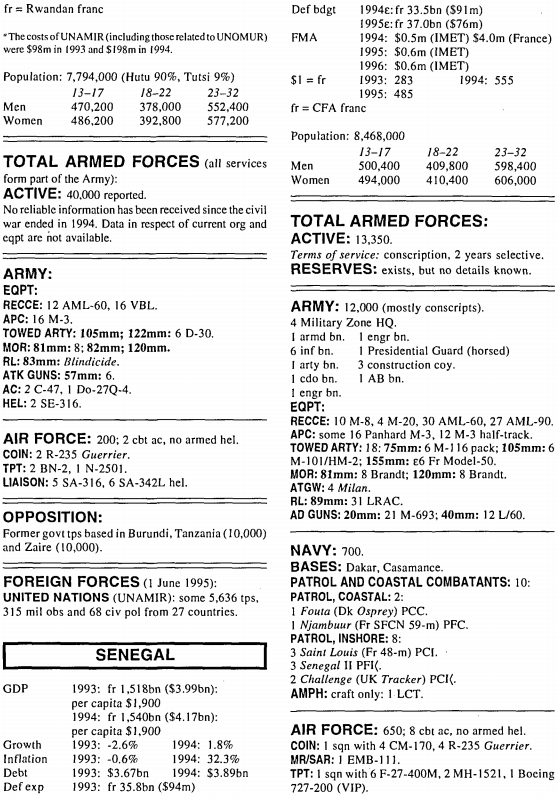
In Chad, the government reached agreement with the Chadian National Front (FNT) on 12 October 1994 for a cease-fire and the integration of FNT members into the national army. InRwanda, the French Operation Turquoise force completed its withdrawal on 30 September 1994, but it was some time later before the UN force (UNAMIR) completed its deployment. UNAMIR now numbers just over 6,000, provided by 27 countries, including 3,662 troops and police from 12 African states. This is the largest UN force after those in Bosnia, Croatia and Haiti. The UN has voted to cut the size of UNAMIR by about two-thirds by November 1995.
West Africa
In December 1994, the warring parties in Liberia agreed to a cease-fire starting at midnight on 28 December. There have, however, been numerous major violations of the cease-fire. The UN Secretary-General has warned that the UN peacekeeping mission (UNOMJJL) may be withdrawn if no agreement can be reached over the proposed joint council of state. Tanzania has withdrawn its troops from the West African peacekeeping force (ECOMOG) and Uganda has also decided to withdraw. In Niger, the government and Tuareg rebel Organisation of the Armed Resistance (ORA) have signed an agreement providing for a cease-fire, a general amnesty, disarmament and weapons collection, and the integration of ORA members into government service. In Mali despite earlier peace talks, the government attacked a Tuareg base in November 1994 and the rebels responded with an attack on Timbuktu in January 1995. However, in June 1995 the Tuareg rebel group, the Arab Islamic Front (FIAA), unilaterally declared an end to hostilities and peace talks are expected shortly. The rebel Revolutionary United Front (RUF) in Sierra Leone released the last of a number of European hostages on 20 April 1995. The government is unclear whether to negotiate with the rebels, or to intensify the war effort in which it is supported by troops from Guinea and Nigeria and, reportedly, a mercenary group of Gurkhas. In Nigeria, General Sani Abacha, who took control of the country in November 1993, has continued to lead an increasingly repressive regime. Mashood K. O. Abiola, the winner of the presidential election in June 1993, remains in prison following his arrest in June 1994 and there seems to be little prospect of either his release or his trial. In February 1994, the Abacha regime, suspecting that the Army was planning a coup, made many arrests. Those arrested included General Olusegun Obasananjo, a former president, and his deputy, retired Major General Shehu Yar Adua. It is rumoured that Obasananjo has been secretly tried and given a long prison sentence. Abacha has said that he will announce his programme to return the country to an elected civilian government on 1 October 1995.
Southern Africa
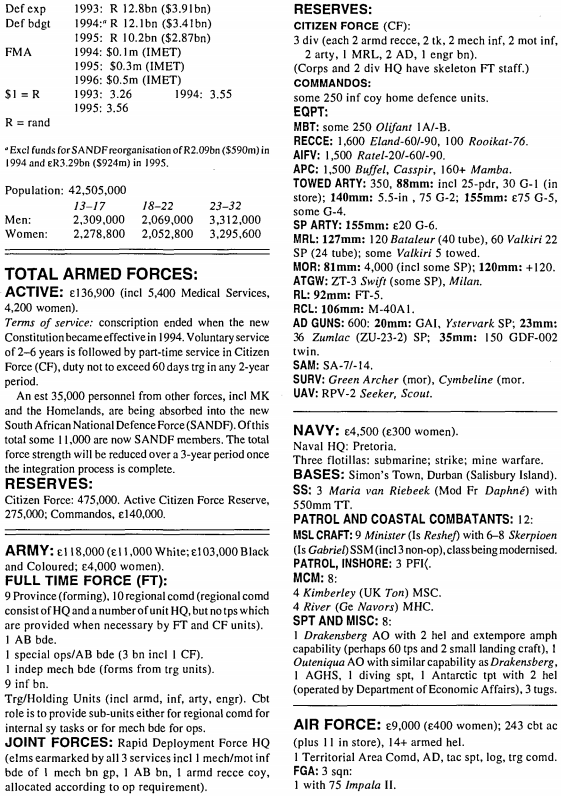
A peace agreement was signed in November 1994 by Angolan President Jose dos Santos and rebel UNITA leader Jonas Savimbi. After assurances from the Angolan Foreign Minister that 'this time peace has come to stay' in February 1995, the UN Security Council adopted Resolution 976 providing for a 7,000-strong force and observers to assist in the disengagement of forces, set up a verification regime and a communications network, and start mine clearance. By the end of May, some 2,000 troops had deployed, including logistic and communications units as well as one infantry battalion. Nearly 350 military observers have been deployed to 50 sites in all six regions of Angola. The United Nations peacekeeping force (ONUMOZ) withdrew from Mozambique in January 1995. It had been planned to incorporate some 30,000 men from both the national army and Renamo into the new Mozambique Democratic Armed Forces (FADM), but by February only 12,000 had agreed to join and President Joaquim Alberto Chissano announced that conscription would be necessary. In South Africa, the armed forces have concentrated on integrating men from Umkhontowe Sizwe (MK) (the military wing of the African National Congress), the Azanian People's Liberation Army, the Zulu Inkatha movement and the armed forces of the Homelands into the South African National Defence Force (SANDF), leaving its reorganisation, including the numerous reserves, until integration is complete. Some 35,000 men have registered for service and, by May 1995, 15,000 of these applications had been processed with 11,000 accepted.
Military Developments
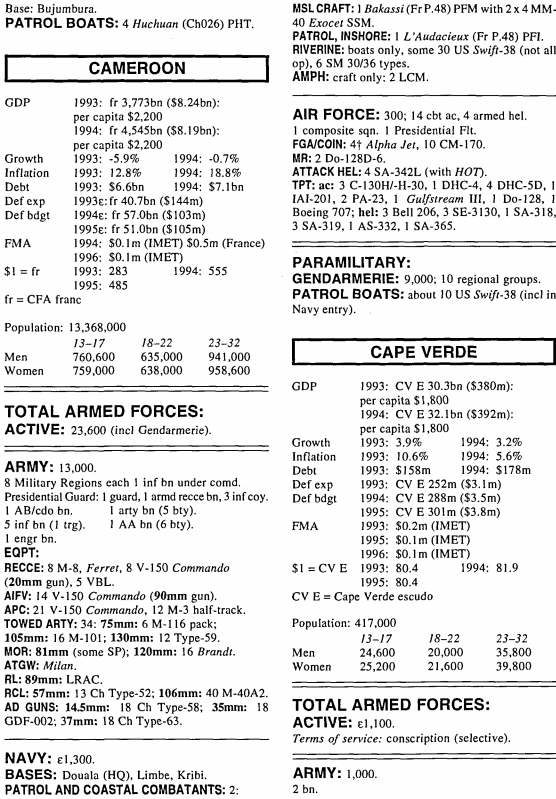
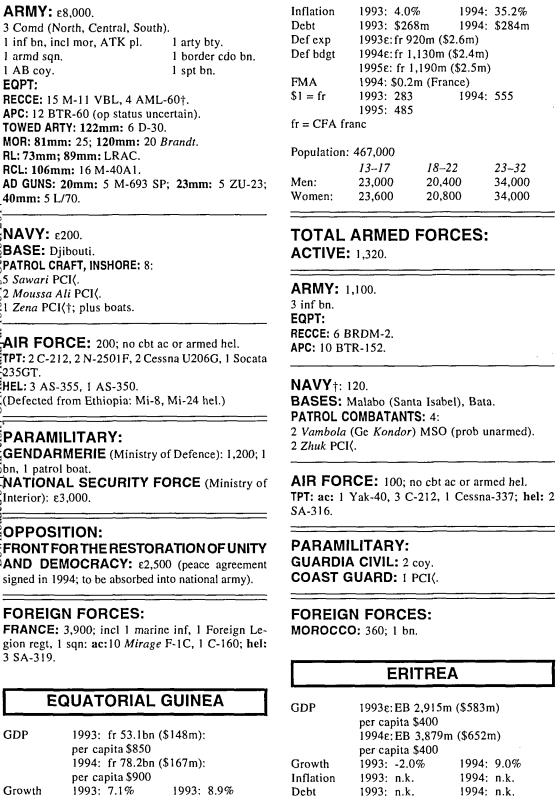
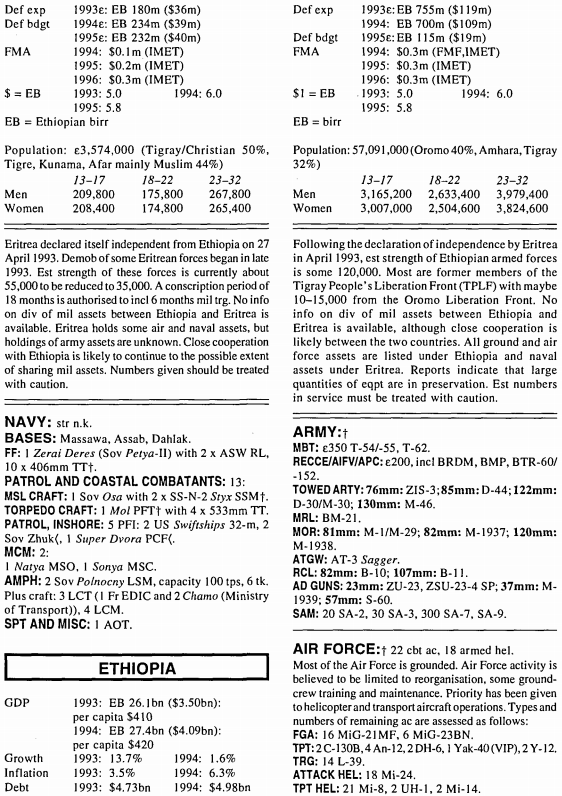
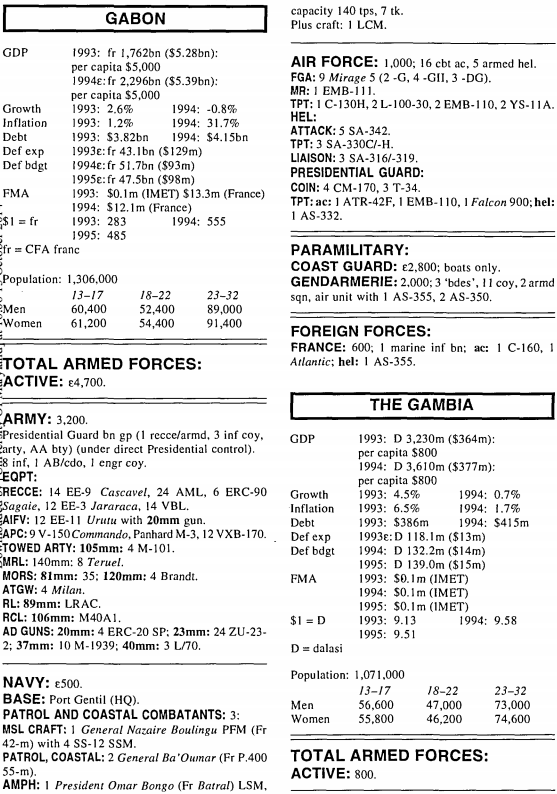
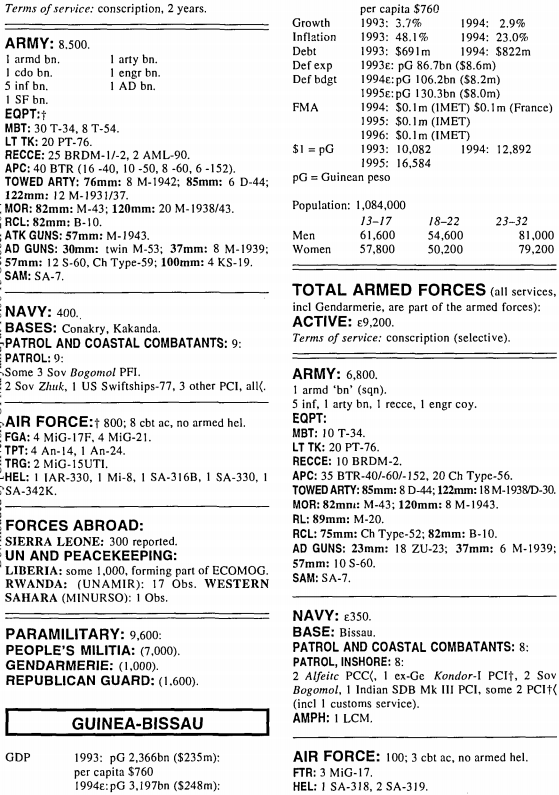
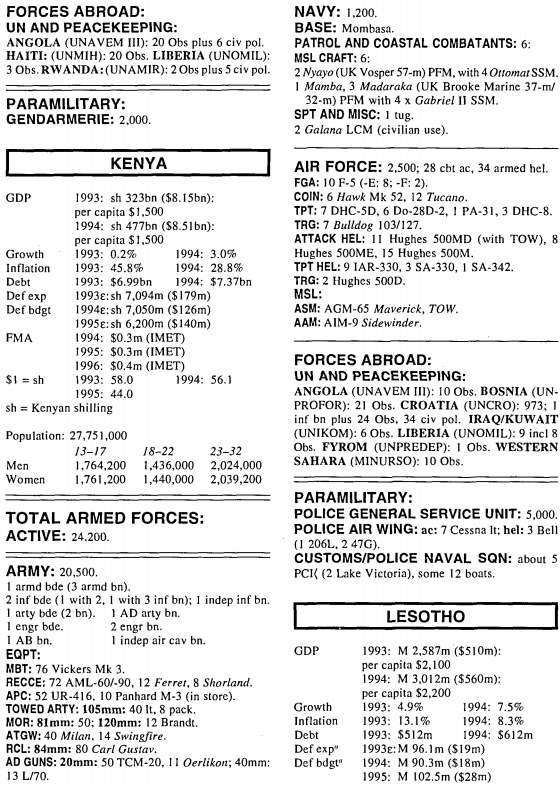
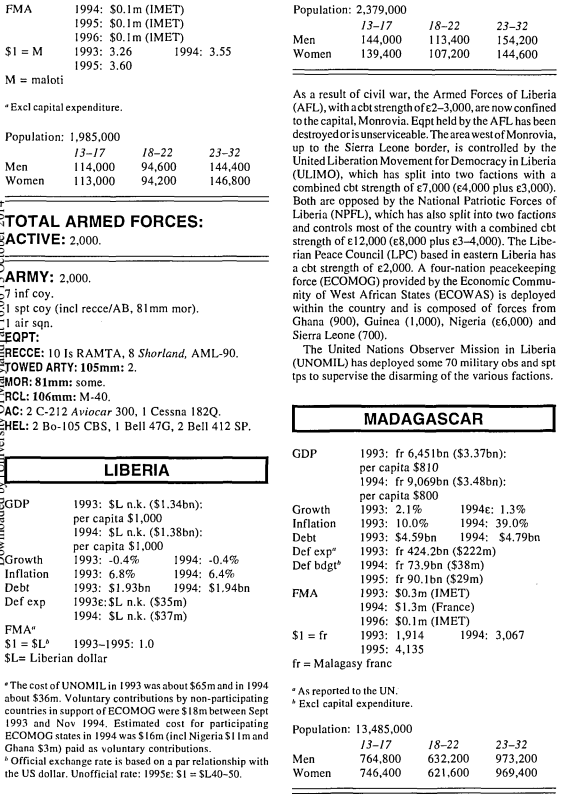
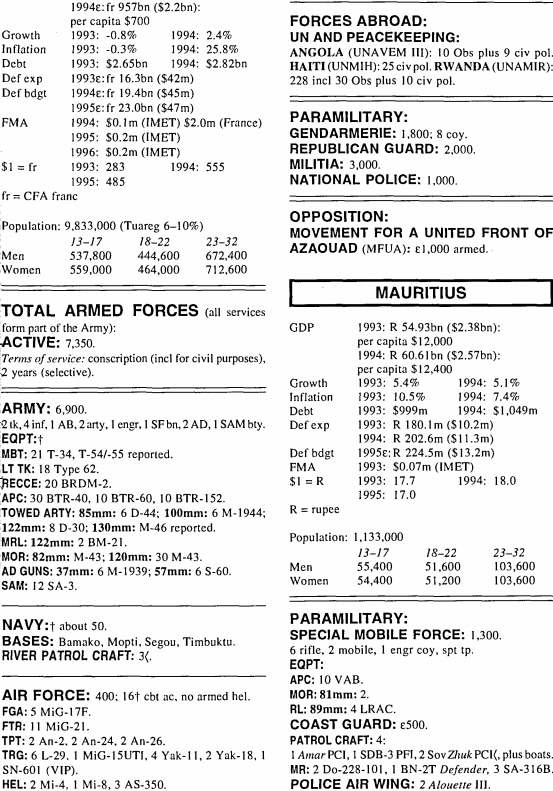
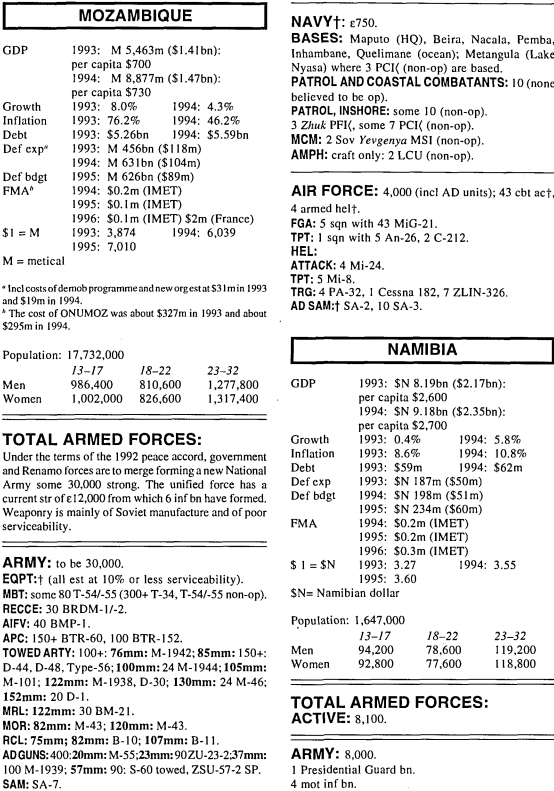
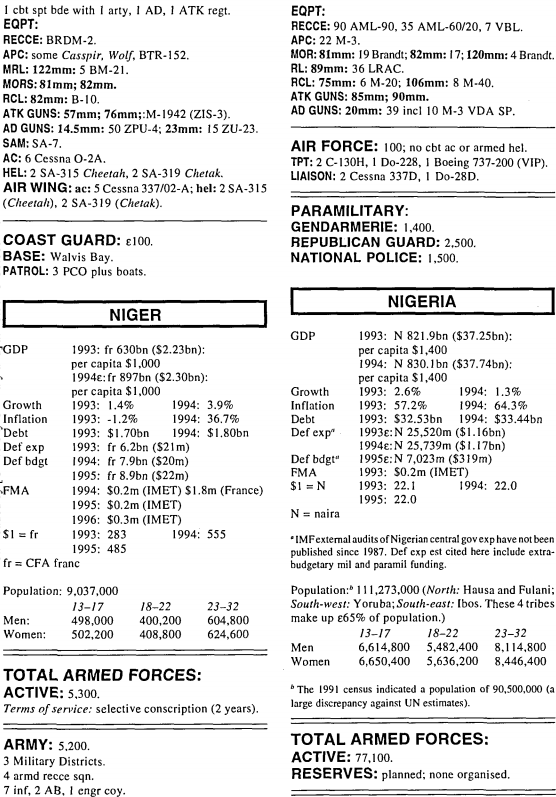
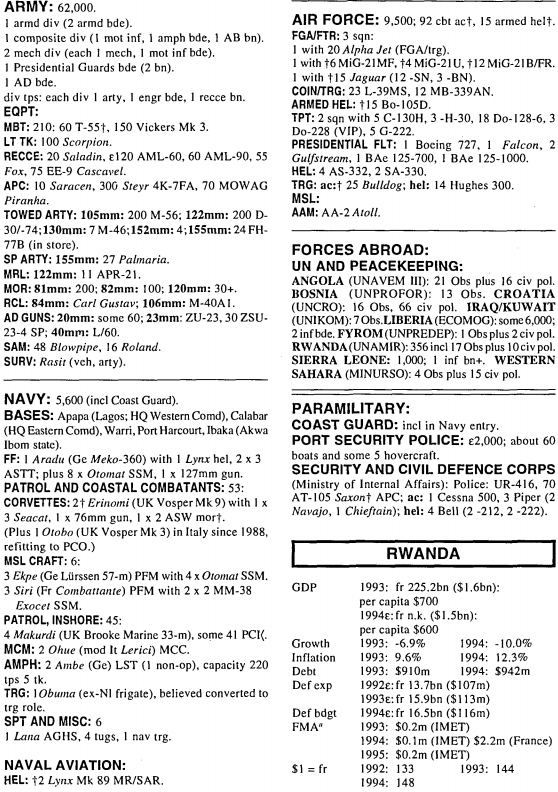
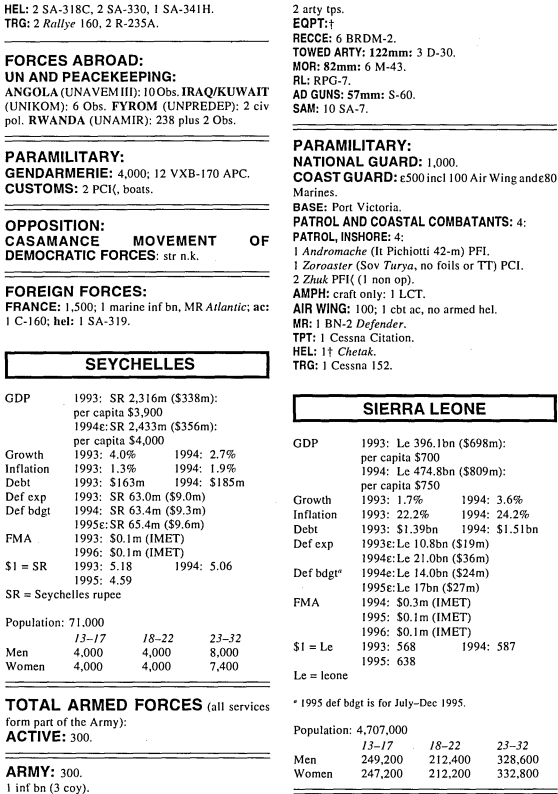
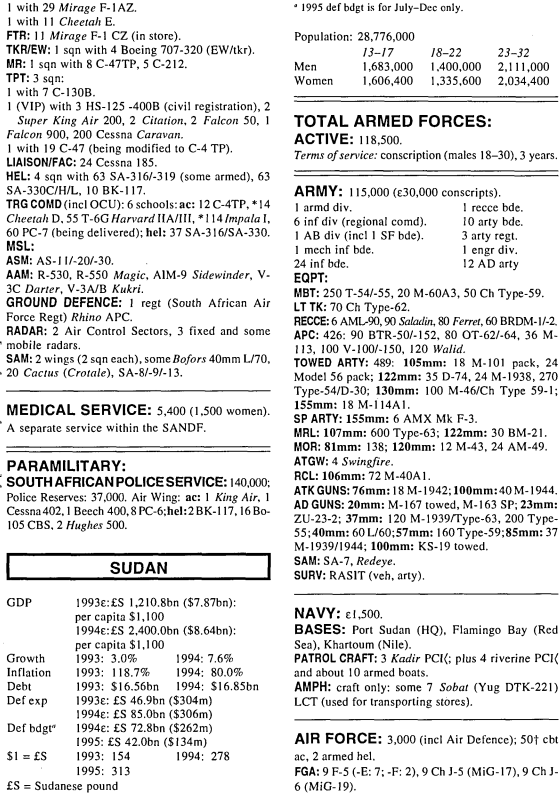
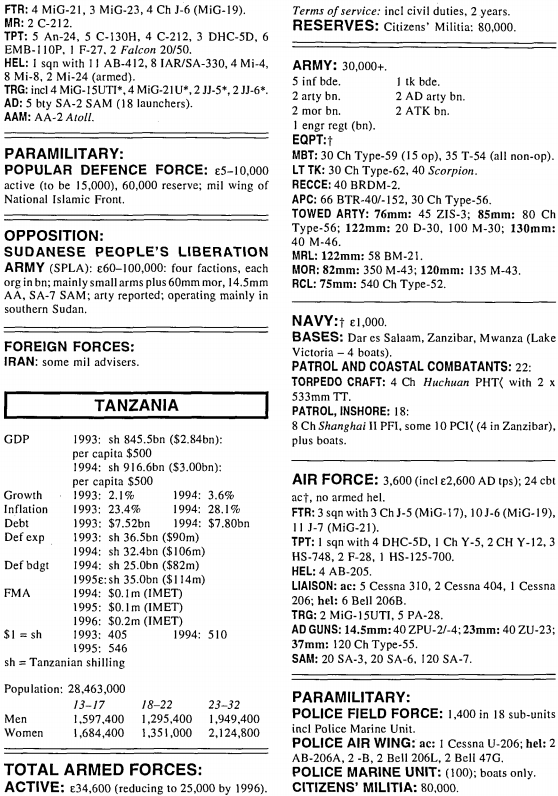
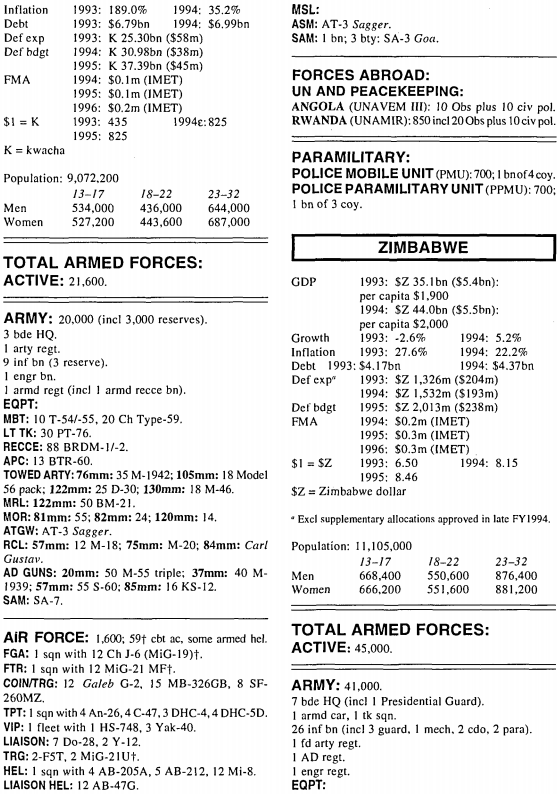
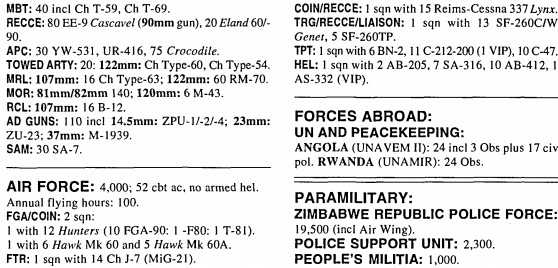
The number of MiG-23 aircraft in the Ethiopian Air Force is six (not 18 as listed in The MilitaryBalance 1994-1995). The Kenyan Army has acquired 20 more AML-60/-90 armoured reconnaissance vehicles. The Mauritius Navy will be taking delivery of a Chilean-built 1,650 ton offshore patrol vessel probably in March 1996. The Tanzanian armed forces have been reduced by 15,000 to some 35,000 in the last 12 months and are planned to reduce further to 25,000 in 1996. The three divisional headquarters and three infantry brigades have been disbanded. EquatorialGuinea has taken delivery of two SA-316 helicopters.
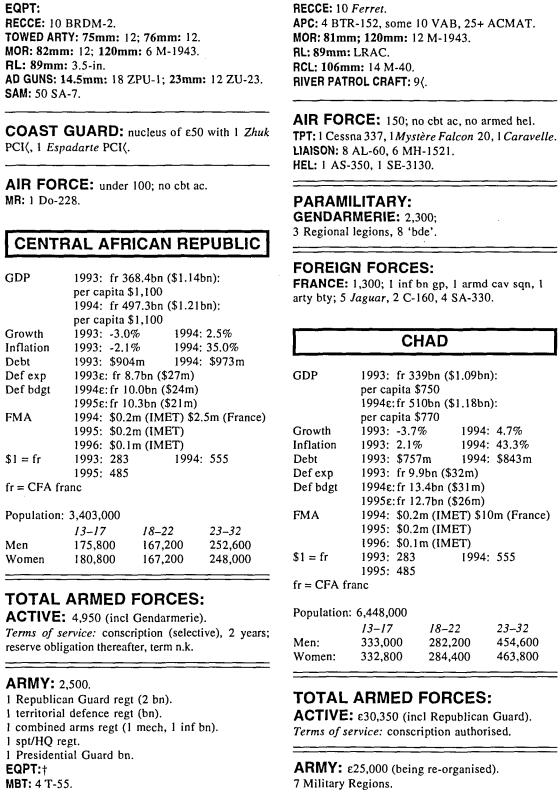
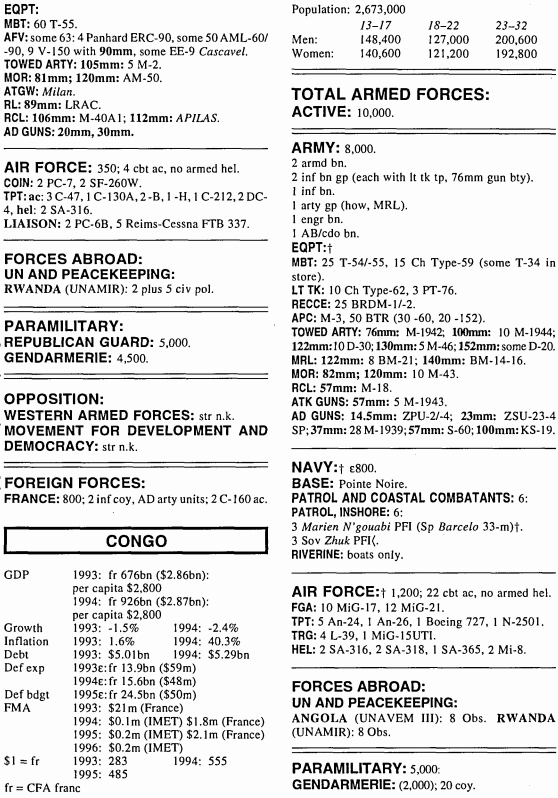
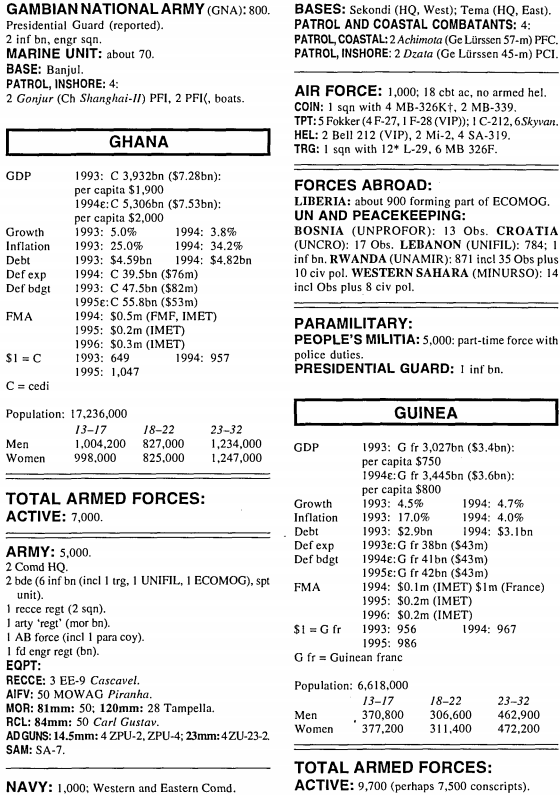
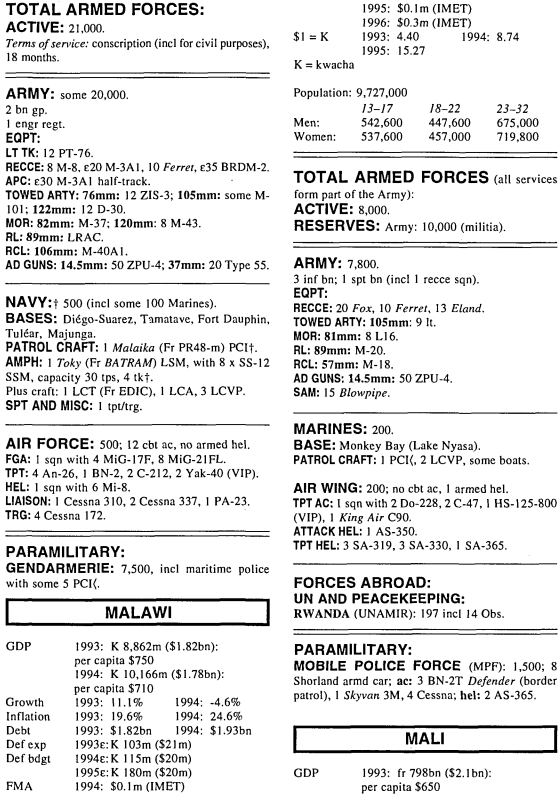
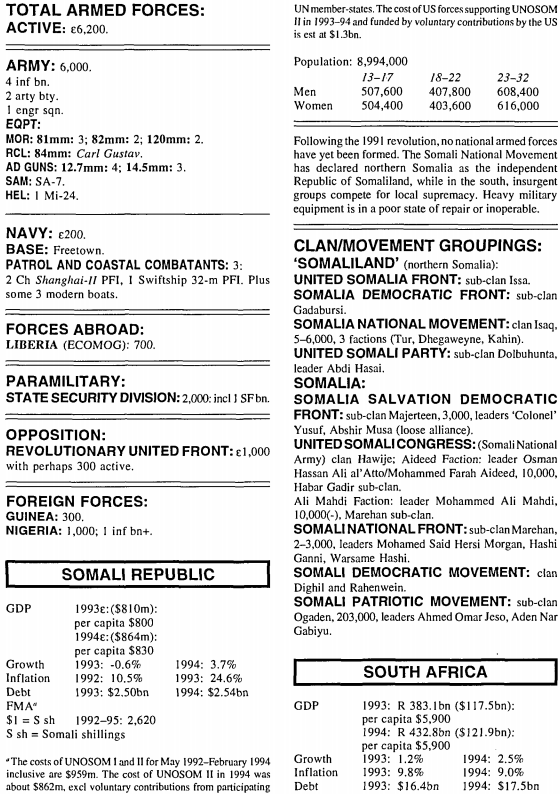
The Congolese Air Force has acquired two Mi-8 helicopters. The Air Force inventory for Guinea has been reassessed. The Guinea-Bissau Navy has commissioned one inshore patrol craft acquired from India. In Mali, the Air Force has acquired three AS-350 helicopters. A Presidential Guard Brigade has been formed in Nigeria. The Army has 32 more Vickers Mark 3 tanks and six more 122mm APR-21 MRL. Sierra Leone has increased the manpower of its army by 7,000, virtually doubling its size; three new infantry battalions have been formed. The Army now has one Mi-24 attack helicopter. 36 Scorpion armoured vehicles including variants are being delivered to the Botswana Army and the Air Force has acquired two BN-2 Defender COIN aircraft. The Malawi Army has 2,000 fewer men than it had last year. Namibia has formed an Air Wing which is equipped with five Cessna 337/02-A aircraft, two SA-315 and two SA-31 9 helicopters. There are now no conscripts in the South African National Defence Force which is 131,000 strong and which will continue to grow before it is reduced to around 91,000 in about three years' time. A decision to purchase four corvettes to give the Navy some reach has been postponed. Two more battalions, one of commandos, have been formed in Zimbabwe. The Army now has a total of 60 122mm RM-70 MRL, and has acquired 20 Eland 60 armoured reconnaissance vehicles.
Defence Spending
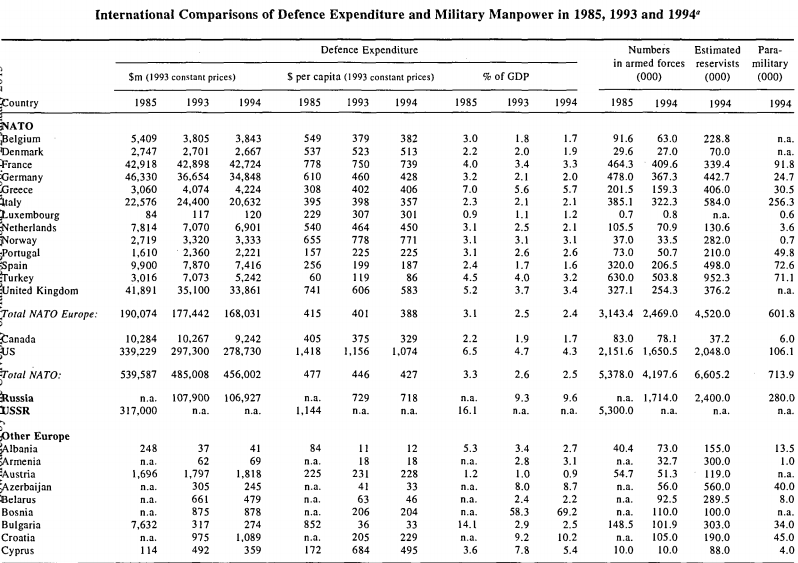
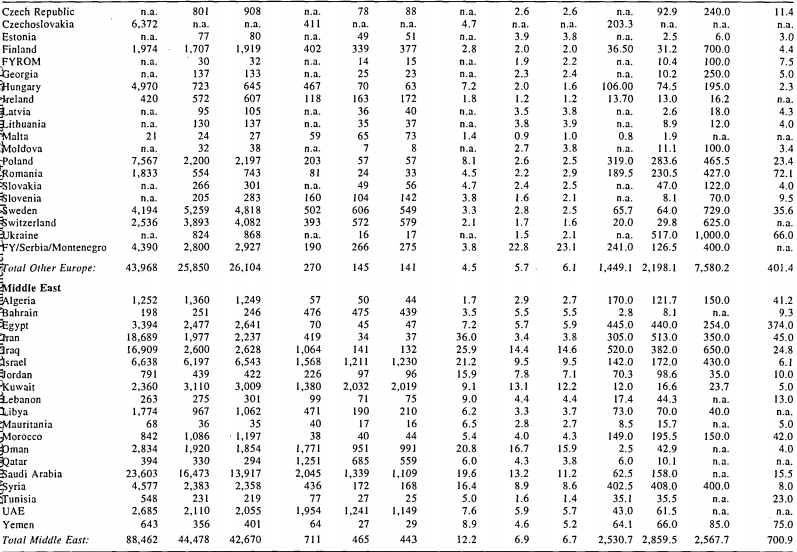
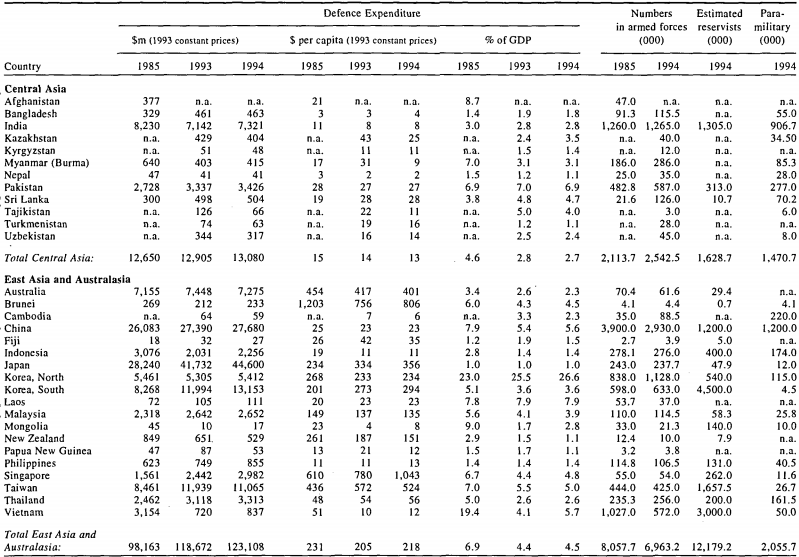
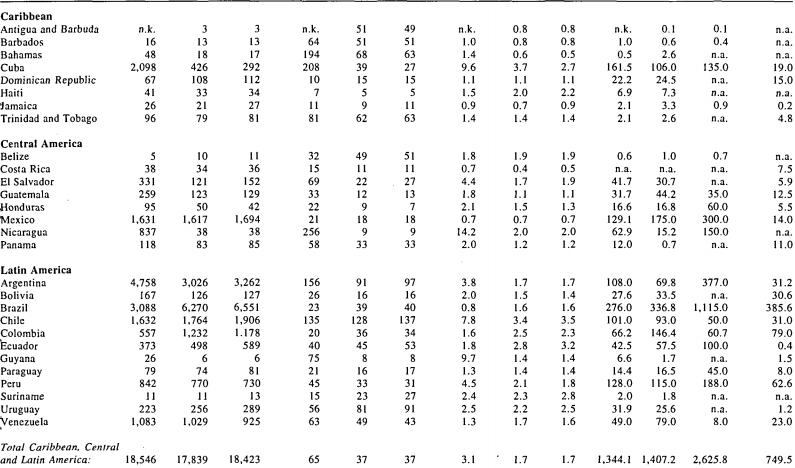
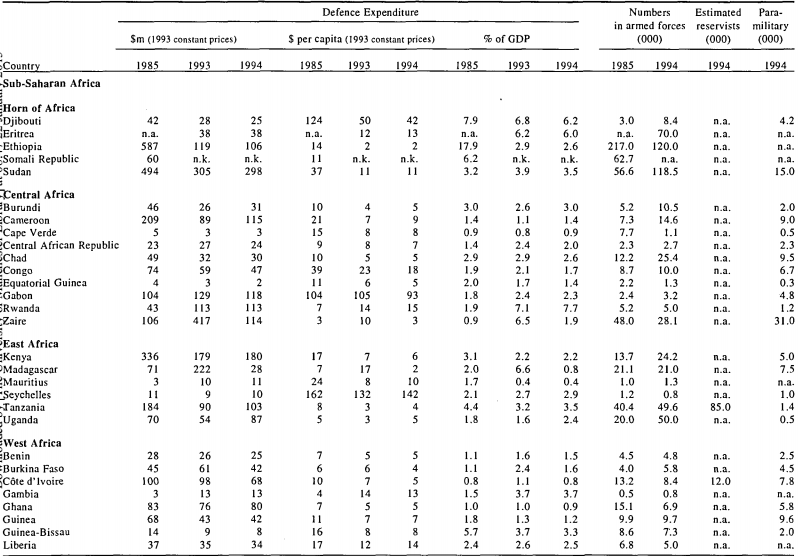
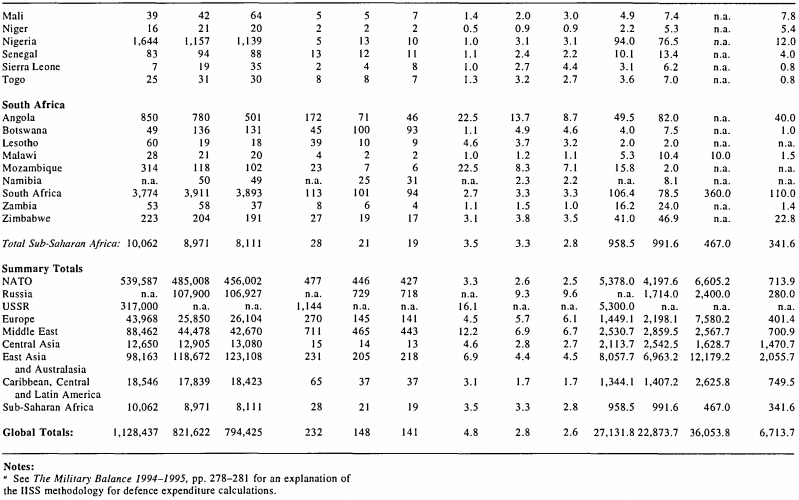
The IISS estimates that regional military expenditure declined in real terms from some $8.6 bn, 3 % of gross domestic product (GDP), in 1993 to about $8 bn, or 2.6% of GDP, in 1994 (all at 1993 prices). The 1994 level is about one-fifth down by comparison with 1985 ($10 bn and 3.6% of GDP). Unlike in the Asia-Pacific region and Latin America, there has been little real GDP growth over the same period (just 2.5% in 1986-94, according to the International Monetary Fund (IMF)) to stimulate investment in defence and security, and GDP per capita has actually declined by 0.5%. Three factors have determined the scale of military spending and its relative decline in recent years. First, the large cost of civil war arising from high levels of military consumption with concomitant economic and humanitarian costs. But spending has declined in recent years because the incidence of civil war is less prevalent than before, although it remains a significant cost for several countries. Second, while national-security costs in the region have declined, the UN and its member-states have taken on a large financial burden as a result of regional peacekeeping. In Mozambique, the cost of ONUMOZ in 1994 - its final year- amounted to about $295m. Other costs for UN peacekeeping in 1994 were about $ 198m for UN AMIR (inclusive of costs related to UNOMUR), some $862m for UNOSOMII, about $36m for UNOMIL (excluding estimated ECOMOG costs of $15m which, for a 5,000-strong military force, compares favourably with the UN's $36m for 70 Observers), and about $26m for UNAVEMII. UNAVEM III seems likely to be another costly UN effort in the region. All told, the cost in 1994 of UN peacekeeping operations and ECOMOG (about $1.4bn) added up to nearly one-fifth of regional military expenditure. The latter has thus declined because there are fewer civil wars and because the UN is increasing its financial contribution to regional security. A third reason concerns those countries that have managed to disengage from civil war. The legacy of repressive regimes has often meant unproductive and largely unaccountable military expenditure.
The impact of changing policy priorities - particularly in respect of economic development has led several countries to seek to reduce unproductive military spending - a frequent target for the IMF's Structural Adjustment Programmes. These aim to reduce central government intervention in the economy through a policy of liberalisation intended to promote the private sector, improve economic competitiveness, particularly in the field of foreign trade, and thus create a more robust regime in the balance of payments through which to reduce the burden of external debt. Some countries, notably Kenya and Ghana, have adjusted strongly and are better placed to increase investment in national security. Others are adjusting more slowly, including several of the Francophone countries where government spending remains under tight constraints following the 1994 devaluation of the Communaute francaise Africaine (CFA) franc.
From an accounting perspective, the lack of transparency in regional military expenditure remains a problem. Few countries (in 1993 only Madagascar and Burkina Faso) report military expenditure to the UN and only a slightly larger number (among them Ghana, Kenya and Mauritius) allow the IMF to publish reasonably timely external audits. No recipient countries reported to the UN Conventional Arms Register in 1993, although counterpart supplier data showed that Angola, Nigeria and Malawi had taken delivery of weapons systems in the qualifying categories. About half the states in the region publish a defence budget for the coming or current financial year, but in some cases provide information on recurrent expenditure only (manpower and operations) and give no details of investment (equipment and construction). If the lack of transparency is one reason to treat official figures on military spending with caution, another is that military expenditure by opposition groups is not subject to systematic reporting for those countries engaged in - or liable to engage in - civil war. In some cases - for example, Angola and Somalia - the sums involved are likely to be considerable.
As a result of the incidence of civil war and weak government controls, systematic data on the market for small arms, ammunition and explosives - the staple materiel of regional civil war are virtually non-existent. As there are only a small number of transactions in advanced weaponry and technology, these are generally conspicuous. The real problem lies in identifying the vast traffic in light weaponry and associated equipment. According to the US Arms Control and Disarmament Agency (ACD A), arms sales to the region have declined sharply since 1987. In that peak year recorded transfers amounted to some $6.1 bn (at constant 1993 prices), reducing to $1.7 bn in 1990. In contrast, recorded transfers (excluding South Africa) to the region were valued at $605m in 1991 and $240m in 1993. It must be emphasised that these figures are unlikely to capture much, if any, of the covert arms trade to the recent regional flashpoints, such as Angola, Somalia, Burundi, Rwanda, Sierra Leone, Liberia and Sudan.
South Africa accounts for nearly half of military spending in Sub-Saharan Africa. The new government has made more information available than its predecessor. In 1994 the defence budget amounted to R12.1bn ($3.1bn) and was supplemented by R1.5bn ($419m) for the amalgamation of the 'homeland' defence forces, R223m ($63m) for the integration of African National Congress (ANC) personnel, and R385m ($108m) for the operations of the National Peacekeeping Force - giving a total defence budget of R14.2 bn ($4bn). Out-turn was some R700m ($197m) less because of a government spending freeze. Equipment spending for 1994 amounted to R2.2bn ($619m) - 20% of the unsupplemented budget - and R&D R329bn ($93m or 3%). The relatively low cost of indigenous procurement of advanced weaponry is illustrated by figures released for the Cheetah-C multi-role fighter modernisation programme, which is priced at R6.5bn ($ 1. 8bn) for 38 aircraft, and the Rooivalk attack helicopter programme - R1.2bn ($338m) for development. The attempt to sell the latter to the UK proved unsuccessful. Imported defence equipment was valued at R833m ($235m) and exports at R519m ($ 146m). The defence budget for 1995 is R9.8bn ($2.7bn) and the military are requesting release of a further R700m held over from 1994 to bring the defence allocation up to R10.5bn ($3m).
Африка к Югу От Сахары
2 июня 1995 года Организация африканского единства (ОАЕ), в которую, помимо перечисленных в этом разделе военного баланса государств, входят Сан - Томе и Принсипи, Свазиленд, Коморские острова и североафриканские государства Алжир, Египет, Ливия, Мавритания и Тунис, но не Марокко, приняла проект договора о зоне, свободной от ядерного оружия. Разработка договора началась в 1993 году после окончания апартеида в Южной Африке. Он представляется Генеральной Ассамблее ООН и после его утверждения будет открыт для подписания. Проект включает протокол (который считается более сильным, чем аналогичное обязательство в Договоре о нераспространении ядерного оружия (ДНЯО)), в соответствии с которым ядерные государства обязуются не применять ядерное оружие против африканских государств. Статус Диего-Гарсии, где, как подозревают, хранится ядерное оружие США, является потенциальной проблемой.
Только две африканские страны-Джибути и Коморские острова - не подписали ДНЯО. Ангола, Ботсвана, Мозамбик, Сан-Томе и Принсипи, Сомали и Судан не подписали Конвенцию по химическому оружию (КХО), но только Лесото, Маврикий и Сейшельские острова ратифицировали ее.
В целом, за последние 12 месяцев произошло очень мало изменений как в боевом порядке, так и в численности личного состава или запасах вооружений африканских государств. Однако перечисленные примеры являются существенными, если принять во внимание общую вооруженную мощь соответствующей страны.
Политические и стратегические события
Африканский рог
В Джибути правительство и Фронт За восстановление единства и демократии (FRUD) подписали 26 декабря 1994 года соглашение, которое предусматривало немедленное прекращение огня, пересмотр Конституции и интеграцию ополченцев FRUD в национальную армию. В декабре 1994 года Учредительное собрание Эфиопии приняло новую Конституцию, устанавливающую федеральное правительство и разделяющую страну на девять штатов со значительной автономией и правом на отделение. Миротворческие силы Организации Объединенных Наций (ЮНОСОМ) завершили свой вывод из Сомали 1 марта 1995 года, и их миссия не была завершена. Кроме того, в марте два лидера из Могадишо, Мохаммед Фарах Айдид и ах Махди Мохаммед, достигли соглашения о совместном контроле над портом и аэропортом (хотя Айдид имел эффективный контроль), и была предпринята попытка сформировать региональный орган власти Бенадира. На севере страны Сомалиленд по-прежнему сохраняет свою независимость, хотя он был ареной некоторых межфракционных столкновений и до сих пор не получил международного признания. Гражданская война в Судане была прервана двухмесячным перемирием, согласованным после мирной инициативы бывшего президента США Джимми Картера. Прекращение огня было объявлено правительством 27 марта 1995 года и принято Народно-освободительной армией Судана (Ноас) 30 марта и Движением за независимость Южного Судана 3 апреля. 4 июня 1995 года Ноас согласилась на продление на два месяца после того, как она подала жалобу на нарушения со стороны правительства. Связи Хартума с Ираном, как представляется, были подтверждены соглашением, подписанным 13 апреля 1995 года, которое, как полагают, включало положения об использовании Ираном военно-морских объектов в Порт-Судане, расширении других областей военного сотрудничества, таких как разведка и подготовка кадров, и поставках оружия Ираном.
Центральная Африка
В декабре 1994 года в Браззавиле состоялся форум по содействию миру в Центральной Африке, организованный совместно Организацией Объединенных Наций по вопросам образования, науки и культуры (ЮНЕСКО) и Конго. Согласно сообщениям, был принят план действий по гуманитарному вмешательству и созданию механизма сотрудничества и безопасности. Был создан Комитет по реорганизации сил безопасности в Конго.
В Чаде правительство 12 октября 1994 года достигло соглашения с Чадским Национальным фронтом (НФН) о прекращении огня и интеграции членов НФН в национальную армию. В Руанде французская операция Turquoise завершила свой вывод 30 сентября 1994 года, но прошло некоторое время, прежде чем силы ООН (UNAMIR) завершили свое развертывание. В настоящее время МООНПР насчитывает чуть более 6000 военнослужащих, предоставленных 27 странами, включая 3662 военнослужащих и полицейских из 12 африканских государств. Это крупнейшие силы ООН после тех, что действуют в Боснии, Хорватии и Гаити. ООН проголосовала за сокращение численности МООНПР примерно на две трети к ноябрю 1995 года.
Западная Африка
В декабре 1994 года воюющие стороны в Либерии договорились о прекращении огня с полуночи 28 декабря. Однако имели место многочисленные серьезные нарушения режима прекращения огня. Генеральный секретарь ООН предупредил, что миротворческая миссия ООН может быть отозвана, если не удастся достичь согласия по предложенному совместному Государственному Совету. Танзания вывела свои войска из состава западноафриканских миротворческих сил (ЭКОМОГ), и Уганда также приняла решение об их выводе. В Нигере правительство и повстанческая организация вооруженного сопротивления туарегов (ORA) подписали соглашение, предусматривающее прекращение огня, всеобщую амнистию, разоружение и сбор оружия, а также интеграцию членов ORA на государственную службу. В Мали, несмотря на предыдущие мирные переговоры, правительство в ноябре 1994 года напало на базу туарегов, а повстанцы ответили нападением на Тимбукту в январе 1995 года. Однако в июне 1995 года повстанческая группировка туарегов - арабский Исламский фронт (ФИА) - в одностороннем порядке объявила о прекращении боевых действий, и вскоре ожидается начало мирных переговоров. Повстанческий Объединенный революционный фронт (ОРФ) в Сьерра-Леоне освободил последнего из ряда европейских заложников 20 апреля 1995 года. Правительству неясно, вести ли переговоры с повстанцами или активизировать военные действия, в которых его поддерживают войска из Гвинеи и Нигерии и, как сообщается, наемная группа гуркхов. В Нигерии генерал Сани Абача, взявший под свой контроль страну в ноябре 1993 года, продолжает руководить все более репрессивным режимом. Машуд К. О. Абиола, победивший на президентских выборах в июне 1993 года, остается в тюрьме после своего ареста в июне 1994 года, и, по-видимому, мало шансов на его освобождение или суд. В феврале 1994 года режим Абачи, подозревая, что армия планирует государственный переворот, произвел много арестов. Среди арестованных были генерал Олусегун Обасананджо, бывший президент, и его заместитель, отставной генерал-майор Шеху Яр Адуа. Ходят слухи, что Обасананджо тайно судили и приговорили к длительному тюремному заключению. Абача заявил, что он объявит о своей программе возвращения страны к избранному гражданскому правительству 1 октября 1995 года.
Юг Африки
Мирное соглашение было подписано в ноябре 1994 года президентом Анголы Жозе душ Сантушем и лидером повстанцев УНИТА Жонасом Савимби. После заверений министра иностранных дел Анголы в том, что "на этот раз мир будет сохранен", в феврале 1995 года Совет Безопасности ООН принял резолюцию 976, предусматривающую присутствие 7000 военнослужащих и наблюдателей для оказания помощи в разъединении сил, создании режима проверки и сети связи и начале разминирования. К концу мая было развернуто около 2000 военнослужащих, включая подразделения материально-технического обеспечения и связи, а также один пехотный батальон. Почти 350 военных наблюдателей были развернуты на 50 объектах во всех шести регионах Анголы. Миротворческие силы Организации Объединенных Наций (ЮНОМОЗ) вышла из Мозамбика в январе 1995 года. Планировалось включить около 30 000 человек как из Национальной армии, так и из РЕНАМО в состав новых демократических Вооруженных Сил Мозамбика (ФАДМ), но к февралю только 12 000 человек согласились присоединиться к ним, и президент Жоаким Альберто Чиссано объявил о необходимости призыва на военную службу. В Южной Африке вооруженные силы сосредоточились на интеграции мужчин из Умхонтове Сизве (МК) (военного крыла Африканского национального конгресса), Азанской Народно-освободительной армии, движения Зулу Инката и вооруженных сил родных земель в южноафриканские национальные силы обороны (САНДФ), оставив их реорганизацию, включая многочисленные резервы, до завершения интеграции. Около 35 000 мужчин зарегистрировались для прохождения службы, и к маю 1995 года 15 000 из них были обработаны, а 11 000-приняты.
Военные события
Количество самолетов МиГ-23 в ВВС Эфиопии составляет шесть (а не 18, как указано в военном балансе за 1994-1995 годы). Кенийская армия приобрела еще 20 бронированных разведывательных машин AML-60/-90. Военно-морские силы Маврикия примут на вооружение построенное в Чили 1650-тонное морское патрульное судно, вероятно, в марте 1996 года. За последние 12 месяцев численность танзанийских вооруженных сил сократилась на 15 000 человек и составила примерно 35 000 человек, а в 1996 году планируется сократить ее еще на 25 000 человек. Три дивизионных штаба и три пехотные бригады были расформированы. Экваториальная Гвинея приняла поставку двух вертолетов SA-316.
Конголезские ВВС приобрели два вертолета Ми-8. Инвентаризация Военно-Воздушных Сил Гвинеи была пересмотрена. Военно-морские силы Гвинеи-Бисау ввели в строй один береговой патрульный корабль, приобретенный у Индии. В Мали ВВС приобрели три вертолета AS-350. В Нигерии сформирована бригада Президентской Гвардии. Армия имеет еще 32 танка Vickers Mark 3 и еще шесть 122-мм APR -21 РСЗО. Сьерра-Леоне увеличила численность своей армии на 7000 человек, практически удвоив ее численность; были сформированы три новых пехотных батальона. В настоящее время в армии имеется один ударный вертолет Ми-24. 36 бронетранспортеров Scorpion, включая варианты, поставляются в армию Ботсваны, а ВВС приобрели два самолета BN-2 Defender COIN. В армии Малави на 2000 человек меньше, чем в прошлом году. Намибия сформировала авиакрыло, которое оснащено пятью самолетами Cessna 337/02-A, двумя SA-315 и двумя SA-31 9 вертолетами. В настоящее время в южноафриканских национальных Силах обороны нет призывников, численность которых составляет 131 000 человек и которые будут продолжать расти до тех пор, пока не сократятся примерно до 91 000 человек примерно через три года. Решение о покупке четырех корветов, чтобы дать флоту некоторую досягаемость, было отложено. Еще два батальона, Один из коммандос, были сформированы в Зимбабве. В настоящее время армия имеет в общей сложности 60 122-мм РМ-70 РСЗО и приобрела 20 бронированных разведывательных машин Eland 60.
Расходы на Оборону
По оценкам МИСИ, региональные военные расходы сократились в реальном выражении с примерно $8,6 млрд., или 3% валового внутреннего продукта (ВВП), в 1993 году до примерно $8 млрд., или 2,6% ВВП, в 1994 году (все в ценах 1993 года). Уровень 1994 года примерно на одну пятую ниже по сравнению с 1985 годом ($10 млрд и 3,6% ВВП). В отличие от Азиатско-Тихоокеанского региона и Латинской Америки, реальный рост ВВП за тот же период был незначительным (всего 2,5% в 1986-1994 годах, по данным Международного валютного фонда (МВФ)), чтобы стимулировать инвестиции в оборону и безопасность, а ВВП на душу населения фактически снизился на 0,5%. Три фактора определили масштабы военных расходов и их относительное сокращение в последние годы. Во-первых, большие издержки гражданской войны, связанные с высоким уровнем военного потребления и сопутствующими экономическими и гуманитарными издержками. Но в последние годы расходы сократились, потому что гражданская война стала менее распространенной, чем раньше, хотя для некоторых стран она по-прежнему представляет собой значительные издержки. Во-вторых, в то время как расходы на национальную безопасность в регионе снизились, ООН и ее государства-члены взяли на себя большое финансовое бремя в результате регионального миротворчества. В Мозамбике, стоимость ЮНОМОЗ в 1994 году - ее окончательный год составил около $295 млн. Прочие расходы ООН по поддержанию мира в 1994 году около $198 млн. для ООН AMIR (включая расходы, связанные с МНООНУР), около $862 млн. для UNOSOMII, около $36 млн. для МНООНЛ (кроме сметных ЭКОМОГ расходы $15 млн, которые, на 5,000-сильной военной силой, с ООН $36 млн. для 70 наблюдателей), и около $26 млн. для UNAVEMII. КМООНА III, кажется, скорее всего, будет другой дорогостоящей усилия ООН в регионе. Таким образом, в 1994 году расходы на миротворческие операции ООН и ЭКОМОГ (около $1,4 млрд.) составили почти пятую часть региональных военных расходов. Последняя, таким образом, сократилась, потому что гражданских войн стало меньше и потому что ООН увеличивает свой финансовый вклад в региональную безопасность. Третья причина касается тех стран, которым удалось выйти из Гражданской войны. Наследие репрессивных режимов часто означало непроизводительные и в значительной степени необъяснимые военные расходы.
Изменение приоритетов политики, особенно в области экономического развития, привело к тому, что некоторые страны стали стремиться к сокращению непроизводительных военных расходов, что является частой целью программ структурной перестройки МВФ. Они направлены на сокращение вмешательства центрального правительства в экономику путем проведения политики либерализации, направленной на развитие частного сектора, повышение экономической конкурентоспособности, особенно в области внешней торговли, и, таким образом, создание более надежного режима в платежном балансе, с помощью которого можно было бы уменьшить бремя внешней задолженности. Некоторые страны, в частности Кения и Гана, значительно адаптировались и имеют больше возможностей для увеличения инвестиций в национальную безопасность. Другие страны приспосабливаются медленнее, в том числе несколько франкоязычных стран, где государственные расходы по-прежнему находятся под жесткими ограничениями после девальвации Франка Франко-африканской Коммуны (КФА) в 1994 году.
С точки зрения бухгалтерского учета отсутствие прозрачности в региональных военных расходах остается проблемой. Лишь немногие страны (в 1993 году только Мадагаскар и Буркина-Фасо) сообщают о военных расходах в ООН, и лишь несколько большее число (среди них Гана, Кения и Маврикий) позволяют МВФ публиковать достаточно своевременные внешние аудиты. В 1993 году ни одна страна-получатель не представила информацию в Регистр обычных вооружений ООН, хотя данные о поставщиках-контрагентах свидетельствуют о том, что Ангола, Нигерия и Малави приняли поставки систем вооружений в соответствующих категориях. Около половины государств региона публикуют оборонный бюджет на предстоящий или текущий финансовый год, но в некоторых случаях предоставляют информацию только о текущих расходах (рабочая сила и операции) и не сообщают подробностей об инвестициях (оборудование и строительство). Если отсутствие прозрачности является одной из причин осторожного отношения к официальным данным о военных расходах, то другая причина заключается в том, что военные расходы оппозиционных групп не подлежат систематической отчетности для тех стран, которые вовлечены - или могут быть вовлечены - в гражданскую войну. В некоторых случаях - например, в Анголе и Сомали - речь идет о значительных суммах.
В результате распространения гражданской войны и слабого государственного контроля систематические данные о рынке стрелкового оружия, боеприпасов и взрывчатых веществ - основных материальных средств региональной гражданской войны - практически отсутствуют. Поскольку существует лишь небольшое число сделок в области передовых вооружений и технологий, они, как правило, бросаются в глаза. Реальная проблема заключается в выявлении огромного потока легких вооружений и связанного с ними оборудования. По данным агентства США по контролю над вооружениями и разоружению (ACDA), продажи оружия в регионе резко сократились с 1987 года. В тот пиковый год зафиксированные трансферты составили около $6,1 млрд (в постоянных ценах 1993 года), сократившись до $1,7 млрд в 1990 году. Напротив, зарегистрированные переводы (за исключением Южной Африки) в регион оценивались в $605 млн в 1991 году и $240 млн в 1993 году. Следует подчеркнуть, что эти цифры вряд ли позволят охватить значительную часть тайной торговли оружием с такими недавними региональными очагами напряженности, как Ангола, Сомали, Бурунди, Руанда, Сьерра-Леоне, Либерия и Судан.
На Южную Африку приходится почти половина военных расходов в странах Африки к югу от Сахары. Новое правительство предоставило больше информации, чем его предшественник. В 1994 году оборонный бюджет составил 12,1 млрд. реалов ($3,1 млрд.) и был дополнен 1,5 млрд. реалов ($419 млн.) на объединение сил обороны "Родины", 223 млн. реалов ($63 млн.) на интеграцию персонала Африканского национального конгресса (АНК) и 385 млн. реалов ($108 млн.) на операции национальных миротворческих сил - в результате чего общий оборонный бюджет составил 14,2 млрд. реалов ($4 млрд.). Из-за замораживания государственных расходов оборот оказался на 700млн ($197млн) меньше. Расходов на оборудование за 1994 год составил Р2.2млрд ($619m) - 20% бюджета пищевую - и НИОКР R329bn ($93 млн или 3%). Относительно низкая стоимость местных закупок современного вооружения иллюстрируется цифрами, опубликованными для программы модернизации многофункциональных истребителей Cheetah-C, которая оценивается в 6,5 млрд реалов ($1.8 млрд) на 38 самолетов, а программа ударных вертолетов Rooivalk - R1,2 млрд ($338 млн) на разработку. Попытка продать последний Великобритании оказалась неудачной. Импортное оборонное оборудование оценивалось в 833 млн р ($235 млн), а экспорт - в 519 млн р ($146 млн). Оборонный бюджет на 1995 год составляет 9,8 млрд реал ($2,7 млрд), и военные просят выделить еще 700 млн реал, удерживаемых с 1994 года, чтобы довести ассигнования на оборону до 10,5 млрд реал ($3 млн).
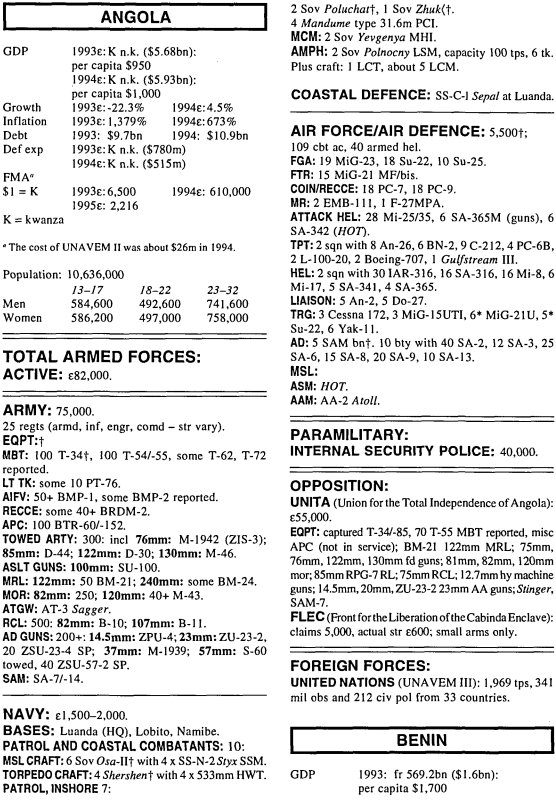
ANGOLA, BENIN
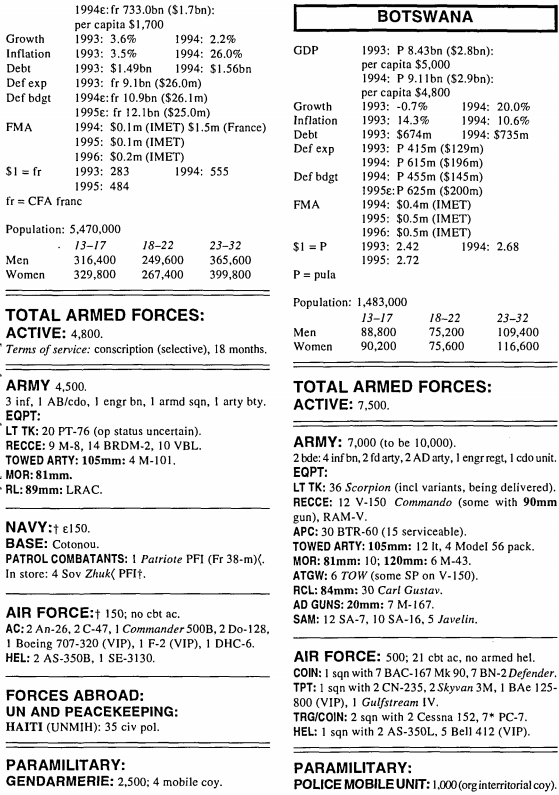
BOTSWANA
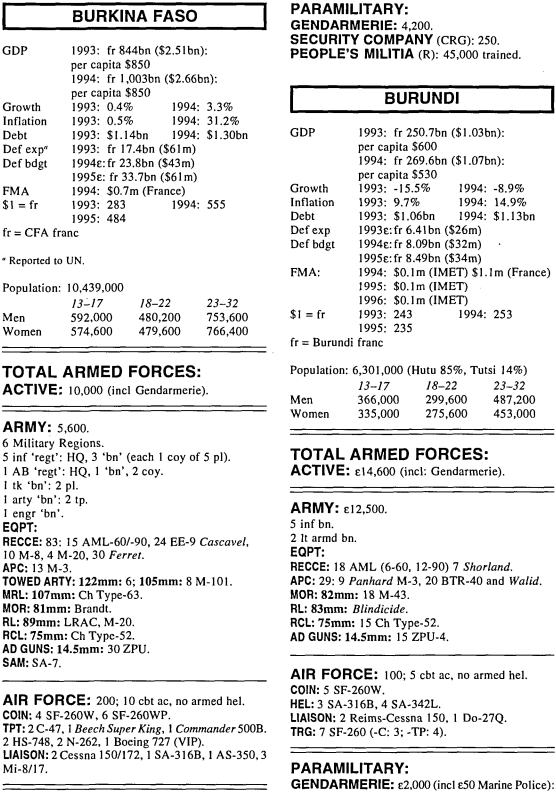
BURKINA FASO, BURUNDI
CAMEROON, CAPE VERDE
CENTRAL AFRICAN REPUBLIC, CHAD
CONGO
COTE D'lVOIRE, DJIBOUTI
EQUATORIAL GUINEA, ERITREA
ETHIOPIA
GABON, GAMBIA
GHANA, GUINEA
GUINEA-BISSAU
KENYA, LESOTHO
LIBERIA, MADAGASCAR
MALAWI, MALI
MAURITIUS
MOZAMBIQUE, NAMIBIA
NIGER, NIGERIA
RWANDA
SENEGAL
SEYCHELLES, SIERRA LEONE
SOMALI REPUBLIC, SOUTH AFRICA
SUDAN
TANZANIA
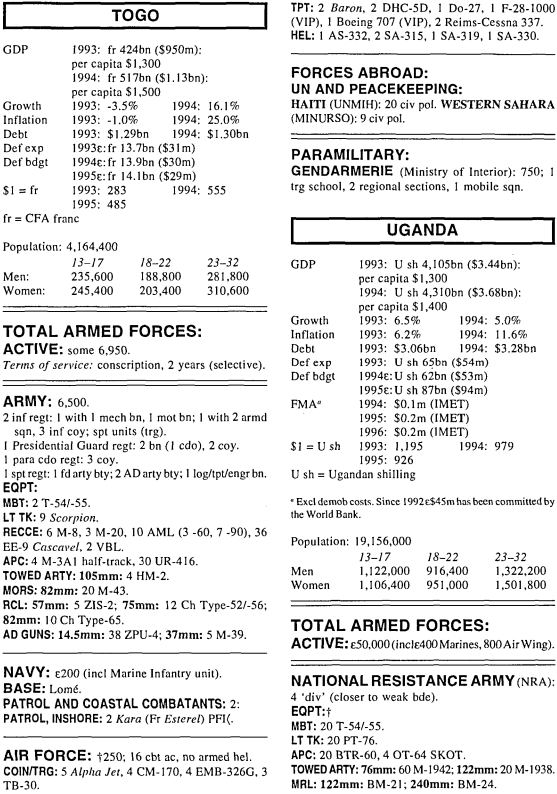
TOGO, UGANDA
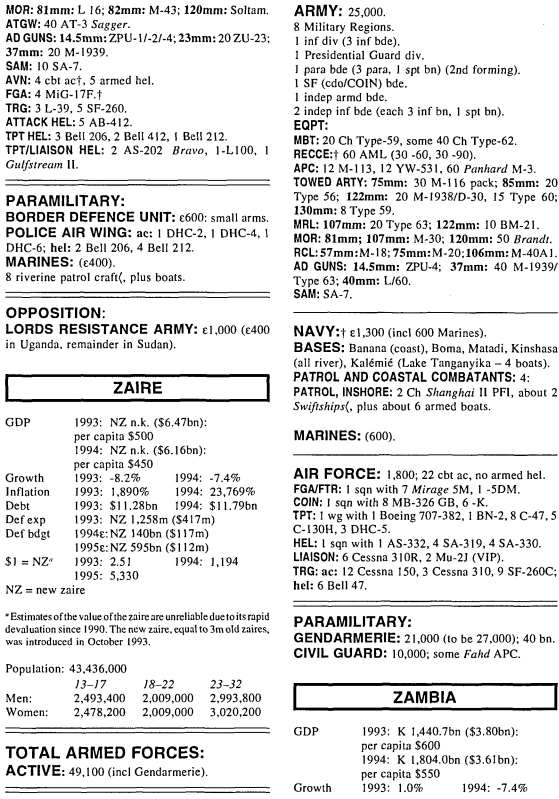
ZAIRE, ZAMBIA
ZIMBABWE
TABLES AND ANALYSES
China's Military Expenditure
(The general problems of estimating and interpreting defence-economics data are discussed in TheMilitary Balance 1994-1995, pp. 278-81.)
Introduction
Few analysts outside the People's Republic of China (PRC) consider the official Chinese defence budget to be a true measure of China's military spending. The uncertainty arises because the Chinese government does not disclose how its defence budget is constituted beyond aggregate figures for recurrent and capital spending - which gives little away. Consistent with this lack of transparency, China does not report its military expenditures to the UN in the standardised format. Such secretive behaviour prompted US Defense Secretary William Perry in 1994 to urge the Chinese to improve the transparency of their military accounting. The absence of reliable information has resulted in widely disparate estimates of China's military spending ranging from $20-140 billion.
The IISS estimates that Chinese military expenditure was over $28bn in 1994 - nearly four times the official figure. The following analysis examines the evidence supporting this conclusion: the enormity of China's Armed Forces and paramilitary and their increasing modernisation since 1989; the strength of the economy and its implications in terms of both the domestic purchasing power of the defence budget and the availability of extra hard currency for foreign equipment and technology; and the falsification in military accounting whereby militaryrelated expenditure is listed under non-defence headings in the central-government budget, and extra-budgetary revenue raised for military application by the regions and the People's Liberation Army (PLA) is not registered at all.
A credibility problem arises primarily because of evidence of a shift in China's intentions and, more obviously, its growing military capability. Although the military doctrine of active defence provides little distinct indication of expansionist intentions, the shift beginning in 1979 from the Maoist concept of a 'people's war' to that of 'local war' confirms some new thinking. The former envisaged the final defeat of the enemy on Chinese soil after a global nuclear war, and in principle involved the tactical yielding of Chinese territory to draw the enemy into defeat. In contrast, the 'local war' doctrine abandons the concept of global war and instead envisages 'localised' conflict through which political objectives can be achieved without nuclear escalation. It might apply, for example, in the case of a conflict with Taiwan or Vietnam over the Spratly Islands. As a consequence of the new doctrine, rapid-reaction forces were formed and equipment modernisation became a top priority.
If the growth in China's military capability were not so demonstrable, the significance of the change in military doctrine could be exaggerated. That growing capability is also a function of an increasingly powerful nuclear capability that aims for global reach, and a massive conventional force, approximately twice the size of any other nation's force. The sheer size of the armed forces (over 4 million including the paramilitary People's Armed Police (PAP)) renders official military accounting implausible. A simple calculation shows that per capita spending amounts to less than $2,000, compared to over $40,000 for Russia and about $ 160,000 for the US. The PLA ground forces alone number over 2 million and are structured into three distinct parts. About 500,000 troops are selected for the best-equipped and trained units, which include at least six rapid deployment formations - the so-called 'fist' units. The second tier comprises supporting combat, training and logistic units, while the balance comprises the service organisations engaged in agriculture, construction and, increasingly, commercial activities. According to some estimates, the PLA owns, administers and sometimes mans some 25,000 enterprises, distinct from the defence industries that produce PLA weaponry and technical equipment under the management of state ministries and are manned by a civilian work-force of 3-3.5 million.
Increased momentum in the modernisation of weapon systems and military equipment also warrants scepticism about the official defence budget. As far back as 1979, the Deng Xiaoping regime identified defence as the fourth pillar of the 'Four Modernisations' programme, and this policy was reaffirmed in 1985. But China's defence spending remained static during most of the 1980s, and it was not until the 1989 Tiananmen Square crisis that the modernisation effort gained momentum. Shortly after, the 1990-91 Gulf War provided further impetus, for the Chinese, like others, could not afford to ignore the startling evidence about the nature of modern warfare. That a renewed modernisation effort is under way is evident both from the purely indigenous R&D and procurement programmes and the increasing numbers of programmes involving international industrial cooperation (facilitated by the relaxation of post-Tiananmen sanctions). A range of substantial industrial cooperation programmes, with Russian and Israeli suppliers, for example, are currently in progress. In the nuclear field, China continues to be the only nuclear state in addition to France still testing nuclear devices and rejecting a ban on the production of fissile material.
New development programmes - the more visible elements of the modernisation process - are said to include: a new generation of strategic weapons for launch from mobile ground (DF-31, DF- 41) and submarine (JL-2) platforms; a new class of SSBN (Type 094); the indigenous fighter J-10 (reportedly based on the defunct Israeli Lavi) and the FC-1 fighter joint venture with Pakistan and Russia; the Luhu-class destroyer of which series production started in 1994; and the Type- 90 main battle tank. To claim, as the Chinese do, that the sizeable increases in the defence budget do no more than compensate for inflation is hardly credible, for modernisation programme funding remains unexplained. It is plausible that technological modernisation is being partly funded by defence budget increases and masked by non-defence funds.
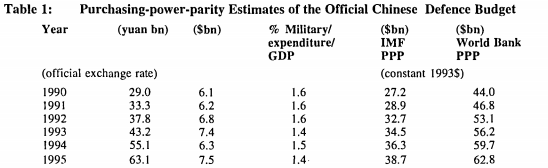
A second method for estimating the value of Chinese military expenditure is to measure the real purchasing power of the defence budget. The official exchange rate fails to capture the real purchasing power of the yuan in a largely autarkic defence economy and, coastal regions apart, in a national economy little influenced by world prices for capital, labour, goods and services. The intrinsic strength of the Chinese economy is better reflected in purchasing-power-parity (PPP) estimates of gross domestic product (GDP). The International Monetary Fund (IMF) GDP estimates for 1991 (which cite various analysts) ranged from $1.3-3.4 bn, or 3-9 times the figure of $379bn calculated using the official exchange rate. Using the IMF's own PPP estimate, annual defence expenditure was between $23 bn and $32 bn from 1990-1995, while the World Bank estimates expenditure at $37-52 bn (Table 1). Despite the substantial differences, these estimates yield a more credible value for the Chinese defence budget than an official exchange-rate conversion predicts. They also show the real increase in the defence budget over the period and bolster the argument that the increase is the result of modernisation costs rather than inflation.
A third reason to doubt official defence budget figures is the concealment of military expenditure. Evidence of hidden military expenditure in other central, regional and local government budgets, and the extra-budgetary funds generated from the PLA's industrial and commercial activities, support this proposition. These are the prima-facie grounds for the charge that China is not revealing the extent of its military spending.
Budgetary falsification takes two forms: military expenditure not included in the central government' s defence budget; and operation of the 'three-thirds' principle, whereby responsibility for raising revenue is shared by the three entities of central government, regional and local government, and PLA units and enterprises. The central government budget provides the primary indication of military funding outside the defence budget. The government includes the defence budget under the heading, 'Building up National Strength', which may be one way of acknowledging that the defence budget does not cover all military spending.
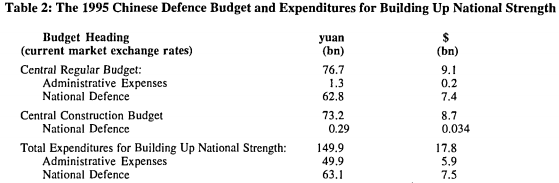
The 1995 Budget for Building up National Strength totals yuan 149.9 bn, $17.8 bn at the official exchange rates (Table 2). The total budget figure is divided according to two overlapping budgetary classifications: activity or departmental function; and regular or construction expenditure. In 1995, the total budget for Building up National Strength includes yuan 63.1 bn for 'National Defence' and yuan 49.9 bn for 'Administrative Expenses'. The central budget is subdivided into the 'regular' and 'construction' budget. Thus, the defence budget appears as an aggregate under the National Defence heading (but is not attributed to any single ministry or organisation), and then disaggregated as a line item in the central regular budget and the central construction budget. The central regular budget covers the range of operating expenditure whilst the central construction budget accounts for government procurement and capital investment programmes in industry and the infrastructure.
Two important conclusions can be drawn from the structure of the central government budget. First, there is a real possibility that some, if not most, of the Budget for Building Up National Strength is devoted to military spending. The Chinese appear to have copied this practice from the Soviet Union which used to conceal military-related expenditure as 'Appropriations for Financing the Development of the National Economy'. Second, the very small defence allocation contained in the central construction budget (yuan 290m or $34m) is implausible, and signifies that a large part of the procurement budget may be hidden under the heading, Building Up National Strength.
Regarding the distribution of defence funds, analysts have concluded that the defence budget may cover primarily operational expenses across the range of the PLA's activities and interests. This included a share of manpower costs and procurement of quartermaster stores, equipment and ordnance from the PLA-administered factories, but it excludes procurement of weapons systems and supporting equipment. It may also include a share of the funding for the PLA's Commission on Science, Technology and Industry for National Defence (COSTIND). The PLA's civilian manpower costs may be accounted as Administrative Expenses under the Building Up National Strength heading. Consequently, it also seems plausible that a large part, if not all, of indigenous procurement - research and development (R&D), weapons and associated programmes, and infrastructure - is funded from the capital construction budget for Building up National Strength, with more funds going to COSTIND via this route. Since analysts have reported that the individual defence industries receive direct funding from the State Council, the construction budget may also fund military-related activities of the State Commission for Science and Technology (CAST), and of the main civilian ministries responsible for the defence industry.
It is not clear how the Chinese military account for arms purchases from foreign suppliers. Analysts tend to see these as another major expenditure item that lies outside the defence budget. Although the Chinese seek to trade on barter terms whenever possible, they have been forced to spend hard currency on foreign weaponry and technology (typically from Russia and Israel in recent years). These outlays appear greater than the proceeds from Chinese arms-sales exports (especially in the light of their decline since the end of the Iran-Iraq War), though some analysts argue that they are funded by accumulated proceeds of past sales. Even if this applied in the past, it is probable that arms purchases now require financing through an extra-budgetary account. Funding for paramilitary organisations, like the PAP, is another military expenditure that does not appear in the defence budget. The budgets of the PAP and other paramilitary forces, such as the Customs Service and the maritime sections of the Public Security Ministry and Border Security Force, are probably listed in the regular budget of Building up National Strength and attributed to the Ministries of Public Security and State Security. The regions also play a role in funding the PLA and the paramilitary; central government allocations for the military subsume some military funds transferred to and administered by the regions. But it also appears that the regions are partly responsible for funding the PAP, as well as regional PLA regular units, reserves and part-time standing militias.
The second form of budgetary falsification is achieved through the three-thirds principle where by the PLA has official sanction to raise revenue. Since 1979, central government revenue as a proportion of GDP has dropped from 31.6% to an estimated 16.2% in 1994, while defence as a proportion of central government spending declined from 17% to 9%. In the meantime, real GDP has grown threefold, so that government revenue has actually increased by half. The high rate of GDP growth has also provided greater commercial opportunities to the PLA. The value of the PLA's own subsistence and revenue-earning activity is difficult to calculate and subject to considerable speculation. Although some argue that it corrupts rather than contributes to the Chinese military effort (and, in any case, should be excluded from calculations of real military expenditure), the evidence suggests that the PLA is formally responsible for raising revenue to cover a part of its operating expenditure, and that consequently, these funds should be included in the calculation of military expenditure.
PLA revenues are derived from two types of activity. First, PLA units together with the reserves and militia engage in farming and food production. The scale of these activities are such that the PLA claimed a production surplus valued at yuan 700m in 1993 which could be sold commercially after military needs had been met. Second, the PLA runs factories and service organisations to meet its own supply requirements for construction and military equipment (excluding weapons systems produced by the civilian-administered defence industries). These activities are also claimed to generate profits for the PLA. Various sources confirm both the proliferation of PLA commercial enterprises and the extent of their diversification into non-military interests. The sum total of value-added activity performed by the PLA in pursuit of its military needs and commercial interests is difficult to quantify. Some analysts claim that the PLA's annual turnover for military and commercial activity is as large as the total National Defence budget, while one press report claims that PLA revenue was in the order of yuan 30bn ($3.6bn) in 1992. In evaluating the military implications of PLA enterprises (and, hence, whether they should be considered in calculations of military expenditure), a distinction should be made between those that promote military needs and those that do not, and between profit-making activities and those effectively subsidised by the defence budget.
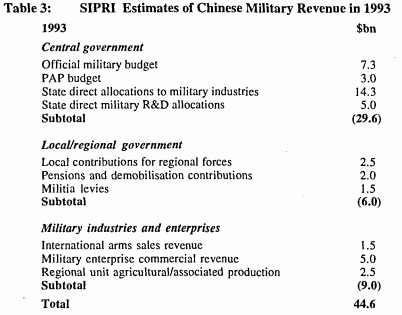
A 1994 study of the Chinese defence budget by the Stockholm International Peace Research Institute (SIPRI) attempts to disaggregate the components of Chinese military revenue and expenditure (Table 3). SIPRI estimates the Chinese military revenue base for 1993 (as distinct from the defence budget) at $45bn and net military spending at $36bn, providing evidence of disaggregated expenditures included in and excluded from the official budget.
US Arms Control and Disarmament Agency (ACDA) estimates show an even higher level of dollar expenditure for 1993 ($56bn) than SIPRI. ACDA's estimate for the defence share of gross national product (GNP) in 1993 (2.7%) is nearly double Chinese government estimates (about 1.5%). The variance between SIPRI and ACDA figures may be attributable to differing assumptions about purchasing-power parity, as the SIPRI analysis does not use the PPP estimates. ACDA comments on the exceptional difficulties of estimating yuan costs and converting them to dollars, and cautions that comparative studies of Chinese military spending are subject to a wide margin of error.
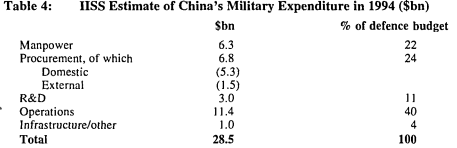
The IISS estimate of Chinese military expenditure in 1994 ($28.5bn) is nearly four times the Chinese defence budget converted at the official rate (Table 4). The IISS estimation method incorporates the three approaches already described: estimating relative (international) cost inputs to the budget (mainly manpower and equipment); estimating the domestic purchasing power of the defence budget; and estimating other military funding contained in central government non defence accounts and PLA extra-budgetary accounts. The IISS method combines a 'top-down' and 'bottom-up' costing method. The latter involves the calculation of the costs of Chinese military inputs (salaries, operations, R&D, procurement, infrastructure, pensions, etc.), which are derived from equivalent NATO costs and take differences in quality into consideration. These are then converted at USS-calculated PPP rates. The top-down method supplements the official defence budget with conservative estimates of other funding, including the budget for Building Up National Strength and the PLA's own revenue, and then applies the same PPP conversion rates. The two independently calculated estimates are then reconciled into a final estimate. It should be noted that these estimates are sensitive to the choice of PPP measure, and that there is no consensus among economists on a single PPP yuan/$ rate. Consequently, using the estimates of either the IMF or World Bank will alter the IISS estimates by a factor of up to 2 - making them compatible with those of SIPRI and ACDA. The IISS has selected a lower PPP measure because estimates derived from costing defence inputs, particularly those applicable to R&D and procurement, are difficult to reconcile with spending levels calculated with higher PPP estimates. In addition, the IISS estimate takes into account that some 5-10% of Chinese military expenditure requires hard currency funding, to which market exchange rates, and not the higher PPP values, are applicable.
Таб.4
Although the Chinese government still maintains that all Chinese military expenditure is accounted in the defence budget and that its level is stable, if not actually in decline, there is a consensus among independent analysts outside China on two counts: Chinese military expenditure is much higher than revealed by the Chinese defence budget; and its military expenditure has increased sharply in real terms since 1989, allowing for inflation. The increase is largely attributable to greater spending on salaries, operations and equipment modernisation. Moreover, the rate of Chinese economic growth continues at such high levels that it would be imprudent to assume that a plateau in military spending has been reached.
Военные расходы Китая
(Общие проблемы оценки и интерпретации оборонно-экономических данных рассматриваются в "военном балансе" за 1994-1995 годы, стр.)
Вступление
Немногие аналитики за пределами Китайской Народной Республики (КНР) считают официальный китайский оборонный бюджет истинным показателем военных расходов Китая. Неопределенность возникает из - за того, что китайское правительство не раскрывает, как составляется его оборонный бюджет, помимо совокупных цифр текущих и капитальных расходов, что мало что дает. В соответствии с этим отсутствием прозрачности Китай не представляет в ООН информацию о своих военных расходах в стандартизированном формате. Такое скрытное поведение побудило министра обороны США Уильяма Перри в 1994 году призвать китайцев повысить прозрачность своей военной отчетности. Отсутствие достоверной информации привело к тому, что оценки военных расходов Китая сильно разошлись - от 20 до 140 миллиардов долларов.
По оценкам МИСИ, военные расходы Китая в 1994 году превысили $28 миллиардов - почти в четыре раза больше официальной цифры. В нижеследующем анализе рассматриваются доказательства, подтверждающие этот вывод: огромные размеры Вооруженных сил и военизированных формирований Китая и их растущая модернизация с 1989 года; сила экономики и ее последствия с точки зрения как внутренней покупательной способности оборонного бюджета, так и наличия дополнительной твердой валюты для иностранной техники и технологий; а фальсификация в военном учете, когда военные расходы перечисляются в Центральном государственном бюджете по разделам, не связанным с обороной, а внебюджетные доходы, собранные регионами и Народно-освободительной армией (НОАК) на военные нужды, вообще не регистрируются.
Проблема доверия возникает прежде всего из-за свидетельств изменения намерений Китая и, что более очевидно, его растущего военного потенциала. Хотя военная доктрина активной обороны не дает четких указаний на экспансионистские намерения, начавшийся в 1979 году переход от маоистской концепции "народной войны" к концепции "локальной войны" подтверждает некоторые новые взгляды. Первая предусматривала окончательное поражение противника на китайской земле после глобальной ядерной войны и в принципе предполагала тактическую уступку китайской территории, чтобы втянуть противника в поражение. Напротив, доктрина "локальной войны" отказывается от концепции глобальной войны и вместо этого предусматривает "локализованный" конфликт, посредством которого политические цели могут быть достигнуты без ядерной эскалации. Он может применяться, например, в случае конфликта с Тайванем или Вьетнамом из-за островов Спратли. В результате новой доктрины были сформированы силы быстрого реагирования, и модернизация техники стала главным приоритетом.
Если бы рост военного потенциала Китая не был столь очевиден, значение изменения военной доктрины можно было бы преувеличить. Этот растущий потенциал также является функцией все более мощного ядерного потенциала, который нацелен на глобальный охват, и массивных обычных сил, примерно вдвое превышающих силы любой другой страны. Сама численность Вооруженных сил (более 4 миллионов человек, включая военизированную народную вооруженную полицию) делает официальную военную отчетность неправдоподобной. Простой расчет показывает, что расходы на душу населения составляют менее 2000 долларов, по сравнению с более чем 40 000 долларов для России и около 160 000 долларов для США. Только сухопутные силы НОАК насчитывают более 2 миллионов человек и состоят из трех отдельных частей. Около 500 000 военнослужащих отбираются для наиболее оснащенных и обученных подразделений, которые включают по меньшей мере шесть формирований быстрого развертывания - так называемые "кулаки". Второй эшелон включает вспомогательные боевые, учебные и материально-технические подразделения, а на балансе - обслуживающие организации, занимающиеся сельским хозяйством, строительством и, во все большей степени, коммерческой деятельностью. По некоторым оценкам, НОАК владеет, управляет, а иногда и руководит примерно 25 000 предприятиями, в отличие от оборонных отраслей промышленности, которые производят вооружение и техническое оснащение НОАК под управлением государственных министерств и укомплектованы гражданской рабочей силой численностью 3-3,5 млн.
Увеличение темпов модернизации систем вооружения и военной техники также вызывает скептицизм в отношении официального оборонного бюджета. Еще в 1979 году режим Дэн Сяопина определил оборону как четвертый столп программы "четырех модернизаций", и эта политика была подтверждена в 1985 году. Но расходы Китая на оборону оставались неизменными в течение большей части 1980-х годов, и только после кризиса 1989 года на площади Тяньаньмэнь усилия по модернизации набрали обороты. Вскоре после этого Война в Персидском заливе 1990-1991 годов дала дополнительный импульс, поскольку китайцы, как и другие, не могли позволить себе игнорировать поразительные свидетельства о природе современной войны. О том, что в настоящее время предпринимаются новые усилия по модернизации, свидетельствуют как чисто местные программы НИОКР и закупок, так и растущее число программ, связанных с международным промышленным сотрудничеством (чему способствовало ослабление санкций, введенных после Тяньаньмэнь). В настоящее время осуществляется целый ряд крупных программ промышленной кооперации, например, с российскими и израильскими поставщиками. В ядерной области Китай по-прежнему остается единственным ядерным государством, помимо Франции, все еще испытывающей ядерные устройства и отвергающей запрет на производство расщепляющегося материала.
Новые программы развития - наиболее заметные элементы процесса модернизации - включают в себя: новое поколение стратегических вооружений для запуска с подвижных наземных (DF-31, DF-41) и подводных (JL-2) платформ; новый класс ПЛАРБ (тип 094); местный истребитель J-10 (предположительно основанный на несуществующем израильском Lavi) и истребитель FC-1 совместного предприятия с Пакистаном и Россией; эсминец класса Luhu, серийное производство которого началось в 1994 году; и основной боевой танк Type-90. Утверждать, как это делают китайцы, что значительное увеличение оборонного бюджета не более чем компенсирует инфляцию, вряд ли можно, поскольку финансирование программы модернизации остается необъясненным. Вполне вероятно, что технологическая модернизация частично финансируется за счет увеличения оборонного бюджета и маскируется за счет средств, не связанных с обороной.
Второй метод оценки стоимости китайских военных расходов заключается в измерении реальной покупательной способности оборонного бюджета. Официальный обменный курс не отражает реальной покупательной способности юаня в условиях автаркической оборонной экономики и, кроме того, в прибрежных регионах, в национальной экономике, на которую мировые цены на капитал, рабочую силу, товары и услуги оказывают незначительное влияние. Внутренняя сила китайской экономики лучше всего отражается в оценках валового внутреннего продукта (ВВП) по паритету покупательной способности (ППС). Оценки ВВП Международного валютного фонда (МВФ) за 1991 год (которые приводят различные аналитики) варьировались от $1,3-3,4 млрд, или в 3-9 раз превышали цифру в $379 млрд, рассчитанную с использованием официального обменного курса. По собственным оценкам МВФ по ППС, в 1990-1995 годах ежегодные расходы на оборону составляли от 23 до 32 миллиардов долларов, в то время как Всемирный банк оценивает их в 37-52 миллиарда долларов (Таблица 1). Несмотря на существенные различия, эти оценки дают более достоверное значение для китайского оборонного бюджета, чем предсказывает официальная конвертация валютных курсов. Они также показывают реальное увеличение оборонного бюджета за этот период и подкрепляют аргумент о том, что увеличение является результатом расходов на модернизацию, а не инфляции.
Таб.1
Третий повод усомниться в официальных цифрах оборонного бюджета - это сокрытие военных расходов. Доказательства скрытых военных расходов в других центральных, региональных и местных государственных бюджетах, а также внебюджетных фондах, полученных от промышленной и коммерческой деятельности НОАК, подтверждают это предположение. Таковы первичные основания для обвинения в том, что Китай не раскрывает масштабы своих военных расходов.
Бюджетная фальсификация принимает две формы: военные расходы, не включенные в оборонный бюджет центрального правительства; и принцип "трех третей", согласно которому ответственность за увеличение доходов несут три субъекта центрального правительства, региональные и местные органы власти, а также подразделения и предприятия НОАК. Бюджет центрального правительства является основным показателем военного финансирования за пределами оборонного бюджета. Правительство включает оборонный бюджет в раздел "наращивание национальной мощи", что может быть одним из способов признания того, что оборонный бюджет не покрывает все военные расходы.
Таб.2
Бюджет 1995 года на укрепление национальной мощи составляет 149,9 млрд. юаней, или $17,8 млрд. по официальным обменным курсам (Таблица 2). Общая бюджетная цифра делится в соответствии с двумя пересекающимися бюджетными классификациями: деятельность или функции департамента; и регулярные или строительные расходы. В 1995 году общий бюджет на укрепление национальной мощи включал 63,1 млрд юаней на "национальную оборону" и 49,9 млрд юаней на "административные расходы". Центральный бюджет подразделяется на "регулярный" и "строительный". Таким образом, оборонный бюджет представляется в виде совокупности по разделу "Национальная оборона" (но не приписывается какому-либо одному министерству или организации), а затем дезагрегируется в виде отдельной статьи в Центральном регулярном бюджете и центральном бюджете строительства. Центральный регулярный бюджет охватывает весь спектр оперативных расходов, в то время как центральный строительный бюджет охватывает государственные закупки и программы капитальных вложений в промышленность и инфраструктуру.
Из структуры бюджета центрального правительства можно сделать два важных вывода. Во-первых, существует реальная возможность того, что часть, если не большая часть, бюджета на наращивание национальной мощи будет направлена на военные расходы. Китайцы, по-видимому, переняли эту практику у Советского Союза, который скрывал военные расходы как "ассигнования на финансирование развития национальной экономики". Во-вторых, весьма незначительные ассигнования на оборону, содержащиеся в центральном бюджете строительства (290 млн юаней или $34 млн долл.), неправдоподобны и означают, что значительная часть бюджета закупок может быть скрыта под заголовком "наращивание национальной мощи".
Что касается распределения оборонных средств, то аналитики пришли к выводу, что оборонный бюджет может покрывать главным образом оперативные расходы по всему спектру деятельности и интересов НОАК. Это включало в себя долю расходов на рабочую силу и закупки квартирмейстерских складов, оборудования и боеприпасов с заводов, находящихся в ведении НОАК, но не включало закупки систем вооружения и вспомогательного оборудования. Он может также включать долю финансирования комиссии НОАК по науке, технике и промышленности в интересах национальной обороны (COSTIND). Расходы НОАК на гражданскую рабочую силу могут учитываться как административные расходы в разделе наращивание национальной мощи. Следовательно, представляется также вероятным, что значительная часть, если не вся, местных закупок - научные исследования и разработки (НИОКР), вооружения и связанные с ними программы и инфраструктура - финансируется из бюджета капитального строительства для наращивания национальной мощи, причем дополнительные средства будут расходоваться по этому пути. Поскольку аналитики сообщают, что отдельные оборонные отрасли получают прямое финансирование от Государственного Совета, бюджет строительства может также финансировать военную деятельность Государственной комиссии по науке и технике (ГКНТ) и основных гражданских министерств, ответственных за оборонную промышленность.
Непонятно, как китайские военные учитывают закупки вооружений у иностранных поставщиков. Аналитики склонны рассматривать их как еще одну крупную статью расходов, лежащую вне оборонного бюджета. Хотя китайцы стремятся торговать на бартерных условиях, когда это возможно, они вынуждены тратить твердую валюту на иностранные вооружения и технологии (как правило, из России и Израиля в последние годы). Эти расходы кажутся больше, чем доходы от экспорта китайских вооружений (особенно в свете их снижения после окончания ирано-иракской войны), хотя некоторые аналитики утверждают, что они финансируются за счет накопленных доходов от прошлых продаж. Даже если это применялось в прошлом, вполне вероятно, что закупки вооружений теперь требуют финансирования за счет внебюджетных средств. Финансирование военизированных организаций, таких как ПАП, является еще одним военным расходом, который не фигурирует в оборонном бюджете. Бюджеты ПАП и других военизированных формирований, таких как таможенная служба и морские подразделения Министерства общественной безопасности и пограничные силы, вероятно, перечислены в регулярном бюджете наращивания национальной мощи и отнесены к министерствам общественной безопасности и государственной безопасности. Регионы также играют определенную роль в финансировании НОАК и военизированных формирований; ассигнования центрального правительства на военные нужды включают часть военных средств, передаваемых регионам и находящихся в их ведении. Но также представляется, что регионы частично ответственны за финансирование ПАП, а также региональных регулярных подразделений НОАК, резервов и частично постоянных ополченцев.
Вторая форма бюджетной фальсификации достигается за счет принципа трех третей, когда НОАК имеет официальную санкцию на увеличение доходов. С 1979 года доля доходов центрального правительства в ВВП снизилась с 31,6% до 16,2% в 1994 году, в то время как доля расходов центрального правительства на оборону снизилась с 17% до 9%. Тем временем реальный ВВП вырос втрое, так что государственные доходы фактически выросли вдвое. Высокие темпы роста ВВП также предоставили НОАК большие коммерческие возможности. Стоимость собственного прожиточного минимума и доходной деятельности НОАК трудно подсчитать и она является предметом значительных спекуляций. Хотя некоторые утверждают, что он скорее развращает, чем способствует китайским военным усилиям (и, в любом случае, должен быть исключен из расчетов реальных военных расходов), факты говорят о том, что НОАК формально несет ответственность за сбор доходов для покрытия части своих оперативных расходов, и что, следовательно, эти средства должны быть включены в расчет военных расходов.
Доходы НОАК получаются от двух видов деятельности. Во-первых, подразделения НОАК совместно с резервами и ополчением занимаются сельским хозяйством и производством продовольствия. Масштабы этой деятельности таковы, что НОАК заявила о наличии в 1993 году излишков продукции на сумму 700 млн. юаней, которые можно было бы продать в коммерческих целях после удовлетворения военных потребностей. Во-вторых, НОАК управляет заводами и обслуживающими организациями для удовлетворения собственных потребностей в поставках строительной и военной техники (за исключением систем вооружения, производимых оборонными предприятиями гражданского назначения). Эти виды деятельности, как утверждается, также приносят прибыль НОАК. Различные источники подтверждают как распространение коммерческих предприятий НОАК, так и степень их диверсификации в невоенные интересы. Общий объем деятельности НОАК, направленной на удовлетворение ее военных потребностей и коммерческих интересов, трудно поддается количественной оценке. Некоторые аналитики утверждают, что годовой оборот НОАК по военной и коммерческой деятельности равен общему объему бюджета национальной обороны, в то время как в одном из сообщений прессы утверждается, что в 1992 году доходы НОАК составляли порядка 30 млрд. юаней ($3,6 млрд.). При оценке военных последствий деятельности предприятий НОАК (и, следовательно, того, следует ли их учитывать при расчете военных расходов) следует проводить различие между теми, которые способствуют военным потребностям, и теми, которые не способствуют, а также между деятельностью, приносящей прибыль, и деятельностью, эффективно субсидируемой оборонным бюджетом.
В исследовании 1994 года оборонного бюджета Китая, проведенном Стокгольмским международным институтом исследования проблем мира (SIPRI), предпринимается попытка дезагрегировать компоненты военных доходов и расходов Китая (Таблица 3). По оценкам СИПРИ, в 1993 году китайская база военных доходов (в отличие от оборонного бюджета) составляла 45 млрд. долл., а чистые военные расходы-36 млрд. долл., что свидетельствует о наличии дезагрегированных расходов, включенных в официальный бюджет и исключенных из него.
Таб.3
Оценки агентства США по контролю над вооружениями и разоружению (ACDA) показывают еще более высокий уровень долларовых расходов за 1993 год ($56 млрд), чем SIPRI. Оценка ACDA доли оборонного сектора в валовом национальном продукте (ВНП) в 1993 году (2,7%) почти вдвое превышает оценку китайского правительства (около 1,5%). Расхождение между показателями SIPRI и ACDA может быть связано с различными предположениями о паритете покупательной способности, поскольку в анализе SIPRI не используются оценки ППС. ACDA комментирует исключительные трудности оценки стоимости юаня и перевода ее в доллары и предупреждает, что сравнительные исследования китайских военных расходов подвержены большой погрешности.
Оценка военных расходов Китая в 1994 году ($28,5 млрд.) по МИСИ почти в четыре раза превышает военный бюджет Китая, пересчитанный по официальному курсу (табл. 4). Метод оценки МИСИ включает в себя три уже описанных подхода: оценку относительных (международных) затрат, вносимых в бюджет (главным образом на оплату живой силы и оборудования); оценку внутренней покупательной способности оборонного бюджета; и оценку других видов военного финансирования, содержащихся в счетах центрального правительства, не связанных с обороной, и внебюджетных счетах НОАК. Метод МИСИ сочетает в себе метод расчета затрат "сверху вниз" и "снизу вверх". Последний включает в себя расчет стоимости китайских военных ресурсов (зарплата, операции, НИОКР, закупки, инфраструктура, пенсии и т.д.), которые являются производными от эквивалентных затрат НАТО и учитывают различия в качестве. Затем они преобразуются в УСС-расчетные показатели ППС. Метод "сверху-вниз" дополняет официальный оборонный бюджет консервативными оценками других источников финансирования, включая бюджет на укрепление национальной мощи и собственные доходы НОАК, а затем применяет те же коэффициенты пересчета ППС. Затем эти две независимо рассчитанные оценки выверяются в окончательную оценку. Следует отметить, что эти оценки чувствительны к выбору показателя ППС и что среди экономистов нет единого мнения относительно единого курса ППС юань/$. Следовательно, использование оценок МВФ или Всемирного банка приведет к изменению оценок МИСИ в 2 раза, что сделает их совместимыми с оценками СИПРИ и АКДА. МИС выбрала более низкую меру ППС, поскольку оценки, полученные на основе затрат на оборонные ресурсы, особенно те, которые применимы к НИОКР и закупкам, трудно согласовать с уровнями расходов, рассчитанными с использованием более высоких оценок ППС. Кроме того, оценка МИСИ учитывает, что около 5-10% военных расходов Китая требует финансирования в твердой валюте, к которой применимы рыночные обменные курсы, а не более высокие значения ППС.
Таб.4
Хотя китайское правительство по-прежнему утверждает, что все военные расходы Китая учитываются в оборонном бюджете и что их уровень стабилен, если не снижается на самом деле, существует консенсус среди независимых аналитиков за пределами Китая по двум пунктам: китайские военные расходы намного выше, чем показано в китайском оборонном бюджете; и его военные расходы резко выросли в реальном выражении с 1989 года, учитывая инфляцию. Этот рост в значительной степени объясняется увеличением расходов на заработную плату, операции и модернизацию оборудования. Более того, темпы экономического роста Китая продолжают оставаться на столь высоком уровне, что было бы неосторожно предполагать, что достигнуто плато в военных расходах.
Developments in the Field of Weapons of Mass Destruction
The first six months of 1995 were successful in the field of nuclear arms control. The US-Russian Strategic Arms Reductions Talks (START) Treaty came into force, the Nuclear Non-Proliferation Treaty (NPT) was extended indefinitely and the negotiations on a Comprehensive Test Ban Treaty (CTBT) made progress. However, China has continued to test nuclear weapons and France announced a plan to resume testing from September 1995. These and other developments in the control or proliferation of nuclear, chemical and biological weapons and of ballistic missiles are reviewed in this section. Changes in national nuclear and missile forces are reflected in the relevant national entry and are highlighted in the text preceding the relevant regional section.
START I
On 16 November 1994, the Ukrainian Verkhovna Rada (parliament) adopted the law on Ukraine's accession to the NPT. It added a number of reservations mainly concerning compensation for the cost of dismantling weapons and the provision of assurances by the nuclear-weapon states. However, these did not affect Ukraine's unconditional accession to the NPT as a non-nuclear state. The final hurdle was cleared at Budapest on 5 December, where the Conference, now Organisation, on Security and Cooperation in Europe (OSCE) summit was being held, when US President Bill Clinton, Russian President Boris Yeltsin and UK Prime Minister John Major signed an assurance document and President Leonid Kuchma of Ukraine signed the instruments of NPT ratification.
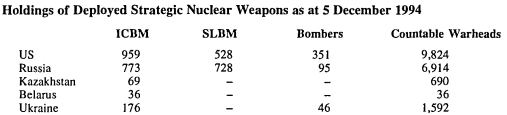
With this the START I Treaty came into effect, allowing verification of weapons elimination to be implemented and clearing the way for the ratification of START II, signed by Russia and the US in January 1993. START I requires each side to reduce their strategic forces to no more than 1,600 delivery vehicles armed with no more than 6,000 warheads. Information was released by all states on their holdings of deployed strategic nuclear weapons as at 5 December 1994.
These figures are somewhat misleading as they refer to all weapons countable under START rules, whether operational or not. For example, 156 of the US bombers were located at the Davis Monthan elimination site and many of the ICBM have had their warheads and other components removed. Counting rules have been interpreted differently. The high number of US ICBM is accounted for by the US-held interpretation that a silo launcher must be considered to contain an ICBM, whether or not a missile is actually deployed at that site, until the silo is destroyed. START I rules that data regarding deployed nuclear forces may not be released to the public for three months after notification. Memorandum of Understanding data is to be fully updated every six months, with the next data as of 5 June 1995 but not releasable until 5 September 1995, too late for inclusion in this edition of The Military Balance. The Military Balance has received some information on current deployment and operational status which is shown in the relevant country entry, but this must not be confused with Treaty-countable weapons.
START II
The START II Treaty signed by US President George Bush and President Yeltsin on 3 January 1993 has not yet been ratified. The Treaty has been presented to the Russian Duma for ratification and the US Senate began formal hearings on ratification on 31 January 1995. START II requires the US and Russia to have reduced their strategic warheads to between 3,000 and 3,500 by 2003. The Treaty bans ICBM with multiple independently targetable re-entry vehicles (MIRV) and limits SLBM to 1,750 for each side. Counting rules for air-delivered warheads have been altered; bombers will be attributed as having the number of warheads they are equipped to carry.
Nuclear Non-Proliferation Treaty
The NPT was extended indefinitely at the 25-year Extension Conference by consensuson 11 May 1995. Indefinite extension had been opposed by a number of states, mainly Arab, led by Egypt because Israel would not join the Treaty. Israel's position on the NPT is that it will not join until it has achieved peace treaties with all the Arab states; then it will support the establishment of a weapons of mass destruction (WMD) free zone in the Middle East. While the NPT was extended without condition, a number of principles and objectives were adopted. However, these are not legally binding documents. Their main purpose is to allow pressure to be brought to bear on the nuclear-armed states in respect of their commitment to nuclear disarmament. The documents are:
• 'Strengthening the Review Process for the Treaty'.
• 'Principles and Objectives for Nuclear Non-Proliferation and Disarmament'. This stressed the importance of achieving a CTBT no later than 1996 (and pending its entry into force advocated that the nuclear-armed states should exercise utmost restraint); a ban on the production of fissile material for nuclear weapons or other explosive use; the determined pursuit of nuclear disarmament.
• The third document was a resolution, proposed by Russia, the US and the UK, which called for the early accession of all states to the NPT and for Middle Eastern states to establish a Middle East zone free of nuclear, chemical and biological weapons and their delivery systems. Since June 1994, the following states, most importantly Ukraine (allowing the START II reaty to enter in to force), have acceded to the NPT: Algeria, Argentina, Bosnia-Herzegovina, Chile, Eritrea, the Former Yugoslav Republic of Macedonia (FYROM), Kyrgyzstan, the Marshall Islands, Micronesia, Moldova, Monaco, Palau, Tajikistan and Turkmenistan. Only 13 countries have not joined the NPT: the undeclared nuclear-weapon states of India, Israel and Pakistan, and Andorra, Angola, Brazil, Comoros, Cuba, Djibouti, Oman, Serbia/Montenegro, the UAE and Vanuatu.
Nuclear Test Moratorium
Until the NPT was extended indefinitely, only China of the five recognised nuclear-weapon states had no nuclear-testing moratorium. President Mikhail Gorbachev ended Soviet nuclear tests for one year from 5 October 1991 . After this was extended to July 1993, the Russian Foreign Minister said that 'Russia would not be the first to end the moratorium, but to expect any nuclear power to refrain from testing if others resumed would be unreasonable'. France announced a moratorium in April 1992 to last until the end of the year. Former President Francois Mitterrand then made clear that there would be no more French tests during his presidency, which ended in May 1995. President Clinton extended the Bush administration's US moratorium, instigated in October 1992, for a further year to September 1995. The US moratorium precludes UK testing.
The Chinese have continued testing and have carried out three tests since June 1994. The first, in October 1994, had an estimated yield of 60 kilotonnes. The second, China's 42nd test, came on 15 May 1995, only days after the successful end to the NPT Review Conference. Initial assessments put the yield of the explosion between 40 and 150 kilotonnes. The third took place on 17 August, measured 5.6 on the Richter Scale and is estimated to have had a yield of between 20 and 80 kilotons. Since then an official Chinese spokesman has said that a schedule of further tests is planned, but that China would stop as soon as any test ban treaty came into force.
Immediately after the French presidential election in May 1995, the new President, Jacques Chirac, announced that France intended to carry out a series of eight tests at the Mururoa Pacific test site between September 1995 and May 1996. The reasons given for the tests were to collect data to allow France to switch to simulated testing in future and to validate the warhead for the new M-5 SLBM. US Secretary of Defense William Perry also advocated the resumption of US tests, but this was opposed by the US Department of Energy (which is responsible for manufacturing US nuclear weapons) and the Arms Control and Disarmament Agency (ACDA). The US administration has now made it clear that testing will not be resumed. However, if the US had not extended its moratorium there would have been some opportunity until 30 September 1996 when the Energy and Water Development Appropriations Act of 1992 stipulates that no further US tests are to take place unless another state conducts a test after this date. The Act allows a total of five safety-related and one reliability-related test per year. One of the safety-related tests can be carried out by the UK.
Comprehensive Test Ban Treaty
The Nuclear Test Ban (NTB) Committee of the Conference for Disarmament closed its first session for 1994 on 7 April 1995. The second session opened on 1 June and closed on 6 July after progress was made on several contentious issues. The UK and France have withdrawn their proposal to authorise exceptions for safety tests. The US has dropped its demand that the CTBT should only be in force for ten years. China is still pressing for the Treaty to ban a nuclear weapons test which releases nuclear energy; such wording would allow peaceful use of nuclear explosions, but ban what are called hydro nuclear tests. Hydro nuclear experiments (HNE) are a research technique in which explosions release nuclear energy and small amounts of fission products. The US has opted for a comprehensive ban, but using explosions with the yield of 4 lbs as the equivalent of zero. However, the Pentagon is keen to hold tests with a force equivalent to 500 tons of explosive and, having lost the chance to perform these tests before the CTBT comes into force, may argue for the Treaty to allow all such tests. The UK is reported to have conducted safety tests below the 41bs level, but would prefer a higher limit (1 OOlbs). Russia wants at least 10 tons while France, claiming that it does not have the ability to acquire the information needed at such low thresholds, argues for 200-300 tons. The non-nuclear states of the NTB Committee were originally ready to accept very low yield hydro nuclear tests in order to obtain a timely treaty. This view has now changed, partly as a result of a better understanding of what hydro nuclear tests can achieve, partly for fear that the nuclear states are looking for a much higher test threshold, and because of their condemnation of the Chinese nuclear test and French test plans so soon after the NPT extension. They are now pushing for a fully comprehensive ban with no loopholes.
Issues still to be settled include the role of the International Data Centre. Should it purely assemble data, or should it also be responsible for interpretation, which the US believes should be a national responsibility? Agreement has not yet been reached on rules for triggering on-site inspections, nor on whether the International Atomic Energy Agency (IAEA) or another new organisation should be the implementing authority. There are also unresolved issues concerning verification (both the permanent seismic monitoring network, and action to be taken after a suspicious event), on the conditions for bringing the treaty into force, and for allowing states to withdraw.
Fissionable Material Production Ban
In January 1994, the UN Conference for Disarmament (CD) appointed Ambassador Gerald Shannon of Canada as special coordinator for a fissile material cut-off. The CD voted unanimously on 23 March 1995 to establish a committee to negotiate an international and verifiable treaty banning the production of fissile material (plutonium and highly enriched uranium (HEU)) for nuclear weapons. But the establishment of the Committee has been held up as some nations would prefer to establish a Committee on Nuclear Disarmament instead, a proposal strongly resisted by the nuclear-weapon states. The US stopped producing fissile materials for weapons in 1992 and in 1994 signed an agreement with Russia committing them to halting plutonium production and closing plutonium production reactors. Verifying a treaty would probably be the responsibility of the IAEA. A criticism of the proposed treaty is that it makes no provision for the control or destruction of weapons-grade material stockpiles. Progress is already being made in this respect, with the US and Russia agreeing to allow inspection of each other's storage sites for dismantled weapons material, the US agreement to purchase 500 tons of Russian HEU once it had been converted to low-enriched uranium (LEU), and President Clinton's announcement that the US would withdraw 200 tons of plutonium and HEU from the weapons stockpile. The plan for the US to purchase Russian HEU has run into difficulties and so far only one token consignment of the equivalent of under one ton has reached the US. The Russian Atomic Energy Minister, Viktor Mikhailov, has even threatened to cancel the agreement unless the US position changes. However, the main problems, which appear to be over-pricing and the lack of agreement between the US Enrichment Corporation, which would be marketing Russian LEU once it reaches the US, and the Russian Ministry of Atomic Energy, were resolved at the time of US Vice-President Al Gore's meeting with Russian Prime Minister Viktor Chernomyrdin in Moscow in June 1995.
Nuclear-Weapon-Free Zones
On 15 September 1994, the Arab League Council reaffirmed its previous resolution (of 27 March 1994) and called upon its member-states and the General Secretariat to pursue contacts at all levels to make the Middle East a region free of all weapons of mass destruction. The call for a Middle East zone free of WMD was reinforced by the resolution proposed by Russia, the US and the UK and adopted at the NPT review conference. The UN General Assembly voted for a resolution sponsored by Pakistan and Bangladesh to reaffirm its support for the concept of a nuclear-weapon free zone in South Asia. Only Bhutan, India and Mauritius voted against the resolution and there were ten abstentions. On 25 March 1995, Cuba, in the presence of the Foreign Minister of Mexico, the depository government, signed the Treaty for the Prohibition of Nuclear Weapons in Latin America and the Caribbean (the Treaty of Tlatelolco), but as yet has not deposited its instrument of ratification. Cuba was the last regional state to sign the Treaty.
On 2 June 1995, the Organisation of African Unity (OAU) unanimously adopted the draft of a treaty establishing a nuclear-weapons-free zone in Africa. The draft was submitted to the United Nations on 26 June where it is expected to be approved by the General Assembly.
North Korea
The US and North Korea held negotiations in Geneva between 23 September and 21 October 1994 and signed an Agreed Framework. The key points were that North Korea would:
* not reprocess nor separate plutonium;
* not restart its 5MW reactor;
* freeze construction of two other reactors;
* close and seal its radiochemistry laboratory (considered to be a separation plant) and subject it to IAEA inspections.
The spent fuel rods unloaded from the 5MW reactor in June 1994 were to remain stored in the cooling pond until arrangements for its disposal outside North Korea had been arranged. In return, the US committed itself to:
* organise an international consortium to finance and supply light-water reactors with an approximate generating capacity of 2.000MW by 2003;
* conclude a bilateral agreement for cooperation in the field of peaceful uses of nuclear energy;
* provide alternative energy in the form of 500,000 tons of heavy oil annually.
Both sides agreed to work for a nuclear-weapon-free Korean peninsula and to strengthen the international nuclear non-proliferation regime. When a significant portion of the light-water reactor is completed, but before nuclear components are delivered, North Korea will come into full compliance with IAEA safeguards and allow inspections at facilities not covered by the agreed freeze. North Korea sent an official letter on 2 November 1994 notifying the US that specific action to freeze its nuclear activities had begun.
The Agreed Framework soon ran into trouble when North Korea refused to accept light-water reactors designed, built and installed by South Korea. The US was equally adamant, as South Korea was mainly financing the project, that South Korean reactors must be accepted. Three weeks of meetings were held in Kuala Lumpur in May and June 1995 and on 13 June a joint statement was released by US Deputy Assistant Secretary, Thomas Hubbard, and North Korean Vice-President, Kim Gye Gwan, agreeing that the Korean Peninsula Energy Development Organisation (KEDO) would finance and choose the reactor. Hubbard told the press that North Korea understood that a South Korean reactor would be chosen and that the prime contractor would also be South Korean.
Chemical Weapons
By 1 June 1995, only 29 of the 159 signatory states had ratified the Chemical Weapons Convention (CWC) leaving 32 states still to sign. The earliest the CWC could have come into force was two years after it was opened for signature on 13 January 1993. It now needs a further 36 ratifications before coming into force. The Australia Group, an informal forum of states which abide by an agreed set of export controls, now has 28 members and the Czech Republic, Poland and Slovakia attended their first meeting in Paris on 29 November 1994. Little progress has been made either by Russia or the US in the destruction of their large CW stocks. Destruction of US CW agents continued at the Johnston Atoll facility, but the second facility to be developed at Tooele, Utah, has been found to have numerous flaws. There is growing opposition to CW incineration from local populations close to destruction plants. The first major terrorist use of CW took place in Tokyo on 20 March 1995 when a weak version of the nerve gas sarin was released at five separate points on the underground railway system. A religious cult, Aum Shinrikyo, is held responsible for the attacks and raids on their premises discovered sufficient chemicals to produce 5.6 tons of sarin. There were four gas attacks again on railway targets in Japan on 4 July 1995, two of which released cyanide gas. There have been no reports of copy-cat incidents elsewhere.
Biological Weapons
In September 1994, a special conference of the Biological Weapons Convention (BWC) states was held to consider the final report of the VEREX group (an ad hoc group of governmental verification experts). There was little agreement at this conference other than to establish another ad hoc group to consider 'appropriate measures, including possible verification measures' and to incorporate these into a legally binding protocol. BW verification is far more problematic than that for CW. Sufficient BW agent for use by saboteurs can be produced in research laboratories (which are not prohibited by CWC); BW agents must be produced before protective vaccines can be made; all equipment and materials needed for BW production are 'dual use' in that they are equally necessary for other legitimate purposes. Two sessions will be held by the new ad hoc group in July and in November-December 1995.
Missiles
An analysis of the current deployment of ballistic missiles across the world is set out at pp. 281 - 84. The composition of the Missile Technology Control Regime (MTCR), a group of nations which voluntarily impose mutually agreed export controls on missile technology and equipment, has not altered in the last 12 months. There are 25 members, and six others have agreed to adhere to the regime's criteria. The US is now satisfied that Russia is meeting its commitments and so supports its immediate membership of the MTCR. Ukraine and China are also committed to the MTCR criteria, but in May 1995 China suspended talks with the US on missile and nuclear issues in protest against the granting of a US visa to the Taiwanese President.
Missile Proliferation
Proliferation, that is to say the spread of nuclear, chemical and biological weapons and the missiles capable of delivering them, is one of the world's greatest concerns. This analysis examines the current deployment of ballistic missiles across the world and looks at the potential of those known to be under development. It also comments on the efficacy of the regimes and measures that have been used to attempt to curb missile proliferation.
Missiles are not the only way that weapons of mass destruction (WMD) can be delivered. Both the US and Russia maintain a force of strategic bombers and many NATO and Russian aircraft can be nuclear-capable. Israel, while having its own Jericho missiles, has often expressed the opinion that more damage can be assured by aircraft attack than by missiles (an F-15E has an 11,000kg weapons load compared to the 1,000 kg of aScud SSM). At the height of the Cold War, nuclear warheads could be delivered by a wide variety of weapon systems: artillery; free-flight rockets; naval missiles and torpedoes; aircraft bombs; depth-charges; anti-aircraft missiles; and atomic demolition mines. Iraq was found to have a stockpile of chemical weapon-filled Scud missiles, aircraft bombs, artillery shells and multi-barrelled launcher rockets. Recently, chemical weapon (CW) agent was released on the Tokyo underground railway network.
Despite the plethora of delivery means, the ballistic missile, mainly on account of its range, speed and cost relative to that of a manned aircraft, is afavoured delivery means for proliferating states and is likely to remain so until a proven anti-ballistic missile defence system has been deployed.
Table 1: Operational Ballistic Missiles and Free-Flight Rockets (excluding Chinese, Russian and US ICBM and all SLBM)
Although there are a number of arms-control treaties and regimes aimed at eliminating and restricting ballistic missiles, each is limited in the effect it has on the overall problem of missile proliferation. The Strategic Arms Reduction Talks (START) Treaties at present only limit the ballistic missiles of Russia and the US and cover intercontinental ballistic missiles (ICBM) (with a range of over 5,500km) and submarine-launched ballistic missiles (SLBM) (with a range of over 600km). In May 1995, the Chinese tested a mobile missile which is reported to have a range of 8,000km. The Intermediate Nuclear Forces (INF) Treaty -which banned land-based ballistic and cruise missiles, regardless of warhead role, with ranges between 500 and 5,500km -again applied only to the US (and US dual-key missiles manned by the German Air Force) and the successor states to the Soviet Union. Shortly after the Treaty came into force it was discovered that SS-23 mobile missiles, which, if Soviet-held, would be covered by the Treaty, had been transferred earlier to several of the then Warsaw Pact countries and so were not covered by the INF. As Table 1 shows, a number of states now possess INF category missiles and the number is likely to grow. The terms of Iraq's cease-fire agreement bans Iraq from holding missiles with a range of over 150km, a requirement endorsed by UN Security Council Resolution 687 of April 1991. Perhaps surprisingly, the Syrian-Israeli 1973 armistice, while limiting men, tanks and artillery deployed 20km on either side of the cease-fire line and banning surface-to-air missiles in the zone, did not include any limitations on surface-to-surface missiles (SSM), despite Syria's use of these in the 1973 war.
The main tool to stem proliferation is supplier constraints; in the missile field this is the task of the Missile Technology Control Regime (MTCR). The MTCR is a group of 25 nations which have been invited to work together on a set of agreed self-imposed export controls. A number of other countries (Brazil, China, Israel, Romania, Russia, Slovakia, South Africa, Ukraine) which have not yet been invited to join the MTCR have committed themselves to complying with MTCR guidelines. The US has negotiated abilateral Memorandum of Understanding with Russia (September 1993) and with Ukraine (April 1994) which formalise their commitment to the MTCR. The US also held negotiations with China which would have led to the lifting of the sanctions imposed by the US on China following China's supply of missile components to Pakistan. China withdrew from these talks as a protest at the granting of a US visa to the President of the Republic of China (Taipei).
The aim of the MTCR is to control the transfer of delivery vehicles (other than manned aircraft) capable of delivering nuclear, CW or biological weapon (BW) warheads. The guidelines cover both complete missile systems and relevant components and technology. The parameters for control are missiles capable of carrying a payload of at least 500kg to a range of 300km or more. The MTCR does not therefore ban the transfer of the Russian Scud-B nor, as the Chinese claim, of their M-11 SSM.
The only alternative to control is, of course, active defence measures. The US is developing a series of theatre missile defence programmes (see p. 16) and is looking to its allies to become collaborative parties.
In earlier days countries obtained their missiles from the two superpowers, although the US only provided these to NATO allies and Israel. On the other hand, the Soviet Union provided a number of Middle Eastern countries (in addition to the Warsaw Pact) with Frog, SS-21 andScud SSM. The longest-range missiles transferred were the US Pershing 1A (720km) (but kept under dual-key control) and the Soviet SS-23 (500km). Neither France nor Israel, which both developed their own missiles (S-3D and Jericho), have transferred these to other countries. India and Pakistan are developing indigenous missile systems, primarily to deter each other, but in India's case also to counter the Chinese missile threat. Missile development and production has been abandoned by a number of countries, notably Argentina, Brazil and South Africa. There are now only two known missile-exporting countries, China and North Korea. However, China has pledged to follow the MTCR guidelines.
It is somewhat bizarre that the end of the Cold War has heightened perceptions of the missile threat, but if the threat from the former Soviet Union has receded, that from other, perhaps less deferrable, areas could result in a direct missile threat to North America and Europe. At present no missiles owned by states other than the US, Russia or China (and French and British submarine launched missiles) can reach European or North American targets. However, that situation could change in coming years. Currently, missile proliferation directly threatens three areas: the Middle East; the Indian subcontinent; and North Korea's neigh bours.
The Middle East has long faced the threat of missile attack. SSM were used in both the Iran-Iraq War and the 1991 Gulf War, and against Israel in 1973. In the first, Iraq launched 331 Scud and modified Scud SSM at Iranian cities, while Iran responded by launching 86 similar missiles plus 253 of the much shorter range (40km) Oghab SSM. During Operation Desert Storm, Iraq fired 93 missiles at targets in Saudi Arabia and Israel. Neither country responded in kind, although they could have done so: Israel with its Jericho series, and Saudi Arabia with its Chinese CSS- 2 acquired in 1988. Iraq'sScuds were provided by Russia. A total of 819 missiles were delivered, of which over 300 were modified to the al Hussein variant with a 600km range compared to the basic Scud-B's 280km range, and ten were modified to the a/ Abbas (or al-Hijara) variant with a range of 900km. All 819 missiles have been accounted for to the UN Special Committee (UNSCOM), and all are considered to have been destroyed. Iran's SSM were originally Soviet ScudB provided by Syria and Libya, but the majority were North Korean versions, most probably financed by Iran and known as Scud-Mod B and Scud-C, the latter having a 600km range. Iran can now manufacture its own Scud-C. Since 1992 there have been persistent rumours that Iran is attempting to buy Chinese M-9 missiles and funding the North Korean No-Dong programme. As yet, despite other use of CW in the region, CW has not been delivered by missile. In many cases the Middle East range is not a problem. All of Israel and Kuwait are within 300km of potential hostile launch sites. In the Gulf, 300km-range SSM sited in Iran could reach Al Jubayl and Dharhan (in Saudi Arabia), Bahrain, Qatar, Abu Dhabi, Dubai and Muscat; San'a in Yemen is within 300km of the Saudi border. Amman, Damascus, Baghdad, Kirkuk and Basra can be struck by much shorter range missiles. Other countries with short-range missiles (Scud, SS-21 Frog) are Algeria, Egypt, Libya, the UAE and Yemen.
A number of ballistic and cruise missiles are being developed by India and Pakistan. At present only the Indian Army's Privthi (150km range with 1,000kg payload) and Pakistan's Hatf 1 (80km with 500kg payload) are known to be in service. Both countries have longer-range missiles probably in the final stages of development. The Air Force version of Pnivthi has a range of 250km with a 500kg payload. India's Agni is reported to have a planned range of up to 2,500km with a payload greater than 1,000kg: it has been successfully test fired to 1,450km. Pakistan's Hatf 2 could have a 280km range with a 500kg payload. While the Agni would reach all parts of Pakistan, and China's strategic missile sites in Qinghai, neither Hatf SSM version could target Delhi, nor could the Chinese M-11. It has been suggested that Pakistan is also developing a 600km range Hatf 3. While China has pledged to abide by the MTCR guidelines and so cannot sell its 600km range M-6 to Pakistan which would threaten Delhi, its long-term policy over missile control is uncertain. India also has a cruise-missile programme, the Lakshya, but this is more likely to be a reconnaissance UAV given its small, 200kg payload. However, the technology is being developed.
North Korea causes the world the most concern. In addition to being strongly suspected of having a nuclear-weapons programme, it is known to have tested theNo-Dong 1 SSM at a 500km range, and on 20 February 1995 carried out another test with a missile travelling some 1,500km. South Korea also has an active arms, including missile, export policy. The No-Dong 1 is considered to be a further development on the Scud design and could have a range of more than 1,000km. Most analysts consider the No-Dong, estimated to have a 1,000kg payload, to be relatively inaccurate with a circular error of probability (CEP) of 2,000-4,000 metres. There has been one report, as yet unconfirmed, that North Korea has up to six No-Dong mobile launchers operational. More worrying are reports released by the CIA and the US Department of Defense that North Korea is developing a new series of SSM, not based on Scud technology. These have been named Taepo-Dong 1 and 2; one with a 2,000km range, and the second with a 3,500km range. Such missiles would require a much higher degree of technology than Scud follow-ons, particularly regarding their engines, body strength (probably requiring an aluminium alloy) and guidance systems. There are some doubts as to whether North Korea can meet all these requirements and the Taepo-Dong series may still be some years away.
North Korean missile advances, and plans for new Chinese missiles reported in The MilitaryBalance 1994-1995, could provoke other East Asian states into developing their own missiles as a counter-threat. Japan, South Korea and Taiwan all have the technical capability to do so, and indeed South Korea and Taiwan both have short-range missiles in service and Taiwan is believed to be developing a missile (the Tien Ma) with a range variously reported as between 600 and 950km. Japan has only a space-launch vehicle programme which it test-fired successfully in February 1994.
What can be done to halt missile proliferation? Obviously, global treaties banning weapons are the ideal, but may be unrealistic, with some countries claiming that their national-security situation precludes joining such a regime. Failing a global ban, a regional treaty could, in the first instance, help to limit missiles (as the START Treaty limits US and Russian strategic missiles), if not to ban them (on the lines of the INF Treaty). But it will certainly be necessary to solve the underlying security problem in any region before expecting to see a weapons ban or limitation regime agreed to. Greater transparency should also be sought through mechanisms such as the UN Conventional Arms Register. Supplier controls (i.e., controls on export) at present offer the best answer to proliferation, but even these are not a foolproof guarantee against proliferation.
Разработки в области оружия массового уничтожения
Первые шесть месяцев 1995 года были успешными в области контроля над ядерными вооружениями. Вступили в силу российско-американские переговоры о сокращении стратегических наступательных вооружений (СНВ), договор о нераспространении ядерного оружия (ДНЯО) был продлен на неопределенный срок, а переговоры по Договору о всеобъемлющем запрещении ядерных испытаний (ДВЗЯИ) продвинулись вперед. Однако Китай продолжал испытывать ядерное оружие, а Франция объявила о намерении возобновить испытания с сентября 1995 года. Эти и другие достижения в области контроля или распространения ядерного, химического и биологического оружия и баллистических ракет рассматриваются в настоящем разделе. Изменения в национальных ядерных и ракетных силах отражены в соответствующей национальной статье и выделены в тексте, предшествующем соответствующему региональному разделу.
СНВ 1.
16 ноября 1994 года Верховная Рада Украины приняла закон о присоединении Украины к ДНЯО. Она добавила ряд оговорок, касающихся главным образом компенсации расходов на демонтаж оружия и предоставления гарантий государствами, обладающими ядерным оружием. Однако это не повлияло на безоговорочное присоединение Украины к ДНЯО в качестве неядерного государства. Последнее препятствие было преодолено 5 декабря в Будапеште, где проходил саммит конференции по безопасности и сотрудничеству в Европе (ОБСЕ), когда президент США Билл Клинтон, президент России Борис Ельцин и премьер-министр Великобритании Джон Мейджор подписали документ о гарантиях, а президент Украины Леонид Кучма подписал документы о ратификации ДНЯО.
Вместе с этим вступил в силу Договор СНВ-1, позволивший осуществить проверку ликвидации оружия и расчистивший путь для ратификации Договора СНВ-2, подписанного Россией и США в январе 1993 года. СНВ-1 требует от каждой стороны сократить свои стратегические силы до не более чем 1600 ностелей, вооруженных не более чем 6000 боеголовками. Все государства опубликовали информацию о своих запасах развернутого стратегического ядерного оружия по состоянию на 5 декабря 1994 года.
Таб
Эти цифры несколько вводят в заблуждение, поскольку они относятся ко всем видам оружия, учитываемым в соответствии с правилами СНВ, будь то оперативное или нет. Например, 156 американских бомбардировщиков были размещены на полигоне Дэвис-Монтан, а у многих МБР были удалены боеголовки и другие компоненты. Правила подсчета были истолкованы по-разному. Большое количество американских МБР объясняется принятой в США интерпретацией, согласно которой пусковая установка шахта должна считаться содержащей МБР, независимо от того, развернута ли ракета на этом объекте, до тех пор, пока шахта не будет уничтожена. Согласно правилам СНВ-1, данные о развернутых ядерных силах не могут быть обнародованы в течение трех месяцев после уведомления. Данные меморандума о взаимопонимании должны полностью обновляться каждые шесть месяцев, а следующие данные - по состоянию на 5 июня 1995 года, но не могут быть опубликованы до 5 сентября 1995 года, что слишком поздно для включения в настоящее издание военного баланса. Военный баланс получил некоторую информацию о текущем развертывании и оперативном статусе, которая показана в соответствующей записи страны, но это не следует путать с оружием, учитываемым в договоре.
СНВ 2
Договор СНВ-2, подписанный президентом США Джорджем Бушем и президентом Ельциным 3 января 1993 года, до сих пор не ратифицирован. Договор был представлен российской Думе на ратификацию, и 31 января 1995 года Сенат США начал официальные слушания по его ратификации. СНВ-2 требует, чтобы США и Россия к 2003 году сократили свои стратегические боеголовки до 3000-3500 единиц. Договор запрещает МБР с несколькими независимо нацеливаемыми боеголовками (MIRV) и ограничивает SLBM до 1750 для каждой стороны. Изменены правила подсчета боеголовок, доставляемых воздушными носителями; бомбардировщики будут учитываться как имеющие количество боеголовок, которыми они оснащены для перевозки.
Договор О Нераспространении Ядерного Оружия
Договор о нераспространении ядерного оружия был продлен на неопределенный срок на 25-летней конференции по продлению действия договора консенсусом 11 мая 1995 года. Ряд государств, главным образом Арабских, во главе с Египтом выступили против бессрочного продления договора, поскольку Израиль не присоединится к нему. Позиция Израиля в отношении ДНЯО заключается в том, что он не присоединится к нему до тех пор, пока не заключит мирных договоров со всеми арабскими государствами; тогда он поддержит создание зоны, свободной от оружия массового уничтожения (ОМУ), на Ближнем Востоке. Хотя ДНЯО был продлен без каких-либо условий, был принят ряд принципов и целей. Однако эти документы не являются юридически обязательными. Их главная цель состоит в том, чтобы позволить оказывать давление на ядерные государства в отношении их приверженности ядерному разоружению. Документы:
* "Укрепление процесса рассмотрения действия договора".
* "Принципы и цели ядерного нераспространения и разоружения". Это подчеркивает важность достижения ДВЗЯИ не позднее 1996 года (и до его вступления в силу выступает за то, чтобы государства, обладающие ядерным оружием, проявляли максимальную сдержанность); запрета на производство расщепляющегося материала для ядерного оружия или другого взрывного применения; решительного стремления к ядерному разоружению.
* Третьим документом стала резолюция, предложенная Россией, США и Великобританией, в которой содержался призыв к скорейшему присоединению всех государств к ДНЯО и к созданию ближневосточными государствами зоны, свободной от ядерного, химического и биологического оружия и систем его доставки. С июня 1994 года к ДНЯО присоединились следующие государства, прежде всего Украина (что позволило СНВ-2 вступить в силу), Алжир, Аргентина, Босния и Герцеговина, Бывшая Югославская Республика Македония (БЮРМ), Кыргызстан, Маршалловы Острова, Микронезия, Молдова, Монако, Палау, Таджикистан, Туркменистан, Чили и Эритрея. Только 13 стран не присоединились к ДНЯО: необъявленные ядерные державы Индия, Израиль и Пакистан, а также Андорра, Ангола, Бразилия, Коморские острова, Куба, Джибути, Оман, Сербия/Черногория, ОАЭ и Вануату.
Мораторий На Ядерные Испытания
До тех пор пока действие ДНЯО не было продлено на неопределенный срок, только Китай из пяти признанных государств, обладающих ядерным оружием, не имел моратория на ядерные испытания. Президент Михаил Горбачев прекратил советские ядерные испытания на один год с 5 октября 1991 года. После продления моратория до июля 1993 года российский министр иностранных дел заявил, что "Россия не будет первой, кто отменит мораторий, но ожидать, что какая-либо ядерная держава воздержится от испытаний, если возобновятся другие, было бы неразумно". В апреле 1992 года Франция объявила мораторий, который продлится до конца года. Бывший президент Франсуа Миттеран тогда ясно дал понять, что во время его президентства, которое закончилось в мае 1995 года, французских испытаний больше не будет. Президент Клинтон продлил мораторий администрации Буша, введенный в октябре 1992 года, еще на один год - до сентября 1995 года. Мораторий США исключает проведение испытаний в Великобритании.
Китайцы продолжают испытания и провели три испытания с июня 1994 года. Первый, в октябре 1994 года, имел расчетную мощность 60 килотонн. Второе, 42-е испытание Китая, было проведено 15 мая 1995 года, всего через несколько дней после успешного завершения конференции по рассмотрению действия ДНЯО. По первоначальным оценкам, мощность взрыва составляла от 40 до 150 килотонн. Третий произошел 17 августа, измеренный в 5,6 балла по шкале Рихтера, и, по оценкам, имел мощность от 20 до 80 килотонн. С тех пор официальный представитель Китая заявил, что планируется график дальнейших испытаний, но что Китай прекратит их, как только вступит в силу какой-либо договор о запрещении испытаний.
Сразу же после президентских выборов во Франции в мае 1995 года новый президент Жак Ширак объявил, что Франция намерена провести серию из восьми испытаний на Тихоокеанском полигоне Муруроа в период с сентября 1995 года по май 1996 года. Эти испытания проводились с целью сбора данных, которые позволили бы Франции в будущем перейти к имитационным испытаниям и проверить боеголовку для новой БРПЛ М-5. Министр обороны США Уильям Перри также выступил за возобновление американских испытаний, но этому воспротивились Министерство энергетики США (которое отвечает за производство американского ядерного оружия) и Агентство по контролю над вооружениями и разоружению (ACDA). Администрация США уже дала понять, что испытания не будут возобновлены. Однако, если бы США не продлили свой мораторий, была бы некоторая возможность до 30 сентября 1996 года, когда закон об ассигнованиях на развитие энергетики и водоснабжения 1992 года предусматривает, что никакие дальнейшие испытания США не должны проводиться, если другое государство не проведет испытания после этой даты. Закон позволяет проводить в общей сложности пять испытаний, связанных с безопасностью, и одно испытание, связанное с надежностью, в год. Одно из испытаний, связанных с безопасностью, может быть проведено Великобританией.
Договор О Всеобъемлющем Запрещении Испытаний
Комитет по запрещению ядерных испытаний (НТБ) конференции по разоружению завершил свою первую сессию 1994 года 7 апреля 1995 года. Вторая сессия открылась 1 июня и закрылась 6 июля после достижения прогресса по ряду спорных вопросов. Великобритания и Франция отозвали свое предложение разрешить исключения для испытаний на безопасность. США отказались от своего требования, чтобы ДВЗЯИ действовал только в течение десяти лет. Китай по-прежнему настаивает на заключении договора о запрещении испытаний ядерного оружия, высвобождающего ядерную энергию; такая формулировка позволила бы использовать ядерные взрывы в мирных целях, но запретила бы так называемые гидроядерные испытания. Гидроядерные эксперименты - это метод исследования, при котором взрывы высвобождают ядерную энергию и небольшое количество продуктов деления. США сделали выбор в пользу всеобъемлющего запрета, но с использованием взрывов с выходом 4 lbs в качестве эквивалента нуля. Однако Пентагон стремится провести испытания с силой, эквивалентной 500 тоннам взрывчатого вещества, и, потеряв возможность провести эти испытания до вступления ДВЗЯИ в силу, может настаивать на том, чтобы договор разрешил все такие испытания. Сообщается, что Великобритания провела тесты безопасности ниже уровня 4 1B, но предпочла бы более высокий предел (100 lbs). Россия хочет получить не менее 10 тонн, в то время как Франция, утверждая, что у нее нет возможности получить необходимую информацию при таких низких порогах, настаивает на 200-300 тоннах. Неядерные государства, входящие в Комитет по НТБ, первоначально были готовы согласиться на проведение гидроядерных испытаний с очень низкой производительностью, с тем чтобы получить своевременный договор. Это мнение теперь изменилось, отчасти в результате лучшего понимания того, чего могут достичь гидроядерные испытания, отчасти из-за страха, что ядерные государства ищут гораздо более высокий порог испытаний, и из-за их осуждения китайских ядерных испытаний и французских планов испытаний так скоро после продления ДНЯО. Теперь они настаивают на полном всеобъемлющем запрете без каких-либо лазеек.
Вопросы, которые еще предстоит решить, включают роль Международного центра обработки данных. Должна ли она просто собирать данные, или же она должна также отвечать за интерпретацию, что, по мнению США, должно быть национальной ответственностью? До сих пор не достигнуто соглашение о правилах проведения инспекций на местах, равно как и о том, Должно ли международное агентство по атомной энергии (МАГАТЭ) или другая новая организация быть органом-исполнителем. Есть также нерешенные вопросы, касающиеся проверки (как постоянной сети сейсмического мониторинга, так и действий, которые должны быть предприняты после подозрительного события), условий вступления договора в силу и разрешения государствам выйти из него.